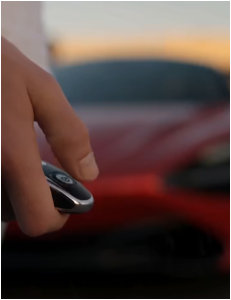
The moment I unlocked Jake Whitmore’s $100,000 sports car in front of half our school, I saw something in his eyes that I had never seen before.
Fear.
Not the ordinary fear of losing an expensive possession.
The fear of someone watching a secret climb out of its grave.
“Where did you get that?” he demanded.
His voice cracked on the last word.
Thirty seconds earlier, he had been laughing at my shoes.
Now his friends were staring at the little black device in my hand, and Jake was backing away from the car he had spent three months telling everyone belonged to him.
I was seventeen years old, wearing a faded white T-shirt and jeans my mother had patched twice. I had never been invited to one of Jake’s parties, never sat at his cafeteria table, and never owned anything that cost more than a few hundred dollars.
But I knew something about that red sports car.
Something Jake didn’t want anyone to know.
And I had spent six weeks deciding whether to reveal it.
To understand why I finally pressed that button, you have to understand what it felt like to be invisible at Westbridge High School.
Our town had two very different sides.
On the north side, enormous houses stood behind iron gates, with heated swimming pools and circular driveways. The families there owned businesses, donated money to the school, and had their names engraved on buildings.
On the south side, where I lived, people counted grocery money before payday.
My mother worked long shifts at the county hospital. She came home smelling faintly of antiseptic, with red marks on her nose from wearing a mask all day.
Our house had two bedrooms, a leaking kitchen faucet, and a garage that had not held a working car in almost a year.
But the garage was the most important room in my life.
Because it was where my father had taught me everything.
“Listen before you touch anything,” he used to say, leaning over an engine with a flashlight between his teeth. “Machines tell you what’s wrong. Most people are just too impatient to hear them.”
My father, Daniel Carter, had been an automotive electronics technician.
Not a famous engineer.
Not a wealthy businessman.
Just a man with rough hands, extraordinary patience, and an almost magical ability to understand complicated machines.
When I was ten, he taught me to identify electrical connections.
At twelve, I could read wiring diagrams.
By fourteen, I was helping him diagnose electronic control systems that professional mechanics sometimes struggled to understand.
Then, eighteen months before that afternoon in the parking lot, my father died.
A sudden heart attack.
No warning.
No final conversation.
One ordinary morning, he kissed my mother’s forehead, reminded me to finish my mathematics homework, and left for work.
He never came home.
After the funeral, I stopped talking much.
People assumed I was shy.
The truth was that silence felt easier than explaining how much I missed him.
Jake Whitmore never bothered to learn any of that.
To Jake, I was simply the poor kid.
He arrived at school every morning in a gleaming red sports car with black leather seats, enormous alloy wheels, and an engine that announced his arrival before anyone saw him.
The car was beautiful.
I could admit that.
Its sculpted body reflected sunlight like polished glass, and its low exhaust note carried across the parking lot.
But Jake treated it as a weapon.
He parked directly beside the main entrance, climbed out slowly, and waited for people to notice.
His closest friends, Brandon and Cole, usually stood nearby, laughing at whatever insult Jake decided to deliver that morning.
“Careful, Carter,” Jake told me one Tuesday when I passed his parking space. “Your shoes might scratch the pavement.”
His friends laughed.
Another morning, he pointed at my backpack.
“Is that thing older than your house?”
I kept walking.
That bothered him more than anything.
Jake wanted anger.
He wanted embarrassment.
He wanted me to lower my head so he could feel taller.
Instead, I looked past him.
One Friday, he stopped me outside the cafeteria.
“Why don’t you ever say anything?”
“About what?”
“About anything. You act like you’re better than everybody.”
I stared at him.
“I’m just trying to get to lunch.”
He stepped closer.
“You think being quiet makes you interesting?”
“No.”
“Then what does it make you?”
I thought about my father.
I thought about the long evenings when he had shown me how to solve problems without raising my voice.
“Someone who doesn’t need your approval.”
Jake’s smile disappeared.
From that day onward, his insults became more personal.
He started talking about my mother’s job.
He joked about our neighborhood.
Once, when I was carrying an old electronics textbook, he snatched it from my hands.
“Planning to build yourself a car?”
“Give it back.”
“Maybe if you study hard enough, you can work for my dad someday.”
He tossed the book onto the floor.
I picked it up.
And said nothing.
But I remembered.
I remembered every word.
Not because I wanted revenge.
Because my father had once told me something I had never understood until then.
“Never confuse a person’s price tag with their value.”
At the time, I thought he was talking about machines.
Later, I realized he had been talking about people.
The first time I noticed something strange about Jake’s sports car was during a rainy Thursday afternoon.
I was leaving the school library when I saw him struggling with the driver’s door.
He pressed his remote repeatedly.
Nothing happened.
Brandon laughed.
“Your hundred-grand toy broken already?”
“Shut up.”
Jake pressed the button again.
The lights flashed weakly.
Then the door opened.
I recognized the problem immediately.
A familiar communication delay.
A familiar response pattern.
And something about the shape of the remote in his hand made my stomach tighten.
I had seen one like it before.
Not in a store.
Not online.
In my father’s garage.
That evening, I went straight home and opened the old metal cabinet beside his workbench.

