Gabriel Hart had imagined a dozen different ways his daughter might greet him when he came home early.
In all of them, Amelia ran to him.
Sometimes she dropped her coloring books and came rushing down the stairs, her dark braids bouncing against her shoulders. Other times she bolted out of the living room, followed by Biscuit, the family’s golden retriever with the golden-brown coat.
In his favorite version, Amelia wrapped her arms around his waist and whispered the two words he missed most whenever business took him away from Connecticut.
“Dad’s home!”
He had pictured that scene so many times during the two-hour flight from Chicago that he could almost hear his daughter’s voice before the plane even touched down.
He had even bought her a gift.
Inside his briefcase was a small silver music box,
wrapped in pale pink paper. When opened, a tiny ballerina began to spin to a delicate melody that Amelia had adored since she was six.
She would be turning ten the following month, but Gabriel suspected she would never stop needing those small things that made her feel safe.
He hoped he hadn’t taken too long to remember that.
For the past three years, he had let work consume his life. After the death of Nora, his wife, he had taken refuge in corporate acquisitions, international contracts, and red-eye flights.
He kept telling himself that every hour away from home was an investment in Amelia’s future.
A better house. Better schools. Financial security.
Everything a father was supposed to provide.
Yet somewhere between the financial reports and the endless conference calls,
he had begun to confuse providing for his daughter with being present in her life.
He had promised himself that this trip would be different.
He would no longer accept projects that kept him away for weeks. He wouldn’t let work emergencies become excuses. And he would stop assuming Amelia was happy just because she had food, clothes, and went to school.
On Thursday, at 5:42 in the afternoon, Gabriel opened the front door of his home in suburban Connecticut.
“Amelia?”
His voice echoed through the foyer and up the stairs.
Silence.
He smiled as he set his suitcase down next to the console table.
“All right, young lady. I know you’re hiding somewhere.”
No one answered.
He loosened his tie and looked into the living room. The television was off.
A few colored pencils lay on the table, and one of Amelia’s picture books rested open on the sofa.
Everything seemed normal.
Too normal.
The house smelled of roast chicken, warm bread, and the lemon-scented furniture polish his mother, Marlene, insisted on using every Thursday.
From the dining room came the familiar clinking of silverware.
Gabriel followed the sound.
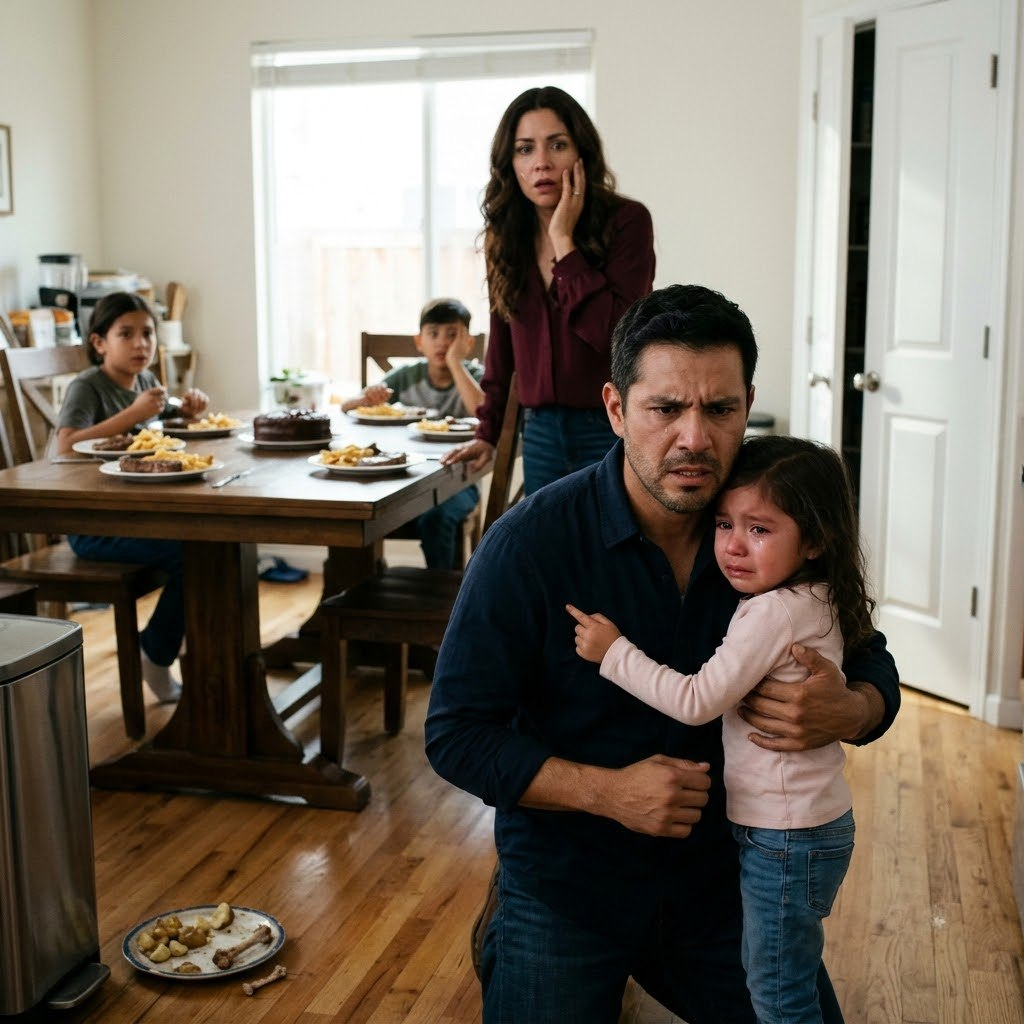
His mother sat at the head of the table, dressed in a cream blouse and a string of pearls. His father, Everett, occupied the chair to her right. Across from them sat his nephews: twelve-year-old Bryce and eight-year-old Theo.
Four people.
Four plates.
Four glasses of water.
Gabriel stopped in the doorway.
The table had six chairs.
Two were empty.
Marlene looked up, her fork suspended halfway to her mouth.
“Gabriel.
”
He opened his arms slightly.
“Surprise.”
His mother’s smile appeared a beat too late.
“You’re home early.”
“That’s usually the idea when you come home early.”
Everett set his fork down.
“How was Chicago?”
“Productive.” Gabriel looked around. “Where’s Amelia?”
For a fraction of a second, his mother’s expression shifted.
It was almost imperceptible: a slight tightening around her eyes and a pause before she swallowed.
Then Marlene lifted her glass.
“I think she’s outside playing.”
Gabriel looked toward the windows.
Rain streamed down the glass, blurring the dark yard. The lawn was soaked, and the patio furniture had been pushed under the covered porch.
“Outside?”
“She was outside a little while ago.”
Marlene turned her attention back to her dinner.
“Go upstairs and freshen up. We’ll have everything ready for you in a moment.”
Gabriel didn’t move.
“Where is she, exactly?”
His mother sighed.
“Do you really have to interrogate me the second you walk through the door?”
“I’m just asking where my daughter is.”
“And I already told you. She was outside.”
A strange unease began to settle over him.
Then he heard a small voice coming from the hallway that connected the kitchen to the dining room.
“Dad?”
Gabriel turned so quickly that his briefcase slipped from his hand.
Amelia was standing in the kitchen doorway.
For one wonderful instant, her face lit up. Her eyes went wide and her lips parted, as if she were about to run to him.
But then she glanced over his shoulder.
Toward the dining room.
Her smile vanished.
Gabriel felt that shift like a physical blow.
“Sweetheart?”
Amelia took a step forward.
She was wearing a pink plaid shirt and worn jeans. Her dark braids were uneven, and there was a small smudge of sauce on one sleeve.
She hadn’t been at the counter.
She had been sitting on the kitchen floor.
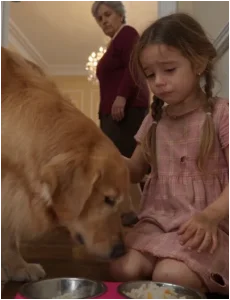
In front of her was a plastic tray holding a plate of roast chicken, rice, and sliced carrots.
Beside her, Biscuit rested with his head on his paws.
For a moment, Gabriel couldn’t make sense of what he was seeing.
Then he noticed the pad beneath his daughter’s knees.
It was an old kitchen mat, thin and frayed at the corners.
Amelia had been eating dinner on the floor.
“Amelia.”
He crossed the kitchen in three strides and knelt beside her.
“What are you doing down here?”
The little girl looked down at her plate.
“I’m eating dinner.”
Gabriel tried to keep his voice calm.
“I can see that. Why aren’t you sitting at the table?”
Amelia stroked Biscuit’s head.
“Grandma says it’s too full.”
Gabriel looked back toward the dining room.
Four people occupied a table set for six.
Two empty chairs.
“Sweetheart, there are two open seats.”
Amelia pressed her lips together.
“Grandma says I always spill things.”
“Do you drop things sometimes?”
“Sometimes.”
“Everyone drops things now and then.”
“Grandma says adults need to eat together and children need to learn not to make everything about themselves.”
She recited the words carefully, almost mechanically.
Gabriel stopped smiling.
He had spent fifteen years negotiating corporate contracts. He knew how people hid ugly truths behind reasonable-sounding explanations.
He knew the difference between an honest answer and a rehearsed excuse.
That wasn’t a spontaneous explanation from a ten-year-old girl.
Someone had taught her what to say.
“How long have you been eating in here?”
Amelia glanced toward the dining room.
It was a tiny movement, barely perceptible.
But Gabriel saw it.
His daughter was checking to see if she had permission to answer.
He had never seen her do anything like that before.
“Look at me, sweetheart.”
Amelia raised her eyes.
“I’m not mad at you.”
“Grandma said you might be mad.”
Those words hurt more than any shouting could have.
Gabriel felt his stomach tighten.
“Why would she tell you that?”
Amelia’s fingers curled around the edge of the tray.
“I don’t know.”
Behind him, Marlene appeared in the kitchen doorway.
“Gabriel, please, don’t turn a minor issue into a family crisis.”
He stood up slowly.
“A minor issue?”
“Amelia prefers to be near Biscuit.”
“Then Biscuit can lie next to her chair.”
“The dog sheds.”
“He’s a dog, Mom. That’s what dogs do.”
Marlene’s expression hardened.
“You’re being difficult.”
“No. I’m asking why my ten-year-old daughter is eating dinner on the kitchen floor while everyone else is sitting at the table.”
“Because she struggles to follow simple instructions.”
“What instructions?”
“Not interrupting. Not fidgeting. Not spilling things. Not talking while adults are speaking.”
“She’s ten.”
“Precisely. She’s old enough to learn some manners.”
Everett appeared behind Marlene, visibly uncomfortable.
“Gabriel, maybe we should all calm down.”
Gabriel turned to his father.
“Did you know this was happening?”
Everett looked at Amelia and then at his wife.
“I didn’t think it was worth arguing over.”
“How long?”
His father remained silent.
Gabriel looked back at his daughter.
She was holding a plastic fork with both hands.
He crouched in front of her.
“Come eat dinner with me.”
Amelia didn’t move.
“Sweetheart?”
“Grandma said I have to finish here.”
Something shifted inside Gabriel.
His anger didn’t fade. It grew quieter, colder, and much harder to control.
“You don’t have to earn the right to sit at your own table.”
He held out his hand.
After a few seconds, Amelia placed her small fingers in his.
Gabriel walked her into the dining room.
Marlene stood beside the table, her face stiff.
Gabriel picked up his mother’s purse from the chair next to his and set it on the kitchen counter.
“Sit here, sweetheart.”
“That’s my seat,” Marlene said.
Gabriel pulled the chair out for Amelia.
“Not tonight.”
His daughter sat down cautiously, as if expecting someone to change their mind at any moment.
Gabriel placed the pink-wrapped gift in front of her.
“I brought you something.”
Amelia’s eyes lit up.
“For me?”
“Who else would I bring a ballerina for?”
The little girl carefully unwrapped the gift and opened the box.
A delicate melody filled the room.
The tiny ballerina began to spin beneath the silver arch.
For the first time since Gabriel had arrived, Amelia smiled without glancing at her grandmother.
He sat down beside her.
Across the table, Bryce stared at his potatoes. Theo seemed fascinated by a smudge on his plate. Everett ate in silence.
Marlene didn’t touch her food.
Halfway through dinner, Amelia reached for the water pitcher.
Her hand trembled slightly, and the pitcher knocked against the rim of her glass.
Water spilled across the tablecloth.
Amelia froze.
Gabriel watched her expression change. Her shoulders went rigid, her lips parted, and the color drained from her face.
“I’m sorry,” she whispered.
She grabbed a napkin and began wiping the table in frantic motions.
“I’m sorry. I’ll clean it up. I didn’t mean to.”
“Amelia, slow down.”
But she kept wiping.
“It won’t happen again.”
Gabriel gently took the napkin from her hands.
“It’s just water.”
Amelia stared at him.
“You’re not mad?”
“No.”
Her eyes darted toward Marlene.
Gabriel followed her gaze.
His mother was watching Amelia with an expression he couldn’t quite read.
It wasn’t simple irritation.
There was something calculating in her stare, as if she were measuring how much Gabriel had discovered and how much damage his unexpected arrival might cause.
For the first time that night, Gabriel felt afraid.
Not of his mother.
But of what she might have been doing while he wasn’t home.
Later, after tucking Amelia in, Gabriel sat beside her in the warm glow of her bedside lamp.
Her bedroom looked almost exactly as it always had: the stuffed rabbit on her pillow, the books arranged by color, and a framed photograph of Nora smiling by a lake.
Gabriel had taken that photograph during their last family vacation.
Nora was laughing at something he could no longer remember.
He wished he could remember it.
“How’s school going?” he asked.
“Good.”
“Do you have any new friends?”
Amelia nodded.
“What’s your teacher’s name?”
“Mrs. Collins.”
“And what do you do after school?”
“Homework.”
“And after that?”
“I help Grandma.”
Gabriel brushed a strand of hair from her forehead.
“Sweetheart, you’re allowed to play, too.”
“I know.”
She said it without conviction.
He waited for her to add something, but Amelia pulled the blanket up to her chest.
Gabriel kissed her forehead and stood up.
“Dad?”
He turned at the doorway.
“If you leave again, can you tell me before you go?”
Gabriel frowned.
“I always tell you.”
“No. Sometimes Grandma says you called, but you didn’t talk to me.”
Gabriel walked back to the bed.
“What do you mean?”
Amelia stared down at the blanket.
“Sometimes she says you were too busy to talk to me.”
He sat back down.
“Did you get my messages from Chicago?”
The little girl shook her head.
“Grandma said they were grown-up things.”
Gabriel felt his heart begin to pound.
He had called home every night during his trip. Twice, Marlene had answered and told him Amelia was already asleep. The other nights, he had left voicemails for his daughter.
He had assumed she listened to them the next morning.
“Did Grandma ever let you listen to them?”
“No.”
“Why?”
“She said you’d worry if I started crying.”
Gabriel stared at her, stunned.
“You cried?”
Amelia’s eyes filled with tears.
“Sometimes.”
He took her hand.
“Sweetheart, you can always tell me when you’re sad.”
Amelia nodded, though Gabriel could tell she didn’t quite believe him.
“Are you leaving tomorrow?” she asked.
“No.”
“Promise?”
He gently squeezed her fingers.
“I promise.”
At last, Amelia closed her eyes.
Gabriel stayed beside her until her breathing grew slow and steady. Then he carefully stood up, tucked the blanket around her shoulder, and left the room.
He didn’t go back to his suitcase.
He didn’t open his laptop, either.
He went downstairs to find his mother.
Marlene was alone in the kitchen, rinsing a plate.
“You humiliated me in front of the children,” she said without turning around.
Gabriel stopped beside the kitchen island.
“You forced my daughter to eat dinner on the floor.”
“It only happened twice.”
The words slipped out before she could stop them.
Gabriel went still.
Marlene stopped rinsing the plate.
For a moment, the only sound was the water running from the faucet.
Then she turned it off.
“A few times,” she added.
“How many?”
“Gabriel, you travel constantly. You have no idea what it takes to run a household.”
“How many times?”
“I don’t keep a log of every dinner.”
“Why did you tell me she was outside?”
“Because I didn’t want you storming in here making accusations.”
“Accusations about what? About the fact that my daughter was eating next to the dog?”
“You’re taking things out of context.”
“Then explain the context to me.”
Marlene folded the dish towel with deliberate precision.
“You have a demanding job. Your daughter needs discipline. Nora spoiled her far too much, and now someone has to teach her how to behave.”
Gabriel felt a tightness in his chest.
“Don’t use Nora to justify this.”
“I’m telling you what she needs.”
“No. You’re telling me what’s most convenient for you.”
Marlene’s face flushed red.
“After everything I’ve done for you—!”
“What have you done for Amelia?”
The question left her speechless.
Gabriel turned toward the trash can, intending to throw away the napkin still in his hand.
That was when he spotted a blue envelope beneath a crumpled paper towel.
He recognized the return address immediately.
Westbridge Trust Company.
That institution managed the special trust fund Nora had set up for Amelia before she died. The money was meant to cover child development services, educational support, and respite care throughout her childhood.
Gabriel reviewed the statements every quarter, though his financial advisor handled most of the paperwork.
He had never seen that envelope.
It was addressed to him.
The envelope had already been opened.
Gabriel pulled it out of the trash.
Inside, he found a letter confirming a quarterly disbursement of $18,450 for in-home child development services and respite care for Amelia Hart.
He read the amount twice.
Then a third time.
He had never authorized that disbursement.
Nor had he requested in-home child development services.
And Amelia had never received that care.
His fingers tightened around the paper.
“What is this?”
Marlene’s expression changed.
It wasn’t the reaction of someone falsely accused.
It was the look of a person who had just realized her secret was no longer safe.
“Give me that letter.”
Gabriel folded it once.
“No.”
“Gabriel, you don’t understand.”
“Then explain it to me.”
Marlene glanced toward the hallway.
Everett had appeared silently behind them.
He looked at the envelope.
All the color drained from his face.
That was when Gabriel noticed a second page inside the letter.
It was a payment authorization.
His name was printed at the bottom.
Beneath it was his signature.
But Gabriel had never signed that document.
Someone had forged his name.
And the money had already been withdrawn.
Gabriel slowly raised his eyes to his parents.
“Which one of you stole my daughter’s money?”
Neither of them answered.
Then Everett whispered something that made Gabriel’s blood run cold.
“Your mother told me you knew.”