THE WOMAN THEY NEVER SHOULD HAVE HUMILIATED
PART I — THE SLAP The slap echoed through the boardroom with an almost unreal sharpness.
A dry, brief, violent sound.
Then nothing.
Not a single movement.
Not a breath loud enough to break the silence.
Through the floor-to-ceiling windows of the thirty-second floor, Paris stretched out beneath the bluish twilight glow. The first lights were beginning to flicker on the Haussmann facades. In the distance, the Eiffel Tower stood out against a still-pale sky. Inside, everything was controlled, precious, almost ceremonial: a long polished walnut table, dark leather armchairs, smoked glass panels, brass accents, leather-bound files aligned neatly before each seat.
And in the middle of this perfectly mastered setting, Claire Delorme had just struck a woman across the face.
The woman in question barely moved.
Her head had turned slightly from the impact.
Her cheek already bore a red mark.
Yet she hadn’t stepped back.
She hadn’t raised her hand.
She hadn’t screamed.
She simply remained standing.
Straight.
Motionless.
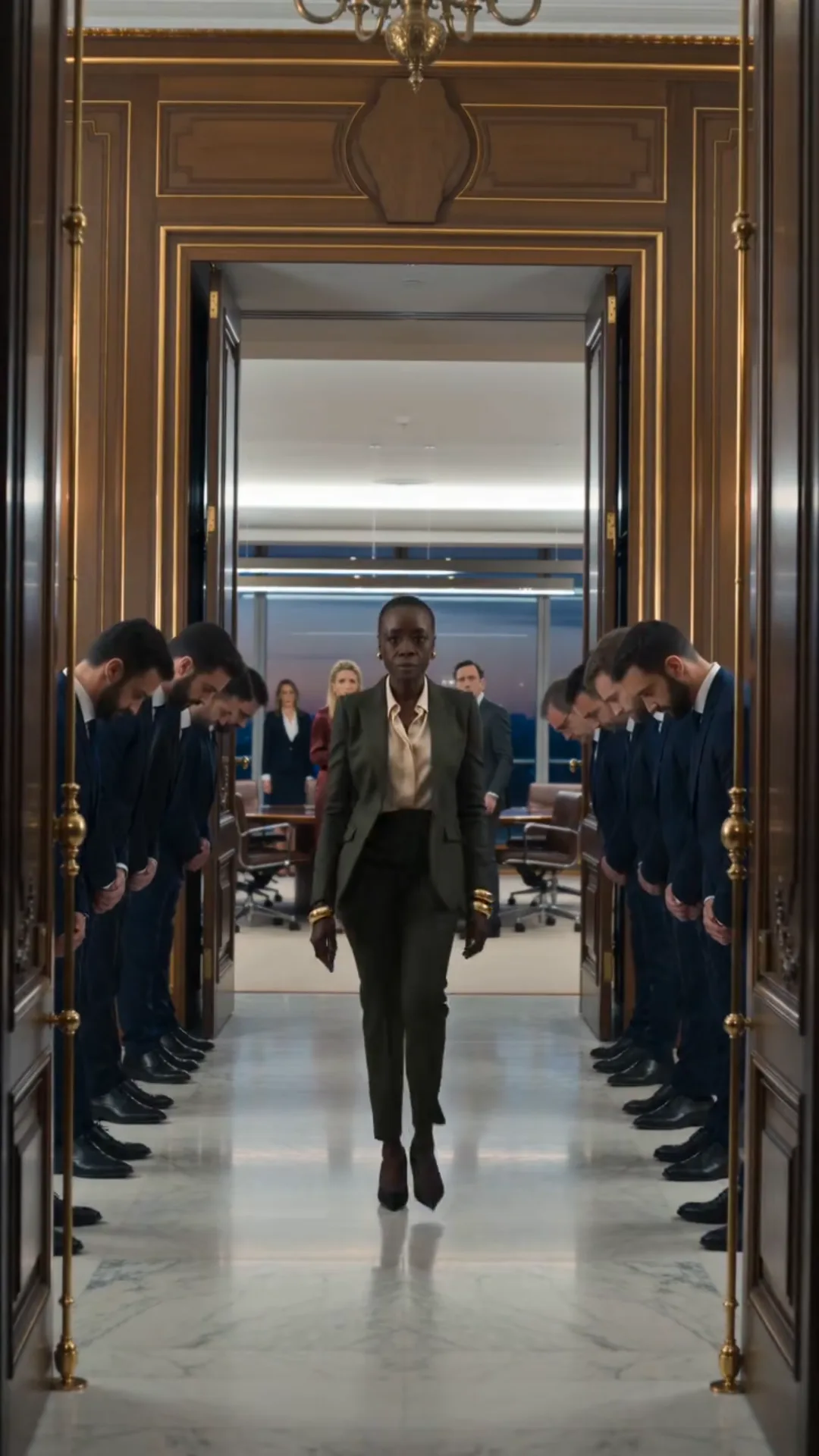
In her perfectly tailored forest green suit, cream silk blouse, and wide gold cuff bracelet, she looked calmer after the slap than before.
Claire, on the other hand, was breathing fast.
Thirty-two years old, impeccably styled blonde hair, burgundy satin dress, pearl earrings—she possessed the elegance of someone accustomed to salons where her name opened doors before she even needed to speak.
A few steps behind her, Antoine Mercier had frozen.
Anthracite gray suit.
White shirt.
Navy blue tie.
Thirty-eight years old.
Deputy Chief Financial Officer of the group.
And Claire’s companion for nearly three years.
Until this exact moment, he had worn that slightly distant assurance of executives who know they belong to the right circle.
The slap had just made that assurance vanish.
Around the table, about a dozen people were watching.
Some were shareholders.
Others assistants.
Two members of the strategic committee.
A group lawyer.
Several executives in midnight-blue suits.
No one knew what to do.
Claire, however, knew exactly what she wanted to do.
Humiliate.
She took a step toward the woman in green.
Then she raised her hand and pointed at her with contempt.
“You have no business being in this room.”
No one spoke.
The black woman stared at her.
A cold gaze.
Not theatrical.
Not furious.
Simply cold.
As if, in her mind, something had just been confirmed.
Claire interpreted this silence as weakness.
That was her first mistake.
The second had been the slap.
The third would be believing she knew the person she had just humiliated.
It had all started ten minutes earlier.
The annual meeting of Vautrin Group’s principal shareholders was scheduled to begin at six-thirty in the evening.
Vautrin Industries was one of the oldest French family groups still operating across several strategic sectors: infrastructure, commercial real estate, financial services, luxury hospitality, and industrial shareholdings.
A discreet company.
Very powerful.
Very Parisian.
The kind of corporation whose executives the general public rarely knew, yet whose decisions influenced thousands of jobs.
Claire Delorme was the daughter of Philippe Delorme, the group’s executive vice-president.
Officially, she held no major position.
But everyone knew she enjoyed a special status.
She attended important meetings.
She accompanied her father to business dinners.
She knew several directors personally.
She had grown up in this world.
And through being admitted everywhere within it, she had ended up believing that certain places belonged to her.
That evening, when Claire had entered the room with Antoine, she had immediately noticed the woman in green.
Alone.
Standing near the large window.
She wasn’t talking to anyone.
She was reviewing a black file resting before her.
Claire had slowed down.
“Who is that?”
Antoine had glanced over.
“I don’t know.”
Claire had observed the woman’s clothing.
They were elegant.
Very elegant, in fact.
Yet she didn’t recognize the brand.
No visible handbag.
No spectacular necklace.
Only that golden cuff.
“A lawyer?”
Antoine had shrugged.
“Maybe.”
Claire had walked closer.
“Excuse me.”
The woman had looked up.
“Yes?”
“This meeting is private.”
“I know.”
The calm tone had instantly displeased Claire.
“Do you have an accreditation?”
The woman simply looked at the file lying in front of her.
“Yes.”
Claire waited.
The woman showed her nothing.
“What firm are you with?”
“None.”
“Who do you represent?”
The woman took a second before replying.
“Myself.”
Claire had smiled.
A smile without warmth.
“Are you a shareholder?”
The woman hadn’t answered.
Antoine had stepped closer.
He already looked uneasy.
“Claire, let it go.”
But Claire didn’t like being told to let things go.
Especially in front of people.
“I’m just asking because we don’t let just anyone in here.”
The woman had slowly closed the file.
“I walked in without difficulty.”
That answer had vexed her.
Claire had looked around.
Two staff members were observing the scene.
One of them seemed ready to intervene.
Claire made a small gesture with her hand.
“It’s nothing.”
Then she looked at the woman again.
“Your name?”
The woman held her gaze.
“Why?”
Claire’s arrogance notched up a level.
“Because I’d like to know who I’m dealing with.”
“You should already know that before deciding how to treat me.”
Antoine had then murmured:
“Claire.”
Too late.
That sentence had struck a nerve.
Claire had stepped closer.
“Watch your tone.”
The woman didn’t flinch.
“I didn’t raise my voice.”
Several people had turned around.
Claire realized an audience was forming.
And instead of backing down, she wanted to dominate the scene.
She had always done that.
Since school.
Since family dinners.
Since her first professional events where everyone knew her name.
The more other people’s gaze mattered, the more she needed the last word.
“Do you even know who you’re talking to?”
The woman replied:
“Yes.”
This time, Claire lost control.
The slap landed.
A single one.
Claire then stood tall, convinced she had just restored order.
Then she snapped:
“You have no business in this room.”
The black woman remained silent for a few seconds.
Then she turned away.
Claire felt an almost immediate relief.
She thought the matter was over.
The woman would leave.
Maybe complain.
Maybe call someone.
But she would leave.
The woman in green walked slowly along the table.
Her heels made a discrete sound on the parquet floor.
She pulled out a smartphone.
She brought it to her ear.
Claire watched her.
Antoine did too.
The woman spoke.
Very calmly.
“Freeze the group’s accounts. Initiate the governance review immediately.”
The silence changed texture.
Heavier.
Antoine abruptly turned his head toward Claire.
Claire didn’t move.
The woman listened for a few seconds.
Then she stopped.
Turned back.
Her gaze swept over Claire.
Then over Antoine.
“And suspend this meeting until I authorize it.”
She hung up.
This time, no one thought she was leaving because she had been humiliated.
She was leaving because she had just made a decision.
And that decision seemed to concern everyone.
A staff member stood up.
Then another.
The assistants in midnight-blue suits naturally positioned themselves along the corridor.
The woman in green walked toward the exit.
As she passed, several people bowed their heads slightly.
Not like before a client.
Like before someone they knew.
Or rather, someone they were required to know.
Claire looked around.
“What is this supposed to mean?”
No one answered.
Antoine had turned pale.
He was staring at the door through which the woman had just vanished.
“Antoine?”
He didn’t reply.
Claire turned to one of the assistants.
“Who is that woman?”
The assistant lowered his eyes.
“I am not authorized to answer.”
Claire felt something fracture inside her.
“Authorized by whom?”
The assistant didn’t answer.
Antoine picked up his phone.
He typed a few words.
Claire watched him.
“What are you doing?”
“Her face reminds me of something.”
A few seconds.
Then Antoine froze.
Claire saw his expression change.
“What?”
He handed her the screen.
A photograph appeared.
Same face.
Same gaze.
Same woman.
Beneath the image:
AMINA DIOP — PRESIDENT OF DIOP CAPITAL PARTNERS
Claire frowned.
“So what?”
Antoine scrolled further down.
His lips parted.
“Oh my God.”
“What?”
He pointed to another line.
Diop Capital Partners — principal shareholder of Vautrin Industries since the recapitalization operation in February.
Claire reread it.
Then again.
“Principal shareholder?”
Antoine nodded.
“Twenty-nine percent directly.”
“My father has more.”
Antoine slowly shook his head.
“Not since February.”
Claire felt a knot tighten in her stomach.
“What?”
“The family pact has been diluted.”
He scrolled the screen.
“Her fund also controls several holding companies that vote with her.”
Claire murmured:
“How much?”
Antoine looked at the number.
Then at Claire.
“Over forty percent of the voting rights.”
The phone almost slipped from her fingers.
Claire looked at the door.
A few minutes earlier, she had asked that woman what she was doing there.
Now, she understood.
Amina Diop wasn’t a guest.
She was there because she could decide who would still be allowed here tomorrow.
Claire’s phone vibrated.
Dad.
Her heart accelerated.
She answered.
“Dad…”
Philippe Delorme didn’t say good evening.
“What have you done?”
Claire closed her eyes.
“I didn’t know who she was.”
There was a silence.
Then her father’s voice, colder than she had ever heard it:
“That is precisely what terrifies me.”
The line went dead.
Claire remained standing.
Antoine was watching her.
No one spoke.
Outside, Paris was lighting up.
Inside, the meeting had been suspended.
Yet what Claire didn’t know yet was that Amina hadn’t come that evening merely to observe an assembly.
She had been investigating for six months.
Millions of euros had vanished.
Decisions had been made without board approval.
Internal complaints had been hushed up.
And several Vautrin Industries executives had used their positions to turn a historic company into a machine serving a select few families.
Amina had come to find out just how far up the problem went.
The slap had simply given her an answer faster than expected.
PART II — SHE WHO CONTROLLED THE SILENCE The next morning, Paris woke up under a gray sky.
At eight-twelve, Amina Diop entered the offices of Diop Capital Partners on Avenue George-V.
She was no longer wearing yesterday’s dress.
She wore black trousers, a white blouse, and a long dark coat.
The red mark on her cheek had almost vanished.
Yet the memory hadn’t.
Amina wasn’t born in boardrooms.
Her father had been a mathematics teacher in Saint-Denis.
Her mother a nurse.
She had grown up in a modest apartment with two younger brothers.
Very early on, she had understood something the business world later confirmed: some people could commit a mistake and be forgiven, while others had to be flawless simply to stay in the room.
Amina had excelled at school.
Prépa.
Grande école.
Investment banking.
Private equity.
Then she had founded her own firm.
At thirty-five, she was already managing several billion euros in assets.
Financial newspapers described her as cold.
She preferred “precise.”
She almost never shouted.
She didn’t seek to impress.
She let the numbers do that.
That morning, her general counsel, Laurent Benhamou, was waiting for her.
“The accounts have been secured.”
Amina set down her bag.
“Did anyone manage to transfer anything?”
“No.”
“The foreign subsidiaries?”
“Same thing.”
“And the meeting?”
“Officially suspended at twenty-eighteen.”
Amina sat down.
“The Delormes?”
“Philippe asked to see you.”
“Later.”
Laurent opened a folder.
“There is something more serious.”
Amina raised her eyes.
“How much?”
“We’ve confirmed twelve million euros in irregular movements.”
She remained motionless.
“Since when?”
“Eighteen months.”
“Origin?”
“Three consulting subsidiaries. Two management companies. A Luxembourg holding company.”
“Beneficiaries?”
Laurent hesitated.
“We have several.”
“Names.”
He slid the folder across.
Amina read.
One name immediately stood out.
Stéphane Delorme.
Philippe’s younger brother.
Executive committee member.
Head of European operations.
Amina inhaled slowly.
“I expected as much.”
Laurent turned a page.
“There is another one.”
Amina read.
Antoine Mercier.
She raised her head.
The man in the gray suit.
Claire’s companion.
The one who had witnessed the slap.
The one who had turned pale upon recognizing Amina.
She understood then that his fear might have had nothing to do with Claire.
He knew something else.
“How much?”
“Two million four.”
“Directly?”
“Via a consulting firm registered in his brother’s name.”
Amina closed the folder.
“Does he know we know?”
“Not yet.”
“Very well.”
Laurent waited.
“And Claire?”
Amina looked at her.
“Claire is a human problem.”
“She struck you.”
“I know.”
“Do you plan to file a complaint?”
Amina remained silent.
“Not today.”
Laurent raised his eyebrows slightly.
“Why?”
“Because if I make a decision now, it will be dictated by humiliation.”
She looked out the window.
“I want to know if this company has a governance problem, or if it is simply governed by people who have forgotten what dignity means.”
Laurent smiled faintly.
“It might be both.”
Amina nodded.
At nine-thirty, Philippe Delorme walked in.
Sixty-three years old.
Deep blue suit.
White hair.
Still-straight posture.
Yet he looked like he had slept poorly.
“Amina.”
She didn’t offer him coffee.
“Sit down.”
He complied.
“I am sorry about Claire.”
Amina placed a hand on the folder.
“We will talk about Claire later.”
Philippe saw the document.
His face changed.
“What is this?”
“Twelve million.”
He didn’t reply.
“Did you know?”
“No.”
“Stéphane?”
Philippe closed his eyes.
Amina understood.
“You had suspicions.”
“No proof.”
“And Antoine Mercier?”
This time, Philippe genuinely seemed surprised.
“Antoine?”
Amina looked at him.
“You were unaware.”
“Yes.”
“Then let’s talk about what you did know.”
Philippe ran a hand over his face.
“My brother has always been aggressive.”
“In business?”
“Everywhere.”
“Why let him run operations?”
Philippe didn’t answer right away.
“Because he was family.”
Amina nodded.
“There is the problem.”
Philippe raised his eyes.
Amina continued.
“This company confused family continuity with competence.”
He remained silent.
“You protected bad behavior because it bore the right name.”
Philippe lowered his head.
“Perhaps.”
“Not perhaps.”
Amina’s tone remained calm.
“Last night, your daughter slapped me because she believed she had the right to decide who belonged in your boardroom.”
Philippe closed his eyes.
“I didn’t raise her like that.”
“Then someone else did.”
The silence was brutal.
Philippe looked out at the city.
“Her mother died when she was seventeen.”
Amina didn’t move.
“I compensated.”
His voice grew softer.
“Too much.”
“By giving her everything?”
“By never saying no to her.”
He offered a sad smile.
“It was easier than being a father.”
Amina looked at the man before her.
For the first time, she saw less of the executive and more of the man who had let grief become an excuse.
“Philippe.”
He looked up.
“Grief explains certain things.”
A pause.
“It does not excuse the consequences.”
He nodded.
Amina opened a second folder.
“You are going to cooperate with the audit.”
“Of course.”
“You will surrender all access.”
“Yes.”
“And you will call neither Stéphane nor Antoine.”
Philippe acquiesced.
“And Claire?”
Amina paused.
“Claire will have to decide what she does with what she has become.”
Philippe frowned.
“You could destroy her reputation.”
“Yes.”
“You could press charges.”
“Yes.”
“Why aren’t you doing it immediately?”
Amina looked at him.
“Because power has no value if we use it only to replicate what we despise.”
Philippe remained silent.
Two days later, Antoine Mercier attempted to leave France.
He was intercepted at the airport before a flight to Geneva.
Not arrested.
Not yet.
But his accounts were frozen.
Investigators recovered his computer.
Three internal files were uncovered.
The irregular transfers were only part of the issue.
There was also a system of favoritism.
Contracts had been awarded to close associates.
Internal candidates had been sidelined without reason.
Employees who reported irregularities saw their careers stall.
Certain women had been removed from projects after refusing advances.
Some employees from modest backgrounds had been humiliated during internal receptions.
The problem was no longer financial.
It was cultural.
Amina realized the group could not be saved simply by an audit.
The way it decided who had the right to speak needed to change.
Then Claire asked to see her.
Alone.
Without her father.
Without a lawyer.
Without Antoine.
Amina agreed.
Claire arrived in a simple black suit.
No satin dress.
No visible jewelry.
She looked younger.
More fragile.
Yet Amina did not confuse fragility with innocence.
Claire walked in.
“Thank you for seeing me.”
Amina didn’t reply.
Claire sat down.
“I came to apologize.”
Amina remained silent.
Claire inhaled.
“I could tell you I was angry.”
Amina waited.
“That I thought I was protecting the meeting.”
Still nothing.
“That I didn’t know who you were.”
Amina watched her.
Claire lowered her eyes.
“But I know now that that is precisely the worst part.”
Amina didn’t move.
Claire continued.
“If I had known who you were, I would have respected you.”
Her voice trembled.
“And that means I didn’t respect you because you were a person. I would have respected you because you had power.”
Amina crossed her hands.
“That is an important distinction.”
Claire nodded.
“Yes.”
She looked at Amina.
“I am not going to ask you to forgive me.”
“Good.”
“I am not asking for protection either.”
Amina remained silent.
“I just want to say that I am sorry.”
Amina studied her face.
There was no more arrogance.
Yet humiliation could produce a false humility.
Amina wanted to know if anything real remained underneath.
“What are you going to do now?”
Claire looked surprised.
“I don’t know.”
“Then your apology isn’t finished.”
Claire stayed motionless.
Amina opened a folder.
“The group has a foundation.”
Claire nodded.
“It spends a lot.”
“Yes.”
“Mostly on galas.”
Claire lowered her eyes.
Amina continued.
“We are going to restructure it.”
She slid a document across.
Scholarship programs.
Employee assistance.
Mentorship.
Support for entrepreneurs from working-class neighborhoods.
Professional training.
Claire looked at it.
“You want me to work on this?”
“No.”
Claire looked up.
“I want you to apply.”
“Apply?”
“Like everyone else.”
Amina leaned forward slightly.
“No privileged family name. No guaranteed interview. No reserved position.”
Claire stared at the file.
“And if I’m rejected?”
“Then you will be rejected.”
Claire slowly nodded.
“Why give me this chance?”
Amina replied:
“I am giving you nothing.”
Claire waited.
“I am giving you the opportunity to see if you are capable of becoming something other than what you showed that night.”
Claire’s eyes filled with tears.
“And if I fail?”
“Then that will be your responsibility.”
Claire stood up.
At the door, she stopped.
“Amina?”
It was the first time she had used her first name.
Amina looked up.
“I really am sorry.”
Amina didn’t smile.
Yet her voice softened slightly.
“Then make sure it amounts to something.”
Claire left.
That evening, Amina stayed alone in her office.
She looked at the Vautrin Industries dossier.
The company could be dismantled.
Sold off in pieces.
The most profitable activities would find buyers.
Shareholders would recover value.
It would be simple.
Clean.
Logical.
Yet nine thousand employees worked for the group.
Amina thought of them.
Then of Claire.
Of Philippe.
Of Antoine.
Of Stéphane.
Of all the people who had agreed to stay silent because they believed they lacked the power to speak.
She made a decision.
She would not destroy Vautrin Industries.
She would rebuild it.
And to do that, she had to start with the single thing powerful families hated most.
Making everything visible.
PART III — THE BOARD THAT COULD BRING IT ALL DOWN The decisive meeting was scheduled for the following Monday.
Same room.
Same walnut table.
Same view of Paris.
Yet the atmosphere was different.
This time, Amina entered first.
No one asked questions.
Philippe was present.
Paler.
More silent.
Stéphane attended remotely with two lawyers.
Antoine had been suspended.
Claire wasn’t there.
She held no official role.
And, for the first time in her life, she perhaps understood that certain doors should not open simply because you knew someone on the inside.
Amina opened the meeting.
“We have three options.”
The directors listened.
“Sell.”
She let the word drop.
“Split.”
Then:
“Or reform.”
A shareholder spoke up.
“Reforming will cost more.”
“Yes.”
“Much more.”
“Yes.”
“And we will lose partners.”
“Probably.”
Another asked:
“Then why do it?”
Amina looked around the table.
“Because a company cannot claim to defend its value while destroying those who create it.”
Silence.
She presented the plan.
Full audit.
Independent whistleblowing channel.
End of family control over promotions.
Publication of nomination criteria.
Rotation of sensitive functions.
External ethics committee.
Enhanced protection for whistleblowers.
Compensation for employees subjected to retaliation.
Review of all contracts linked to close associates.
Mandatory executive training.
And above all:
Separation of operational chairmanship and family control.
Philippe listened.
Then he raised his hand.
“I resign.”
The room froze.
Amina looked at him.
“That is not demanded by the plan.”
“I know.”
Philippe pulled out an envelope.
“But it is necessary.”
He placed his letter on the table.
“I spent too many years believing that not knowing protected me from responsibility.”
His voice trembled slightly.
“That is not true.”
Amina said nothing.
Philippe continued.
“I will stay for three months to ensure the transition. Without executive functions. Without compensation.”
A director asked:
“And after?”
Philippe looked at Amina.
“Afterward, the company will have to learn to live without considering my name a qualification.”
The silence was long.
Amina nodded.
“Accepted.”
The plan was voted on.
Eight votes for.
Three against.
One abstention.
The group would survive.
Yet the difficulties began immediately.
Two major banks reduced their credit lines.
A key client suspended their contracts.
The press leaked the investigation.
The group’s bond values dropped.
Rumors of layoffs circulated.
Certain employees accused Amina of having created the crisis by exposing the problems.
A director told her:
“We could have settled all of this quietly.”
Amina replied:
“That is what you had been doing for years.”
The following weeks were brutal.
Amina spent entire nights working.
She met with unions.
Executives.
Banks.
Suppliers.
She refused to save profitability by mass-laying off the most vulnerable teams.
Instead, executive bonuses were suspended.
The executive committee’s variable compensation was reduced.
Secondary assets were sold.
Certain subsidiaries were merged.
The Delorme family lost several contractual privileges.
Then came the most difficult internal trial.
Stéphane.
The evidence was solid.
He had authorized fictitious contracts.
Indirectly profited from commissions.
Used Antoine as an intermediary.
And attempted to influence several witnesses.
Philippe attended his hearing.
On his way out, he crossed paths with Amina.
“He is my brother.”
“I know.”
“I wish I could say he isn’t like that.”
Amina looked at him.
“But?”
Philippe closed his eyes.
“I knew it for a long time.”
Not the crimes.
Not the amounts.
Yet the character.
The way he treated people.
The humiliations.
The threats.
The ease with which Stéphane used the Delorme name.
“And you let him do it.”
Philippe nodded.
“Yes.”
Amina replied:
“Then your responsibility begins now.”
Philippe testified.
Against his own brother.
That was the moment Amina understood he had genuinely changed.
Not because he regretted it.
Because he was finally accepting the cost of regret.
Meanwhile, Claire was applying to the foundation.
Her first application was rejected.
The committee explained:
“Profile too centered on personal networks. Insufficient field experience.”
She wept.
Then she wanted to call her father.
She didn’t.
For three months, she worked as a volunteer in an association supporting young graduates.
She took the subway.
She began meeting people who didn’t know who her father was.
At first, it terrified her.
Then she discovered something.
She could be interesting without her name.
She could be useful.
She could listen.
When she applied again, she was accepted.
Junior position.
Ordinary salary.
No private office.
Amina did not participate in the decision.
One evening, Claire crossed paths with her in the lobby.
“I was accepted.”
Amina smiled slightly.
“I heard.”
“Did you know?”
“The committee informed me afterward.”
Claire nodded.
“Thank you for not intervening.”
Amina looked at her.
“That is the first intelligent thing you are thanking me for not doing.”
Claire laughed.
It was the first time they had laughed together.
Yet the crisis was far from over.
Three months later, Vautrin Industries ran low on liquidity.
The primary bank demanded additional guarantees.
The board proposed a solution:
Sell the hospitality division.
It was profitable.
Yet twenty-two hotels would be affected.
Thousands of jobs.
Amina initially refused.
Then the numbers became impossible.
The board convened again.
“If we don’t sell, we risk default,” said Laurent.
Amina reviewed the projections.
She knew he was right.
Philippe, present purely as an advisor, spoke up.
“I have an option.”
Everyone looked at him.
“The family still owns the Neuilly mansion.”
Amina frowned.
“Your father’s estate?”
“Yes.”
“What is it worth?”
“About forty million.”
The room fell silent.
Philippe continued.
“Sell it.”
Amina looked at him.
“That is a family asset, not corporate.”
“I know.”
“You don’t have to.”
“I know.”
“Why?”
Philippe replied:
“Because for twenty years, we asked employees to make sacrifices to preserve a company my family sometimes used to preserve itself.”
He inhaled.
“It is time that was us.”
The mansion was sold.
Then two other family assets.
The Delorme family injected the funds.
The sale of the hotel division was averted.
Six months later, Vautrin Industries emerged from the danger zone.
Then, gradually, it began to grow again.
Not as fast.
Yet better.
Turnover dropped.
Whistleblowing reports initially increased.
Certain board members grew anxious.
Amina responded:
“More reports do not necessarily mean more problems.”
She pointed to the figures.
“It can mean people have finally stopped being afraid.”
Then the reports decreased.
Operational results rebounded.
Promotions became more transparent.
New profiles emerged in management positions.
And exactly one year to the day after the slap, Amina received an invitation.
From Claire.
Not to a gala.
Not to a dinner.
To a scholarship award ceremony.
The Vautrin Foundation was funding its first cohort of young professionals from modest backgrounds.
Amina accepted.
She did not yet know that this evening would close a loop neither of them could have imagined.
PART IV — WHO HAS THE RIGHT TO ENTER THE ROOM Exactly one year after the slap, Amina entered the boardroom once more.
Same table.
Same windows.
Same view of Paris.
Yet something had changed.
Not just the people.
The room itself felt different.
Less intimidating.
The armchairs had been rearranged.
Part of the glass partitioning had been opened up.
Important internal meetings now regularly welcomed observers from various hierarchical levels.
Two young employees were present that evening.
A legal assistant.
A maintenance technician.
Amina noticed this immediately.
She smiled.
Claire walked over.
She wore a simple midnight-blue dress.
No glittering satin.
No pearls.
“Good evening.”
“Good evening.”
Claire hesitated.
“Does it do something to you, coming back here?”
Amina looked at the exact spot where she had been struck.
“Yes.”
Claire lowered her eyes.
“Me too.”
Amina looked at her.
“Do you still think about it?”
“Every day.”
Amina nodded.
“Perhaps that’s useful.”
Claire looked surprised.
“You think so?”
“If the memory keeps you from becoming that person again.”
Claire smiled faintly.
“Then I hope I never forget.”
The ceremony began.
Ten scholarship recipients were introduced.
A finance student from Cergy.
A young law graduate from Marseille.
An accounting apprentice from Saint-Denis.
An engineer from Lyon.
A young woman who had worked two years in a supermarket before returning to her studies.
Families were present.
Many seemed awed by the Parisian headquarters.
Certain parents looked at the walls as though afraid to touch anything.
Amina noticed a woman in her fifties near the door.
She wore a simple coat.
Her hands were worn.
She was hesitating to step inside.
Claire saw her too.
She walked over.
“Ma’am?”
The woman smiled nervously.
“I am Samir’s mother.”
Claire smiled.
“He’s right over there. Come along.”
The woman looked at the room.
“I wouldn’t want to intrude.”
Claire replied:
“You are exactly where you are supposed to be.”
Amina heard.
Claire turned back.
Their gazes met.
For a moment, neither spoke.
Then Amina smiled.
Not much.
Yet enough.
The ceremony continued.
At the end, a waiter passed by with a tray.
He slightly bumped into Claire.
A glass of water spilled onto her dress.
The young man turned pale.
“Ma’am, I am so sorry.”
Claire looked at her dress.
Then at the waiter.
A two-second silence.
Amina watched.
Claire picked up a napkin.
“It’s only water.”
The waiter sighed.
“Really sorry.”
Claire smiled.
“These things happen.”
The waiter walked away.
Amina approached.
“Impressive.”
Claire laughed.
“Not humiliating someone doesn’t deserve a medal.”
“True.”
“Still, I’m making progress.”
“Yes.”
Claire looked around the room.
“Can I ask you a question?”
“Yes.”
“Do you forgive me?”
Amina reflected.
“Some days, yes.”
Claire nodded.
“And the others?”
“I remember.”
Claire remained silent.
Amina continued.
“Forgiveness does not erase.”
“I understand.”
“Yet I do not want your worst moment to become your identity.”
Claire’s eyes filled.
“Thank you.”
Amina added:
“Don’t thank me. Keep going.”
A few weeks later, Philippe left the group permanently.
On his final day, he asked to see Amina.
They met in a private lounge.
Philippe looked lighter.
“I wanted to thank you.”
“For what?”
“Because you could have sold.”
Amina smiled.
“I thought about it.”
“I know.”
“For a long time.”
Philippe laughed.
Then his expression grew serious.
“My father always said Vautrin was a family.”
Amina raised an eyebrow slightly.
“Dangerous phrase.”
“Yes.”
Philippe smiled.
“Because a company is not a family.”
“Indeed.”
“A family sometimes forgives too much.”
“A company should not.”
Philippe nodded.
“Then what should it be?”
Amina looked out the window.
“A place where rules matter more than names.”
Philippe remained silent.
Then he extended his hand.
Amina shook it.
“Take care of them,” he said.
Amina replied:
“Above all, I am going to try to build a system that does not depend on my kindness.”
Philippe smiled.
“That is probably better.”
He left.
Two years later, Vautrin Industries surpassed its pre-crisis results.
Yet Amina refused to let anyone frame this as her victory.
She had learned something.
Lasting transformations do not come from a hero.
They come from systems.
From people.
From repeated decisions.
Claire became program manager at the foundation.
She turned down several promotions tied to her name.
When she was eventually promoted, the committee voted unanimously.
Philippe no longer held any influence.
That mattered to her.
Antoine was convicted after admitting his participation in the embezzlement.
Stéphane as well.
Claire never reconnected with Antoine.
She gradually understood that the man she had taken for a partner had mostly appreciated access to her family.
The discovery hurt.
Yet it also forced her to look at her former world with greater lucidity.
Amina, for her part, remained a principal shareholder.
Yet she gradually stepped down from active board leadership.
She established an independent governance committee.
She wanted to be able to leave without the company reverting to what it had been.
Five years after the slap, a new shareholder meeting took place.
This time, Amina was no longer at the center.
She sat off to the side.
An observer.
A young woman took the floor.
Barely thirty years old.
Daughter of a bus driver.
Former foundation scholar.
New independent board member.
She presented a report on promotion diversity.
At the conclusion, the shareholders applauded.
Amina looked at Claire.
Claire was looking at the young board member with pride.
The meeting adjourned.
People left the room.
Amina remained alone for a few moments.
She walked over to the exact spot where Claire had slapped her.
She placed a hand on the back of an armchair.
The memory returned.
The shock.
The warmth on her cheek.
The stares.
The phrase.
You have no business being in this room.
Amina closed her eyes.
Then she heard a voice behind her.
“Amina?”
Claire.
Amina turned around.
“Are you leaving?”
“Yes.”
Claire looked at the spot.
She understood.
“It was right here.”
“Yes.”
Claire lowered her eyes.
“I wish I could erase that.”
Amina reflected.
“I don’t.”
Claire looked surprised.
“Why?”
Amina looked around the room.
“Because if we erased it, we would forget everything that changed afterward.”
Claire followed her gaze.
The long table.
The new board members.
The seats reserved for employee observers.
The governance files.
The doors left open to the corridor.
“So you’re glad it happened?”
Amina shook her head.
“No.”
A pause.
“I am glad for what we made of it.”
Claire smiled.
They walked together toward the exit.
In the lobby, a young maintenance worker was cleaning the marble floor.
He stepped aside to let them pass.
Amina took a step to the side.
“No, go ahead.”
The man smiled.
“Thank you, ma’am.”
Claire and Amina waited a few seconds.
Then moved forward.
At the elevators, a group of young employees arrived.
A man recognized Amina.
He immediately stepped back.
“Madame Diop, go ahead.”
Amina shook her head.
“No.”
He hesitated.
“But…”
She smiled.
“We’re taking the same elevator.”
The doors opened.
Everyone stepped inside.
Amina.
Claire.
Two interns.
A director.
A technical worker.
An assistant.
No one seemed to find it strange.
On the ground floor, the doors opened to Paris.
It was raining lightly.
The city gleamed beneath the streetlights.
Claire stopped under the porch.
“Do you remember what you thought when I told you that you had no business being in that room?”
Amina reflected.
“Yes.”
“What?”
Amina looked out at the street.
“I wondered how many times you had said that to people without pronouncing the words.”
Claire lowered her eyes.
“A lot, probably.”
“Yes.”
Then Amina added:
“But the real question was different.”
Claire looked at her.
“Which one?”
Amina smiled softly.
“How many people had already left the room before anyone even told them they didn’t belong there.”
Claire didn’t answer.
They watched the passersby.
Executives.
Delivery workers.
Tourists.
Employees.
Students.
People in suits.
People in uniform.
Paris blended everyone together in the rain.
At a distance, titles disappeared.
Fortunes too.
Only silhouettes remained, moving forward through the same city.
Amina pulled her coat tighter.
Claire opened her umbrella.
“Shall I walk with you?”
Amina smiled.
“You’ve been trying to make amends for five years.”
Claire laughed.
“Is it working?”
Amina reflected.
“Tonight, yes.”
They began to walk.
Behind them, the lights of the Vautrin headquarters were still shining.
Inside the boardroom, no one talked about the slap anymore.
Yet everyone knew its legacy.
It had exposed a governance failure.
Uncovered embezzlement.
Shattered privileges.
Forced a family to look at itself.
Transformed an arrogant heiress.
Given a voice back to employees.
Opened doors.
And reminded a powerful woman that true authority is not about humiliating in return.
It is about changing the rules so that no one needs to be powerful in order to be respected.
Amina took one last look at the building.
Then she turned to Claire.
“Do you know what really changed this company?”
Claire smiled.
“Your phone call?”
Amina shook her head.
“No.”
“The audit?”
“No.”
“Then what?”
Amina looked up at the windows of the thirty-second floor.
“The day people understood they could speak without asking permission.”
Claire remained silent.
Then nodded.
They continued on their way.
The rain fell softly over Paris.