Chap 1
The first person to laugh when my mother called me a damaged product was my younger brother.
The second was his new wife.
The third was a man who had once held me on his shoulders during the Fourth of July parade and promised that nobody would ever hurt me as long as he was around.
My father.
Two hundred guests sat beneath crystal chandeliers in one of Nashville’s most expensive hotel ballrooms, surrounded by white roses, gold decorations, and champagne glasses that cost more than my weekly grocery budget.
And every single one of them had just watched my family turn me into the evening’s entertainment.
I remember the sound of the laughter more clearly than the music.
It rolled across the ballroom in waves, growing louder whenever someone glanced at my table and noticed that I wasn’t laughing along.
My name is Sarah Mitchell. I was thirty-four years old that night, a divorced mother of a nine-year-old boy, and until my younger brother Jake’s wedding reception, I had spent most of my life trying to earn a place in a family that had never quite wanted me on equal terms.
I didn’t know that yet.
Or perhaps I did, somewhere deep inside, but admitting it would have meant questioning every childhood memory I had spent years protecting.
So I kept making excuses.
My mother was difficult because she had sacrificed so much for us.
My father was distant because he worked long hours.
Jake was selfish because he had always been the baby.
And I was the one who had to understand.
I had become so accustomed to understanding everyone else that I had forgotten what it felt like to be understood.
That night, I wore a dark blue dress I had purchased during a clearance sale three weeks earlier. It wasn’t designer clothing, but it fit well, and I had felt beautiful when I first tried it on.
Mason had been sitting on the edge of my bed while I got ready, swinging his legs and watching me apply mascara.
“Mom?”
“Yes, sweetheart?”
“Do you think Uncle Jake will dance with me tonight?”
I had smiled at him through the mirror.
“Of course he will.”
“Even though he’s getting married?”
“Especially because he’s getting married. Weddings are for dancing.”
Mason had grinned, revealing the small gap between his front teeth.
He had been talking about Jake’s wedding for weeks. He’d even practiced a dance in our living room, moving his arms with exaggerated seriousness while I clapped along.
Jake had always been his favorite uncle.
When Mason was four, Jake had taught him how to throw a baseball. When he was six, Jake had taken him fishing at a lake outside Nashville and allowed him to stay up late watching movies afterward.
And when my marriage fell apart, Jake was the only member of my family who had called me without first asking what I had done wrong.
At least, that was what I had believed.
For the first time in months, Mason had something to look forward to that didn’t involve school, homework, or the quiet little apartment where we lived together.
I wanted the wedding to be perfect for him.
I wanted him to see that families could still gather around a table, laugh together, dance together,
and celebrate something beautiful.
I wanted him to believe that the people who shared our blood would always be there when we needed them.
I should have known better.
The reception began beautifully enough.
The hotel ballroom was decorated with cascading white roses, ivory tablecloths, and tall arrangements of eucalyptus and baby’s breath. A string quartet played near the dance floor while servers moved between tables carrying trays of appetizers.
Jake looked handsome in his black tuxedo.
Brittany Collins, his new wife, looked like someone who had stepped out of a bridal magazine. Her fitted white gown glittered beneath the chandeliers, and her diamond necklace flashed whenever she turned her head.
She had spent the past year making sure everyone knew how much her wedding cost.
The flowers had been flown in from California. The photographer had worked with celebrities. The champagne was imported, and the ballroom had been reserved for an entire weekend.
My mother, Linda Mitchell, had been talking about the wedding for months as though she were personally hosting a royal event.
She had even sent me a message three days earlier reminding me that I should dress appropriately because Brittany’s friends included several wealthy business owners.
I had read the message twice before responding.
I wrote, “I’ll be there, Mom. I’m looking forward to celebrating Jake.”
She hadn’t replied.
When Mason and I arrived at the hotel, my mother was standing near the entrance with a glass of champagne.
She looked me up and down.
“That’s what you’re wearing?”
I glanced at my dress.
“Yes. Is something wrong with it?”
Her mouth tightened.
“No. I suppose it will have to do.”
Then she turned toward a woman beside her and continued speaking as though I were no longer there.
I swallowed the familiar sting and took Mason’s hand.
We found our assigned seats at Table Twelve, near the back of the ballroom.
I had assumed the placement was accidental. There were many guests, and wedding seating arrangements were complicated.
Still, I couldn’t help noticing that my cousins were seated near the dance floor, while my parents occupied a prominent table beside the newlyweds.
I told myself it didn’t matter.
Mason was happy. He had a little place card with his name printed in elegant gold lettering, and he spent several minutes carefully straightening it.
“Look, Mom. They spelled my name right.”
I laughed.
“That’s a good start.”
He leaned closer.
“Do you think Uncle Jake will come over before dinner?”
“I’m sure he will.”
But Jake didn’t come over.
Neither did my father.
My mother passed our table twice without stopping.
I watched my brother from across the room as he posed for photographs, shook hands with guests, and leaned close to Brittany whenever she whispered something in his ear.
He looked happy.
I wanted him to be happy.
That was what made the next part so painful.
After dinner, the band began playing softer music, and guests returned to their seats for the speeches.
Jake’s best man told embarrassing stories about college. Brittany’s father praised his daughter’s determination and beauty. People laughed, applauded, and raised their glasses.
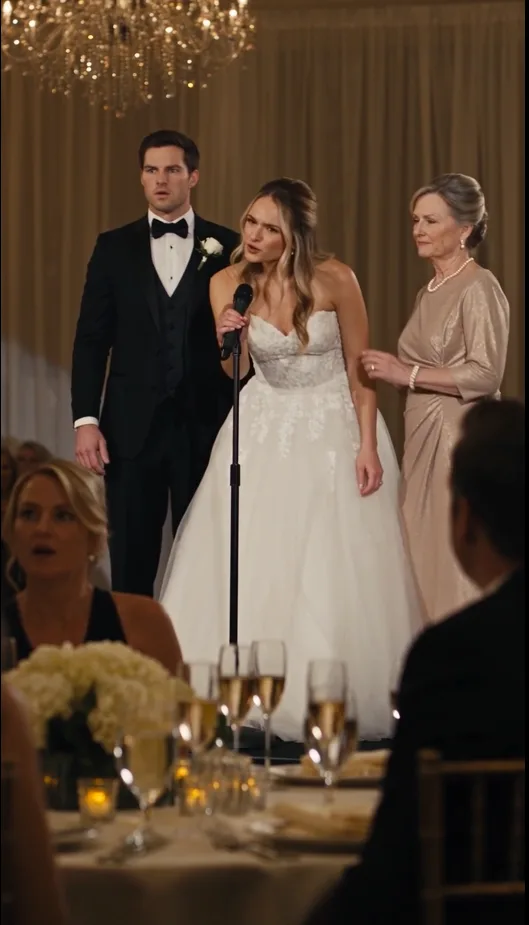
Then Brittany took the microphone.
She stood beneath the chandeliers, her smile bright enough to convince anyone who didn’t know her that she was the kindest woman in the world.
“Before we cut the cake,” she announced, “I want to say something about family.”
The ballroom quieted.
She looked toward my table.
“And especially my new sister-in-law, Sarah.”
I felt Mason turn toward me.
I smiled politely because I thought she was about to say something welcoming.
Instead, Brittany tilted her head and gave the audience a sympathetic expression.
“Sarah is such an inspiration. She’s proof that a woman can survive almost anything—even being abandoned by her husband.”
A few people chuckled.
My smile froze.
Brittany continued.
“Honestly, I don’t know how she does it. Raising a child alone, showing up to weddings without a date, and pretending she’s perfectly happy. That’s a special kind of confidence.”
This time, the laughter spread farther.
I stared at her, waiting for the punch line that might somehow make it harmless.
There wasn’t one.
Brittany raised her champagne glass.
“To Sarah Mitchell. The only woman I know who can turn being unwanted into a full-time personality.”
The room erupted.
My fingers tightened around my napkin.
I looked toward Jake.
He was standing beside Brittany, holding a champagne flute. His smile was uncomfortable, but he didn’t interrupt her.
He didn’t take the microphone.
He didn’t tell the guests that his sister deserved better.
He simply lowered his eyes.
And in that moment, something inside me began to change.
Then my mother stood.
“Oh, Brittany, you’re terrible,” Linda said, laughing.
She turned toward the guests.
“But she’s not entirely wrong. Sarah has always been a little difficult to love.”
My father chuckled.
I heard it.
I heard my own father laugh.
My mother continued, enjoying the attention.
“She’s like a clearance item with a damaged label. Technically still available, but nobody wants to deal with the trouble.”
People laughed again.
A man at the next table covered his mouth.
A woman shook her head while smiling.
Someone behind me whispered something about my divorce.
I felt as though I were sitting outside my own body, watching a woman who looked like me struggle to remain upright while the people who were supposed to protect her took turns striking her with words.
I had spent years making excuses for them.
I had driven my mother to medical appointments. I had helped my father organize his taxes. I had covered Jake’s rent when he was twenty-three and unemployed.
When my parents needed money for an unexpected home repair, I had given them nearly four thousand dollars from my savings.
When Jake’s first business failed, I had quietly paid several overdue bills because he was too embarrassed to ask our parents.
I had done these things because I loved them.
I had never sent invoices.
I had never demanded public recognition.
I had simply assumed that, when the moment came, they would remember that I was their daughter and sister.
Instead, they had turned me into a joke.
My fork slipped from my hand and struck the plate.
The sharp metallic sound seemed impossibly loud.
Mason looked at me.
His little face had gone pale.
“Mom,” he whispered.
“I’m okay.”
The words came automatically.
I wasn’t okay.
He knew it.
Children often recognize the truth long before adults are willing to say it aloud.
Brittany laughed into the microphone.
“Oh, Sarah, please don’t cry. It’s a wedding, not a funeral.”
That was when Mason pushed back his chair.
The legs scraped across the floor.
I reached for his hand.
“Mason, sit down, sweetheart.”
But he was already standing.
He looked at Brittany, then at my mother, then at my father.
Finally, he looked at Jake.
“Uncle Jake?”
My brother blinked.
“What is it, buddy?”
“Can I say something?”
Jake gave a strained laugh.
“Maybe after the speeches, champ.”
“No.”
The word was quiet.
But it carried.
Mason had never spoken to an adult that way before.
He walked toward the stage.
At first, nobody paid much attention. They probably assumed he wanted to hug his uncle or ask for a dance.
Then he climbed the steps.
Brittany looked down at him with irritation.
“Sweetie, what are you doing?”
“I need the microphone.”
A few guests laughed nervously.
Brittany glanced at Jake.
He shrugged, apparently believing that a child couldn’t possibly disrupt the carefully arranged evening.
She handed Mason the microphone.
He took it with both hands.
I stood halfway from my chair, my heart pounding.
“Mason,” I whispered.
He looked back at me.
For one brief moment, I saw the little boy who had fallen asleep against my shoulder during thunderstorms, who still asked me to check under his bed when he had nightmares, and who saved the best part of his birthday cake for me.
Then he turned toward the ballroom.
“My mom is not a clearance item.”
The laughter stopped.
Mason swallowed.
“She’s the best person I know.”
Nobody moved.
“She’s the person who stays up when I’m sick. She’s the person who makes sure I have lunch even when she says she’s not hungry. She’s the person who tells me I can be anything I want to be, even when people are mean to us.”
My eyes filled with tears.
Mason’s voice trembled, but he kept going.
“And she never tells me I’m difficult to love.”
A woman near the dance floor lowered her champagne glass.
Someone whispered, “Oh, my God.”
Mason looked directly at my mother.
“Grandma, you told me family is supposed to protect each other.”
Linda’s smile disappeared.
“Sweetheart, this isn’t the time—”
“Then why did you tell Uncle Jake that Mom was the only person who could ruin everything?”
My mother’s face changed.
Not gradually.
Instantly.
The color drained from her cheeks, and her fingers tightened around the stem of her glass.
Jake stopped breathing for a moment.
Brittany reached toward Mason.
“That’s enough. Give me the microphone.”
He stepped away from her.
“No. You said Mom was unwanted. But I heard what you said when you thought nobody was listening.”
The ballroom had become so silent that I could hear the faint hum of the ventilation system overhead.
My father slowly stood.
“Mason,” he said, his voice suddenly stern, “you need to come down from there.”
My son looked at him.
“I heard Grandma talking to Uncle Jake in the library three weeks ago.”
Jake’s glass slipped from his fingers.
It struck the floor and shattered.
Several guests gasped.
My brother didn’t even look down.
He was staring at Mason with an expression I had never seen before.
Fear.
Not embarrassment.
Not anger.
Fear.
Mason raised the microphone again.
“And Grandma said that if Mom ever found out what happened to the money Grandpa left her, she would tell everyone that Mom was crazy.”
My stomach dropped.
The money?
What money?
My grandfather had died seven years earlier, leaving behind a small estate that had supposedly been divided according to his will.
My mother had handled the paperwork.
She had told me there wasn’t much left after the medical bills and taxes.
I had never questioned her.
Mason’s voice grew quieter.
“She said Uncle Jake had to marry Brittany before Mom found the papers. She said they needed the house and the business to stay in the family.”
Jake took a step toward the stage.
“Mason, stop talking.”
My son flinched.
I saw it.
And something inside me went cold.
Jake had never spoken to Mason like that.
Never.
I pushed my chair back and walked toward the stage.
“Jake, don’t you dare frighten my son.”
My brother stopped.
For the first time that evening, he looked directly at me.
His face was white.
“Sarah, please. You don’t understand.”
“Then explain it.”
He opened his mouth.
Nothing came out.
My mother moved toward us, her heels clicking sharply against the polished floor.
“This is ridiculous,” she announced. “He’s nine years old. He’s confused. Someone has obviously put ideas in his head.”
Mason shook his head.
“No, Grandma. I heard everything.”
My mother reached for the microphone.
He pulled it against his chest.
Then he said the words that would change our family forever.
“Grandma said the papers prove that Mom owns the house where Uncle Jake’s business is.”
My father’s face went rigid.
Brittany stopped smiling.
And I remembered something I had not thought about in years.
The small brick commercial building on Franklin Road.
The building my grandfather had owned.
The building my mother had told me was sold after his death.
The building where Jake had started his first successful business.
The building that, according to everything I had been told, no longer belonged to our family.
I looked at my mother.
“Is that true?”
She stared at me.
Then she looked at Mason.
Then at Jake.
And finally, she did something I will never forget.
She smiled.
It was the same smile she had used throughout my childhood whenever she wanted to convince someone that a terrible thing was actually harmless.
“Sarah,” she said softly, “you need to take your son home before he embarrasses himself any further.”
I looked at the two hundred guests.
At the shattered champagne glass.
At my brother, who could not meet my eyes.
And at the woman who had spent my entire life teaching me that being a good daughter meant never asking uncomfortable questions.
For the first time, I didn’t obey.
I stepped onto the stage and took Mason’s hand.
“No,” I said. “I think we’re finally going to have a conversation.”
My mother stopped smiling.
Because somewhere in that ballroom, among the guests who had come to celebrate a marriage, there were people who knew exactly what my grandfather had left behind.
And one of them was standing near the ballroom entrance, holding a leather briefcase.
He had been watching everything.
When he saw me turn toward him, he slowly nodded.
Then he walked forward.
“Sarah Mitchell?” he asked.
“Yes.”
“My name is Robert Hayes. I was your grandfather’s attorney.”
My mother’s champagne glass slipped from her hand.
This time, nobody laughed.
Robert opened his briefcase.
“And I believe it’s time you learned what your family has been hiding from you.”
That was the moment my brother’s wedding stopped being a celebration.
It became an investigation.
And the first thing Robert said was a name I had not heard in seven years.
“Your grandfather, William Mitchell, never sold the building.”
He paused.
“He left it to you.”
Chap 2
For several seconds, I couldn’t understand the sentence.
The building belonged to me?
I stared at Robert Hayes, waiting for him to correct himself, to explain that he had mistaken me for another Sarah Mitchell, or that he was referring to some insignificant property that had nothing to do with Jake’s business.
But Robert didn’t look confused.
He looked like a man who had waited a very long time to deliver a message and was finally relieved that someone was willing to hear it.
“That isn’t possible,” I whispered.
Robert nodded sympathetically.
“I understand why you would say that.”
“My mother told me the building was sold.”
“Your mother told you many things about your grandfather’s estate.”
Across the stage, Linda made a sharp sound of disbelief.
“This is completely inappropriate.”
Robert turned toward her.
“Mrs. Mitchell, with respect, you have no authority to decide what is appropriate anymore.”
My mother stared at him as though he had slapped her.
The guests remained motionless.
A moment earlier, they had been laughing at me. Now they were watching the same woman who had insulted me lose control of a situation she had carefully arranged.
Brittany stepped toward Jake.
“What is he talking about?”
Jake didn’t answer.
His eyes remained fixed on Robert’s briefcase.
I recognized the expression on his face.
It was the look he used to wear as a child when he had broken something expensive and was waiting to discover whether our father had noticed.
Robert placed a folder on a nearby table.
“Your grandfather established a trust before his death. The principal asset was a commercial property on Franklin Road, along with an investment account and several smaller holdings.”
I felt the ballroom tilt.
My grandfather, William, had been the only person in my family who had never made me feel like I was competing for affection.
He had owned a small construction supply company before retiring. He was a quiet man with rough hands, a gentle laugh, and a habit of carrying peppermints in his coat pockets.
Whenever I visited him, he asked about my work, my interests, and my plans.
He never asked whether I had lost weight.
He never compared me to Jake.
And he never suggested that my divorce meant I had failed as a woman.
When Mason was born, my grandfather had cried while holding him.
“There’s a lot of good in this boy,” he had told me. “Make sure the world doesn’t convince him otherwise.”
Those were some of the last words he had ever said to me.
He died six months later.
I had been devastated.
My mother handled most of the funeral arrangements, the estate paperwork, and the discussions with the attorney.
She told me that Grandpa had left behind debts.
She told me the construction business had been struggling.
She told me there was barely enough money to cover his medical expenses.
I believed her because she was my mother.
And because grief had made me too exhausted to investigate every document placed in front of me.
“How much?” I asked.
Robert looked at the folder.
“The property alone was appraised at approximately eight hundred thousand dollars at the time of your grandfather’s death. The investment account contained an additional four hundred and twenty thousand.”
A guest near the front of the room whispered something to his wife.
I barely heard him.
Eight hundred thousand.
Four hundred and twenty thousand.
More than a million dollars.
My mother had told me there was nothing.
“You’re saying he left all of that to me?”
“He left the property and the investment account in a trust designated for your benefit. The documents also specified that the property could not be sold or transferred without your written consent.”
I looked toward Jake.
His face was pale.
“Jake?”
He finally met my eyes.
“I didn’t know about the account.”
“Did you know about the building?”
He swallowed.
“Sarah, please.”
“Did you know?”
He glanced toward my mother.
That tiny movement told me more than any answer could have.
“Yes,” he whispered.
The word landed between us.
I had expected denial.
I had expected him to insist that Robert was mistaken.
I had even expected him to accuse me of making a scene.
I had not expected him to admit that he knew.
“How long?”
Jake looked down.
“Several years.”
I felt a strange calm settle over me.
Sometimes the truth hurts so much that the mind stops trying to protect itself from it.
“How many?”
“Sarah—”
“How many years, Jake?”
“Six.”
Six years.
For six years, I had believed that the building was gone.
For six years, I had worked overtime, skipped vacations, and carefully saved money for Mason’s future.
For six years, I had worried about rent increases while my younger brother operated his business from a building that might legally belong to me.
I remembered the Christmas when Jake had complained that his landlord was raising the rent.
My mother had asked me to help him.
I had given him two thousand dollars.
I remembered the year his business nearly failed. I had lent him another three thousand, telling him he could repay me whenever he was comfortable.
He had never repaid a cent.
I had assumed he was struggling.
Now I wondered whether I had been financing a lie.
Brittany seized Jake’s arm.
“You told me the property belonged to your parents.”
Jake closed his eyes.
“They said it was being transferred.”
“Who said that?”
He didn’t answer.
She looked at Linda.
My mother lifted her chin.
“Your husband is under considerable stress. This is neither the time nor the place to interrogate him.”
Brittany’s expression hardened.
“Linda, you told me this property was going to secure our expansion loan. You said the ownership paperwork was settled.”
My mother stared at her.
“Lower your voice.”
“No.”
Brittany’s voice trembled.
“You promised us that building.”
I looked at my new sister-in-law.
For the first time that evening, she seemed less concerned about humiliating me than about discovering whether her own future had been built on a lie.
It didn’t make me feel sorry for her.
Not yet.
But it did tell me that the secret was larger than a missing inheritance.
Robert opened the folder and removed several pages.
“Before anyone makes further claims, I want to establish the facts. The original trust remains in force. The deed has never been lawfully transferred out of it.”
He placed a document on the table.
“The property remains legally connected to Sarah’s trust.”
My father finally spoke.
“That’s not what the paperwork said.”
Robert turned to him.
“What paperwork did you review, Mr. Mitchell?”
My father hesitated.
Linda interrupted.
“This is a family matter.”
“No,” I said.
Everyone turned toward me.
My voice surprised me. It was steadier than I felt.
“It stopped being a family matter when you stood in front of two hundred people and made my life a joke. It stopped being a family matter when you allowed people to laugh at my son and me. And it certainly stopped being a family matter when you took something Grandpa left for me.”
My mother gave me a wounded look.
“After everything I’ve done for you—”
“Don’t.”
One word.
She stopped speaking.
For thirty-four years, I had listened to that sentence whenever I questioned her decisions.
After everything I’ve done for you.
It had been used to explain why I needed to help Jake.
Why I needed to forgive my father.
Why I needed to accept insults without responding.
Why I needed to be grateful for whatever scraps of affection they chose to offer.
I had finally learned that gratitude did not require surrender.
Robert closed the folder.
“Sarah, I recommend that you review these documents privately with independent counsel. There are questions about how the trust was administered and whether certain representations were made to financial institutions.”
“Can you tell me who received the money?”
He looked at Linda.
Then at my father.
Then at Jake.
“I can tell you that the records show substantial withdrawals from an account associated with the estate. I cannot tell you the full story until we examine the original banking documents.”
My mother laughed sharply.
“There were medical bills. Legal expenses. Taxes. Your grandfather’s estate was complicated.”
“Then why did you tell me nothing was left?” I asked.
“Because you were grieving!”
“So were you.”
Her lips pressed together.
For a moment, I saw something beneath her anger.
Panic.
Then she looked at Mason.
“This is all because of what that child overheard. Children misunderstand conversations. He probably heard one sentence and invented the rest.”
Mason moved closer to me.
“I didn’t invent anything.”
“I think you’ve said enough,” she snapped.
He flinched again.
I stepped between them.
“You will not speak to my son like that.”
My father sighed as though I were the one creating an inconvenience.
“Sarah, let’s not destroy your brother’s wedding over a misunderstanding.”
I stared at him.
“His wedding?”
He gestured toward the guests.
“Look around you. There are people here who have traveled from other states. There are business associates. Important people. This is not the place to discuss money.”
I almost laughed.
Not because anything was funny.
Because my father had spent the entire evening watching his daughter be humiliated, yet the first thing he wanted to protect was the reputation of the family.
“Then perhaps you should have thought about that before allowing your wife to use me as entertainment.”
His expression darkened.
“Watch your tone.”
“No.”
The word came more easily this time.
“No, Dad. I spent my entire life watching my tone, watching my words, watching my reactions, and trying to keep everyone comfortable. Tonight, I watched my own mother compare me to damaged merchandise while my father laughed.”
His face reddened.
“I did not—”
“I heard you.”
He fell silent.
I turned to Jake.
“I want the truth. Not tonight, not because two hundred people are watching, and not because Robert is standing here. I want every document connected to Grandpa’s estate.”
Jake’s eyes filled with tears.
“I’m sorry.”
I looked at him for a long time.
“I don’t know what that means anymore.”
Then I took Mason’s hand.
We left the stage together.
As we crossed the ballroom, nobody laughed.
A few guests lowered their eyes. Others watched us with expressions that ranged from sympathy to curiosity.
Near the exit, Mason squeezed my hand.
“Mom?”
“Yes, sweetheart?”
“Are you mad at me?”
I stopped walking.
The question broke my heart more thoroughly than anything my mother had said.
I knelt in front of him.
“Why would I be mad at you?”
“Because I told everyone.”
I held his face between my hands.
“You told the truth. You don’t have to apologize for that.”
His lower lip trembled.
“But Grandma looked really angry.”
“I know.”
“Is she going to stop loving us?”
I swallowed the ache in my throat.
“I can’t tell you what Grandma will do. But I can promise you something. You will never have to make yourself smaller just to keep someone else happy.”
He leaned into my arms.
For several seconds, we remained there in the hotel corridor while the wedding continued behind us in a silence that must have felt unbearable to the people who had arranged it.
Then Mason whispered something I would remember for the rest of my life.
“Grandpa told me you were supposed to have the building.”
I pulled back.
“What?”
Mason wiped his nose with his sleeve.
“Before he died. I was little, but I remember visiting him with you. He showed me a picture of the building and said it was going to help you and me.”
My heart began pounding.
“Did he say anything else?”
Mason nodded.
“He told me that if Grandma ever said the papers were missing, I should remember where he kept the blue envelope.”
I stared at him.
“What blue envelope?”
“The one in the old desk.”
I felt a chill run down my spine.
Grandpa had owned a heavy oak desk with a broken brass handle. After his funeral, my mother had told me she donated most of his furniture.
I had never asked where it went.
Mason looked at me anxiously.
“Did I do something wrong?”
I pulled him into my arms again.
“No, sweetheart. You may have just helped us find something very important.”
Behind us, the ballroom doors opened.
Robert Hayes stepped into the corridor.
He was carrying his briefcase, but his expression had changed.
“Sarah, there’s one more thing I need to tell you.”
I stood.
“What is it?”
He glanced toward Mason.
Then he lowered his voice.
“Your grandfather didn’t simply leave you the property. He included a provision that would activate if anyone attempted to transfer it without your consent.”
“What kind of provision?”
Robert’s face grew serious.
“A provision requiring a formal investigation into the trust’s administration.”
He paused.
“And if the evidence supports what I suspect, the people responsible may have committed more than a civil breach of trust.”
I looked through the ballroom doors.
My mother was standing beneath the chandeliers, speaking urgently to my father.
Jake had disappeared.
Brittany was crying.
And for the first time in my life, I understood why my family had worked so hard to keep me quiet.
They hadn’t been protecting me from the truth.
They had been protecting themselves from what I might do once I knew it.
Chap 3
I didn’t sleep that night.
After putting Mason to bed, I sat at our kitchen table with a cup of coffee that had gone cold and a notebook filled with questions I had never imagined needing to ask about my own family.
Who had controlled Grandpa’s estate?
Why had my mother told me the building was sold?
Where had the investment money gone?
Why had Jake been allowed to operate his business from a property that Robert said was connected to my trust?
And most importantly, what exactly had Mason overheard three weeks before the wedding?
I had asked him about it in the car on the way home, but he had been exhausted and overwhelmed.
He remembered Grandma and Uncle Jake arguing in the library of my parents’ house.
He remembered my mother’s voice.
He remembered the words money, papers, and Sarah.
But he couldn’t recall every detail.
He had been visiting my parents while I worked an extra shift at the medical billing office where I had been employed for nearly eight years.
My mother had offered to watch him for the afternoon.
I had thanked her.
I had even bought her flowers on my way home.
Now that memory felt like another small betrayal.
At 1:17 a.m., my phone rang.
Jake’s name appeared on the screen.
I stared at it until the call stopped.
A minute later, a message arrived.
Sarah, please answer. We need to talk.
I didn’t respond.
Another message appeared.
Mom is making everything worse. I didn’t know how far she had gone.
I read the words several times.
Then I placed the phone facedown.
If Jake wanted to tell me the truth, he could begin by telling it without expecting me to comfort him.
At 7:30 the next morning, I dropped Mason off at school.
He hugged me before getting out of the car.
“Are we going to be okay?”
I smiled as gently as I could.
“We’re going to take things one day at a time.”
He nodded, then ran toward the entrance.
I waited until he disappeared inside before allowing myself to cry.
I cried because I was angry.
I cried because I was frightened.
And I cried because the people who had hurt me were the same people I had spent years hoping would one day be proud of me.
When I arrived at work, my supervisor, Denise, took one look at my face and asked whether I needed the day off.
“I might.”
“Take it.”
She didn’t ask for details.
That kindness nearly made me cry again.
I returned home, called Robert Hayes, and arranged to meet him at his office.
His practice occupied the second floor of a modest brick building near downtown Nashville. There were no marble floors or elaborate decorations, just shelves of legal books, framed certificates, and a waiting room that smelled faintly of coffee.
Robert greeted me at the door.
“I was hoping you’d call.”
He led me into his office and placed a thick file on the desk.
“I’ve spent most of the morning reviewing the preliminary records.”
“Have you found something?”
“I’ve found enough to justify a closer examination.”
He opened the file.
The first document was a copy of my grandfather’s will.
The second was a trust agreement.
The third was a property deed.
I leaned forward.
The pages were filled with legal language, but Robert patiently explained each section.
Grandpa had established the trust eighteen months before his death. The building on Franklin Road was its primary asset, and I had been named the sole beneficiary.
The trust also contained an investment account that was supposed to remain available for property maintenance and my future financial security.
My grandfather had not wanted me to become wealthy overnight.
He had wanted me to have stability.
He knew I was raising Mason and wanted to make sure we would always have a place to live and a source of income if life became difficult.
The property generated rent from several small businesses, including the office space occupied by Jake’s company.
According to the trust, those rental payments were supposed to be deposited into an account administered for my benefit.
“How much rent does the property generate?” I asked.
“At the time of your grandfather’s death, approximately seven thousand dollars per month.”
I stared at him.
“Seven thousand?”
“The amount has likely changed over the years.”
I tried to calculate the total.
Six years.
Seventy-two months.
Even without rent increases, the income would have been substantial.
“Where did the money go?”
“That’s one of the questions we’re investigating.”
Robert showed me copies of bank statements. Several pages were missing, but the transactions that remained suggested that the trust account had been active for years after my grandfather died.
Then, roughly six months later, the balance had fallen sharply.
By the end of the following year, the account appeared to have been closed.
I felt sick.
“Who closed it?”
Robert pointed to a document.
“The signature appears to be your mother’s.”
“She was allowed to manage the estate?”
“She was authorized to handle certain administrative matters while the estate was being settled. She was not authorized to transfer your beneficial interest to herself or distribute the trust’s principal assets without following the trust agreement.”
“Could she have believed she was allowed to do it?”
“That is a question for her and her legal counsel. What I can tell you is that the documents I have reviewed do not establish that she had the authority to do what appears to have happened.”
I pressed my fingertips against my forehead.
I wanted to believe there was an innocent explanation.
I wanted to believe my mother had misunderstood the paperwork, that my father had been trying to help, and that Jake had simply been caught in a situation he didn’t understand.
But every explanation required me to ignore another fact.
“Why didn’t you contact me when the account was closed?”
Robert’s expression grew uncomfortable.
“I attempted to reach you several times.”
I looked up.
“What?”
“I sent letters to the address listed in the trust. Two were returned. I also called the number on file, but I was told you had moved and could not be reached.”
“I never received any letters.”
“I suspected as much.”
He removed a sheet of paper from the folder.
“The contact information was changed shortly after your grandfather’s death. The new mailing address was your parents’ home, and the phone number belonged to your mother.”
My hands went cold.
“She intercepted the correspondence?”
“I cannot prove that yet. But the records indicate that notices were redirected.”
I sat back.
It was one thing to discover that my mother had lied about money.
It was another to discover that she might have deliberately prevented me from learning that the money existed.
Robert continued.
“There is something else. Your grandfather anticipated that someone might try to interfere with the trust. He left a sealed letter with my office.”
He reached into a drawer and removed a smaller envelope.
My name was written across the front in my grandfather’s familiar handwriting.
Sarah.
Just Sarah.
No surname.
No formal greeting.
I touched the paper with trembling fingers.
“Why didn’t you give this to me earlier?”
“The letter was sealed with instructions that it be delivered after a specific event. I believed that event had occurred last night.”
I carefully opened the envelope.
Inside was a single handwritten page.
My dearest Sarah,
If you are reading this, something has happened that I hoped you would never have to face. I want you to remember that you have never needed to earn your place in this family. You were loved before you could speak, and you are loved now, regardless of what anyone tells you.
I know your mother can be persuasive. I know your father avoids conflict, and I know Jake has learned to depend on other people to solve problems he should face himself.
I am not writing this to make you hate them.
I am writing because love without honesty becomes a chain.
The building on Franklin Road is yours. The income from it is intended to help you raise your child without fear of losing everything when life becomes difficult. Do not surrender it because someone tells you that a good daughter would.
I have also left a blue envelope in the bottom drawer of my old oak desk. It contains copies of documents that explain why I established the trust and why I insisted that the property remain in your name.
If the envelope is missing, do not assume the documents have disappeared forever.
Trust the records. Trust your judgment. And remember that the truth does not become less true simply because the people you love refuse to acknowledge it.
All my love,
Grandpa.
I read the letter twice.
By the third reading, the tears were falling so quickly that the words blurred.
Robert quietly handed me a tissue.
“He knew,” I whispered.
“He was concerned.”
“About my mother?”
“About the possibility that your inheritance might become a source of conflict.”
I folded the letter carefully.
Then I remembered Mason’s words.
The blue envelope.
The old desk.
“Where is Grandpa’s desk now?”
Robert checked his notes.
“According to the estate inventory, it was listed as transferred to your parents’ residence after his death.”
I stared at the wall.
My parents still lived in the same house where I had grown up. The house with the oak staircase, the formal dining room, and the library where Mason had overheard my mother speaking to Jake.
The desk might still be there.
Or the envelope might have been removed years ago.
Either possibility frightened me.
“What happens if the documents prove my mother transferred the money illegally?”
“That will depend on the evidence, the applicable law, and the findings of the relevant authorities. You may have civil remedies, and certain conduct could warrant further investigation.”
“And Jake?”
Robert folded his hands.
“That depends on what he knew and what he did.”
I thought about my brother’s face at the wedding.
His frightened eyes.
His whispered apology.
His refusal to answer when I asked how long he had known about the building.
“Can I trust him?”
Robert didn’t answer immediately.
“I can’t make that decision for you. But I can tell you that trust should be based on what someone does when the truth becomes inconvenient.”
I left his office carrying copies of the documents and my grandfather’s letter.
On the drive home, I stopped at a traffic light beside a row of small shops.
Across the intersection, I could see the roof of a building with a faded sign.
For a moment, I imagined Grandpa standing beside me, his hand resting on my shoulder.
I imagined him telling me that I was stronger than I realized.
Then my phone rang.
It was Jake.
This time, I answered.
“Sarah, thank God.”
“What do you want?”
He went quiet.
“I need to explain.”
“Then explain.”
“I didn’t know everything Mom was doing. I swear.”
“But you knew the building belonged to me.”
“Yes.”
“And you used it for your business.”
“Yes.”
“Did you pay rent?”
He hesitated.
“Not directly.”
I closed my eyes.
“How much have you paid our parents over the years?”
“Sarah, that’s complicated.”
“No. It’s a number.”
He exhaled shakily.
“I don’t know exactly.”
“Then find out.”
“I will.”
“And Jake?”
“Yes?”
“If you call me again, don’t ask me to protect you from the truth.”
I ended the call.
For the first time in years, I felt no obligation to make him feel better.
That afternoon, I drove to my parents’ house.
I told myself I was going to ask about the desk.
I told myself I would remain calm and leave if the conversation became hostile.
But as I parked in front of the familiar brick house, I noticed a large black SUV in the driveway.
A man I didn’t recognize was standing on the porch, speaking to my father.
When he saw my car, he stopped talking.
My father followed his gaze.
The expression on his face changed immediately.
He hurried toward me before I had even opened my door.
“Sarah, what are you doing here?”
“I need to see Grandpa’s desk.”
His face went rigid.
“What desk?”
“The oak desk you took from his house after he died.”
My father looked toward the porch.
The stranger closed a leather folder.
Then he walked down the steps.
“Mr. Mitchell,” he said quietly, “I believe you should let your daughter inside.”
My father turned toward him.
“That is not your decision.”
The man glanced at me.
“Sarah, my name is Michael Grant. I’m a forensic accountant.”
I looked at my father.
Then at Michael.
“Why are you here?”
Michael answered before my father could.
“Because someone has been moving money through accounts connected to the property your grandfather left you.”
He paused.
“And your father’s signature appears on several of the transfers.”
Chap 4
For a moment, I forgot how to breathe.
My father’s signature?
I looked at Michael Grant, expecting him to explain that he meant a routine document, perhaps a tax return or a property maintenance form.
Instead, he opened his folder.
“I have not reached any final conclusions,” he said carefully. “But there are transactions that require explanation.”
My father stepped between us.
“This is private financial information.”
Michael closed the folder.
“That is precisely why I’m not discussing the details on your front porch.”
“Then leave.”
“Arthur,” my mother called from inside the house, “what is going on?”
Her voice carried the same sharp authority I remembered from childhood.
My father glanced at the door.
I took the opportunity to step past him.
“I’m going inside.”
“Sarah, don’t.”
I stopped.
“Why?”
He looked older than he had the night before.
The lines around his eyes seemed deeper, and his shoulders had begun to sag.
“Because you don’t know what you’re walking into.”
I studied his face.
“Then tell me.”
He opened his mouth, but no words came.
I walked past him.
Michael followed after asking whether I wanted him to remain present.
I nodded.
If my family had taught me anything, it was that conversations changed when there were witnesses.
My mother was standing in the living room beside the fireplace. She wore a cream sweater and black trousers, and her hair was perfectly arranged despite the early hour.
She looked at Michael with open hostility.
“Who invited you?”
“I did,” I said.
“No, you didn’t.”
“Then perhaps we can agree that someone is finally here who isn’t afraid to ask questions.”
Her face tightened.
“Don’t speak to me like that in my own house.”
I almost laughed.
The phrase had followed me through childhood like a warning bell.
My mother’s house.
My mother’s rules.
My mother’s version of the truth.
I had lived there until I was twenty-two, and even after moving out, I had continued behaving as though I needed her permission to exist.
Not anymore.
“I want to see Grandpa’s desk.”
Linda folded her arms.
“The desk was donated years ago.”
“To whom?”
“I don’t remember.”
“Where?”
“I said I don’t remember.”
Michael remained quiet beside the doorway.
I took a breath.
“Then let’s talk about the building on Franklin Road.”
My mother’s eyes flashed.
“There is nothing to discuss.”
“Robert Hayes says Grandpa left it to me.”
“He made complicated arrangements while he was ill.”
“He was not confused when he signed the trust.”
“You weren’t there for every conversation.”
“Neither were you, apparently, if you believe I should accept whatever you say without seeing the documents.”
My father entered the room.
“Sarah, this isn’t helping.”
I turned toward him.
“Then help me understand. Michael says your signature appears on transfers connected to Grandpa’s estate.”
My father’s face became expressionless.
“That is an accusation.”
“It’s a question.”
“I signed documents when your grandfather died. Your mother handled the financial matters.”
“Did you know the property was supposed to belong to me?”
He looked at Linda.
She shook her head almost imperceptibly.
It was a tiny gesture.
But I saw it.
My father looked back at me.
“I understood that the estate would be divided according to the arrangements your grandfather made.”
“Which arrangements?”
“I don’t remember the details.”
I stared at him.
My father was a meticulous man. He kept receipts from grocery stores and stored old tax returns in labeled folders. He could remember the exact cost of a replacement water heater purchased twelve years earlier.
Yet he couldn’t remember the details of a million-dollar estate?
“Did you sign any document transferring the property?”
He rubbed his forehead.
“Sarah, I don’t know.”
Michael finally spoke.
“Mr. Mitchell, if you would like to review the documents with your own attorney, we can arrange that. But I recommend you avoid making further statements about the estate until you’ve had a chance to examine the records.”
My father looked at him sharply.
“Are you threatening me?”
“No. I’m advising caution.”
My mother moved toward Michael.
“You have no right to come into our home and intimidate us.”
“I’m not here to intimidate anyone. I’m here because Sarah requested assistance understanding the financial records connected to a trust of which she is the beneficiary.”
Linda turned to me.
“Look what you’ve done.”
There it was again.
The familiar shift.
Whatever happened, I was responsible for the discomfort it caused.
If my mother insulted me, I was too sensitive.
If Jake needed money, I was selfish for refusing.
If my father avoided the truth, I was disrespectful for asking questions.
And now, if their financial records required scrutiny, I was destroying the family.
I looked at her.
“I haven’t done anything except ask what happened to something Grandpa left me.”
“You are embarrassing us.”
I thought of the wedding.
The microphone.
The laughter.
My mother’s voice comparing me to damaged merchandise.
“You embarrassed me in front of two hundred people last night,” I said. “And you expected me to smile.”
Her face flushed.
“That was a joke.”
“No. It was cruelty disguised as entertainment.”
For the first time, she had no immediate answer.
I continued.
“You made fun of my divorce. You made fun of my appearance. You suggested nobody wanted me. And when Mason stood up to defend me, you tried to silence him.”
“Because he was making accusations he couldn’t understand!”
“Then why are you frightened of the documents?”
My mother’s lips parted.
Nothing came out.
Michael looked at me, then at the hallway leading toward the library.
“Sarah, if the desk was kept in this house, it may be worth checking whether any inventory records exist.”
My mother stepped directly into the hallway.
“No one is going into that room.”
I looked at her.
“Why?”
“Because it contains private belongings.”
“Grandpa’s belongings?”
“They belong to this family.”
“His letter says the blue envelope was in the desk.”
The reaction was immediate.
My mother went perfectly still.
My father closed his eyes.
Michael noticed.
So did I.
“What blue envelope?” Linda asked.
Her voice was too quick.
I stared at her.
“The one Grandpa mentioned in his letter.”
“You have a letter?”
“Yes.”
“Who gave it to you?”
“His attorney.”
She looked toward my father.
He seemed to shrink into himself.
I understood then that they had not expected Robert to still be involved.
They had assumed that, after years of silence, the matter was finished.
My mother drew herself upright.
“Your grandfather was very ill. He wrote many things that didn’t make sense.”
“Then you won’t mind if I look for the envelope.”
She didn’t move.
I took one step toward the hallway.
She grabbed my arm.
“Sarah, listen to me.”
I looked down at her hand.
She released me.
“Whatever you think you’ve discovered, you need to stop before you make a mistake you can’t undo.”
“Is that a warning?”
“It’s advice.”
“Then give me a reason to follow it.”
Her eyes filled with tears.
For one brief moment, I saw the mother I had spent my life wanting.
The woman who had tucked blankets around me when I was sick, who had held my hand during thunderstorms, who had kissed my forehead before my first day of school.
Then she spoke.
“You have a son. You need to think about his future.”
I felt a chill.
“That’s exactly what I’m doing.”
“No, Sarah. You’re risking everything because you believe a dead man’s papers are more important than your family.”
I stepped back.
“My grandfather was my family.”
She flinched.
It was the first time I had ever said it aloud.
Michael cleared his throat.
“Perhaps we should leave for now and arrange a formal review.”
I nodded, though every instinct told me to keep searching.
As we approached the front door, my father followed.
“Sarah.”
I turned.
He looked at me with an expression that was almost pleading.
“I never wanted things to turn out this way.”
“Then why did they?”
He stared at the floor.
“I made mistakes.”
“What kind?”
He swallowed.
“More than you know.”
For one second, I thought he might finally tell me everything.
Then Linda appeared behind him.
“Arthur, don’t.”
My father fell silent.
I walked out.
Michael accompanied me to my car.
“Your mother reacted strongly to the envelope,” he observed.
“She knew about it.”
“Possibly.”
“She was afraid I would find it.”
“That seems reasonable to investigate.”
I leaned against my car.
“What if my father helped her?”
Michael took a moment before answering.
“Then the records will tell us more than either of them may be willing to admit.”
I drove home with those words echoing in my mind.
That evening, Jake arrived at my apartment.
He stood outside the door holding a cardboard box.
When I opened it, he looked exhausted.
“I brought everything I could find.”
I didn’t invite him inside immediately.
“What is it?”
“Copies of the property records, old bank statements, and some documents Mom gave me when I started the business.”
“Why are you bringing them now?”
He looked down at the box.
“Because I can’t keep lying to you.”
I stepped aside.
Jake entered slowly and placed the box on the kitchen table.
For several minutes, he sorted through the papers without speaking.
Then he removed a photocopy of a deed.
The document appeared to transfer certain rights connected to the Franklin Road property to a company called Mitchell Commercial Holdings.
The signature at the bottom was mine.
I stared at it.
My name.
My handwriting, or something that looked disturbingly similar.
But I had never signed that document.
“Jake,” I whispered, “where did this come from?”
He rubbed his face.
“Mom gave it to me when the business expanded. She said you had agreed to transfer the property into the company.”
“I never agreed to that.”
“I know.”
“How do you know?”
“Because I asked her to let me speak to you before I signed the lease documents. She told me you were going through a difficult time and didn’t want to be bothered.”
I felt my knees weaken.
“And you believed her?”
“At first.”
“What changed?”
He looked at me.
“Because I saw you at Christmas two years ago. You were talking about saving money to buy a house, and Mom said something about how irresponsible it was for you to expect everyone else to rescue you.”
His voice cracked.
“I realized you didn’t know anything about the property.”
I stared at him in disbelief.
“You knew two years ago?”
He closed his eyes.
“Yes.”
“And you said nothing?”
“I was scared.”
“Of what?”
“Of losing everything I’d built.”
I stepped away from the table.
“So you let me struggle because you didn’t want to lose your business.”
Jake began to cry.
“I told myself Mom would fix it. I told myself the paperwork was complicated. I thought if I waited long enough, everything would become legal.”
“Things don’t become legal because you ignore them.”
“I know.”
“No, Jake. You know now because someone else discovered the truth.”
He lowered his head.
I wanted to hate him.
Part of me did.
But another part remembered the little boy who had followed me around our childhood backyard, begging me to teach him how to ride a bicycle.
I remembered him crying when our grandfather died.
I remembered him holding Mason for the first time.
Love didn’t disappear simply because someone had betrayed you.
Sometimes it became the very thing that made betrayal so difficult to accept.
Jake pushed the photocopy toward me.
“There’s something else.”
He removed a folded sheet of paper.
It was a handwritten note from my mother.
The original documents must remain secure. Do not discuss Sarah’s ownership with anyone outside the family. Once the bank approves the expansion loan, everything will be much easier to explain.
The note was dated eleven months earlier.
I read it twice.
Then I looked at Jake.
“What does ‘once the bank approves the expansion loan’ mean?”
His face turned pale.
“The business borrowed money against the property.”
“But the property wasn’t his to use as collateral.”
“I know.”
“How much?”
He hesitated.
“One point eight million dollars.”
The room seemed to grow smaller.
“Who guaranteed the loan?”
Jake looked toward the window.
Then he whispered the answer.
“Your father.”
Chap 5
I sat down because my legs could no longer support me.
One point eight million dollars.
My father had guaranteed a business loan using property connected to a trust that belonged to me.
At least, that was what the documents appeared to suggest.
I needed confirmation from a lawyer and a forensic accountant before drawing conclusions, but the implications were terrifying.
If the bank believed the property had been lawfully offered as collateral, the dispute could threaten Jake’s business, my financial future, and perhaps my father’s remaining assets.
It could also expose everyone involved to legal consequences.
I looked at my brother.
“Tell me everything.”
Jake rubbed his hands together.
“Mom said Grandpa had intended the building to go to the family. She told Dad that you were too young to manage it and that the business needed a stable foundation.”
“How old was I?”
“Twenty-seven.”
“I was old enough to work full-time, raise my son, and pay my own bills.”
“I know.”
“Then why did you let them decide I was incapable?”
He looked ashamed.
“Because it was easier.”
The honesty of that answer hurt more than a dozen excuses.
It was easier for Jake to accept the building than to question our mother.
It was easier for my father to sign documents than to confront her.
It was easier for everyone to treat me as unreliable than to acknowledge that I had a legitimate claim to something they wanted.
And it had been easier for me to believe them than to imagine my own family might deceive me.
I opened the box again.
“Why did you bring these documents to me now?”
Jake hesitated.
“Because Brittany found out.”
I looked up.
“Found out what?”
“She was reviewing the company’s finances before the wedding. She wanted to know why the business paid certain expenses through an account Dad controlled. She found the old trust reference in a bank file.”
“Then what happened?”
“She confronted me. I told her Mom had handled everything.”
“Did she believe you?”
“No.”
He looked at the floor.
“She said she wouldn’t marry me unless I could prove the business was financially secure.”
I stared at him.
“So you married her anyway.”
“I thought I could resolve it before she discovered the truth.”
“And what did you plan to do about me?”
He didn’t answer.
I felt a bitter laugh rise in my throat.
There it was.
The real reason my mother had made me the target of her jokes at the reception.
She wanted the guests to see me as unstable, unsuccessful, and jealous.
If the dispute over the property became public, she wanted everyone to believe that I was a bitter divorced woman trying to take money from her successful brother.
The joke had not been spontaneous.
It had been a performance.
And I had been chosen as the villain before I even arrived.
“Did Mom tell Brittany to humiliate me?”
Jake’s silence answered before his words did.
“She said it would make things easier if everyone understood what kind of person you were.”
I looked at him.
“What kind of person am I?”
He shook his head.
“She said people would believe you were jealous of Brittany. She thought if the guests laughed at you, any claims you made later would seem vindictive.”
I closed my eyes.
My mother had turned my private pain into public evidence against me.
My divorce.
My financial struggles.
My decision to raise Mason without rushing into another relationship.
Everything I had worked to survive had been repackaged as proof that I was unworthy of being believed.
I stood and walked to the kitchen sink.
For several moments, I stared out the window at the parking lot below.
Then I turned back.
“Did Brittany know what she was doing?”
Jake swallowed.
“She knew Mom wanted the speech to make you look bad. I don’t think she knew about every detail of the trust.”
“That’s not an answer.”
“No,” he admitted. “She knew enough to understand that humiliating you was supposed to serve a purpose.”
I felt something harden inside me.
Brittany had not simply made an insensitive joke.
She had chosen to participate in a plan designed to damage my credibility.
I looked at the clock.
Mason would be home from school in less than an hour.
I didn’t want him to see me unravel.
I collected the documents and placed them in a folder.
“You’re going to give Robert everything you have.”
“I will.”
“You’re going to tell him exactly what you knew and when you knew it.”
Jake nodded.
“And you’re not going to contact Mom to coordinate your stories.”
His head snapped up.
“I wouldn’t do that.”
“Then you won’t mind agreeing to it.”
He looked wounded.
“Sarah, I’m your brother.”
I stared at him.
“That used to mean something to me.”
He lowered his eyes.
I wanted him to understand that an apology wasn’t a magic word that restored everything he had broken.
I wanted him to feel the weight of the years I had spent believing his lies.
But I also knew that if I allowed anger to make every decision, I could become consumed by the very people I was trying to escape.
So I made a choice.
“You can tell the truth now,” I said. “You can cooperate, provide the records, and accept whatever consequences follow. I won’t promise to forgive you. I won’t promise to protect you. But I won’t stop you from doing the right thing.”
Jake wiped his eyes.
“That’s more than I deserve.”
“Probably.”
He gave a sad, broken laugh.
For the first time in years, we had spoken honestly.
It wasn’t enough to repair our relationship.
But it was a beginning.
After Jake left, I called Robert and arranged for him to collect the documents.
Then I called Michael Grant.
He listened carefully as I explained the alleged loan guarantee.
“I’ll need to review the original loan file,” he said. “A photocopy alone won’t establish whether the transaction was valid, but it gives us a direction.”
“What if the bank tries to seize the building?”
“That is one of the risks we need to evaluate. Your attorney should contact the lender through the appropriate legal channels and notify them that ownership is disputed. We should not assume the bank’s rights or your position until the documents are reviewed.”
I appreciated his caution.
For the first time, someone was refusing to promise me an easy answer just because I was frightened.
After we hung up, I began cooking dinner.
Mason came through the door at four fifteen, dropped his backpack beside the couch, and ran toward me.
“Mom!”
I caught him in my arms.
“Hey, sweetheart.”
He hugged me tightly.
“Nobody at school knows about the wedding, right?”
I pulled back.
“Why would they?”
“Because I talked into the microphone. What if someone posted it online?”
I hadn’t thought about that.
In the age of phones and social media, two hundred witnesses could become thousands of spectators in minutes.
“I don’t know if anyone recorded it,” I admitted. “But if they did, you haven’t done anything wrong.”
He nodded uncertainly.
Then he asked the question I had been dreading.
“Are Grandma and Grandpa bad people?”
I put the spoon down.
Children want simple answers.
They want heroes and villains, good people and bad people, promises that everything will be all right.
But life rarely offers such clean divisions.
“I think Grandma and Grandpa have made choices that hurt us,” I said carefully. “And I think they need to take responsibility for those choices.”
“Does that mean we can’t see them anymore?”
“It means we’ll decide what is safe and healthy for us. You don’t have to decide anything today.”
He studied my face.
“Uncle Jake said he was sorry.”
“He did.”
“Do you forgive him?”
I considered the question.
“Not yet.”
Mason nodded as though that made sense.
Then he said something that made my throat tighten.
“That’s okay. You don’t have to forgive someone just because they want you to stop being sad.”
I stared at him.
He was nine years old.
He should have been thinking about soccer practice, comic books, and whether he could have dessert before dinner.
Instead, he was trying to make sense of betrayal.
I pulled him close.
“You are a very wise boy.”
He rested his head against my shoulder.
“Grandpa used to say that.”
I smiled through my tears.
“Yes, he did.”
That evening, after Mason went to bed, I received an email from Brittany.
The subject line read: We need to talk.
I almost deleted it.
Then I opened it.
Sarah,
I know you have every reason to hate me after what happened at the wedding. I am not going to pretend that I didn’t know the speech was meant to embarrass you. I did.
Linda told me that if the guests saw you as unstable and jealous, it would protect Jake’s reputation if the property dispute became public. I agreed because I was afraid the business would collapse and I would lose the future I had planned.
That doesn’t excuse what I did.
But there is something I need you to know. The documents I found at the bank were not the only documents connected to your grandfather’s estate.
I found a second set of records showing that the original trust was changed after his death. The signature on the amendment is yours.
I know you say you never signed it. I believe you.
And I think someone in your family forged it.
I read the email twice.
Then I scrolled to the bottom.
Brittany had attached a photograph of a document.
The page was slightly blurred, but I could clearly see my name at the bottom.
Sarah Mitchell.
The signature looked like mine.
Almost.
But there was something wrong with the final stroke of the letter h.
I had always written my surname with a small upward curve.
This signature ended with a sharp downward line.
I enlarged the photograph.
A date appeared near the top.
Six years earlier.
The same year my mother told me the estate had been settled.
The same year Jake’s business moved into the Franklin Road building.
And beneath the signature was a sentence that made my blood run cold.
I hereby relinquish all present and future beneficial interest in the Mitchell Family Trust.
I had never signed those words.
I had never seen that document.
But someone had used my name to make it appear that I had willingly surrendered my inheritance.
I forwarded the email and photograph to Robert.
His reply arrived less than five minutes later.
Do not confront anyone about this document yet. We need the original.
A second message followed.
Sarah, there is a serious issue here. If this amendment was used to transfer trust assets, we need to establish who created it, who witnessed it, and who presented it to the bank.
Then he called me.
His voice was unusually grave.
“Sarah, I’ve examined the image.”
“What does it mean?”
“If the document is authentic in appearance but not in origin, it may be evidence of forgery. But I need the original and the complete execution records before I can reach a conclusion.”
“Who would have had access to my signature?”
He was quiet for a moment.
“Several people, possibly. But there is one detail I want you to consider.”
“What?”
“The amendment lists two witnesses.”
I waited.
“One is your mother.”
My stomach tightened.
“And the other?”
Robert paused.
“Your father.”