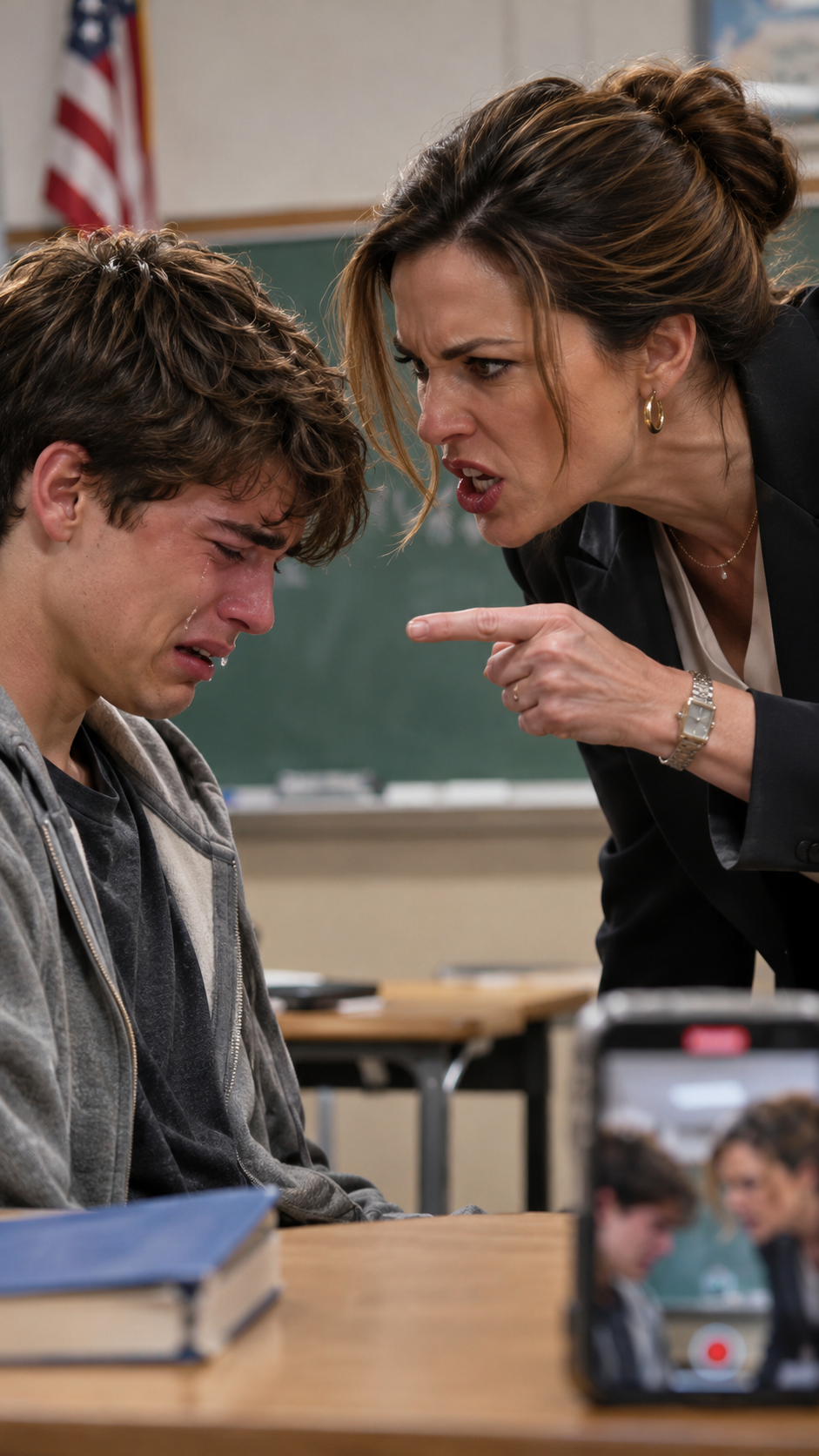
Mrs. Victoria Hale caught my son’s forearm and hauled him away from his desk so sharply that his chair scraped across the floor.
Her other hand closed around the front of his school shirt, bunching the dark fabric under her fist.
Ethan’s feet stumbled as he tried to find his balance, and thirty classmates watched him struggle not to cry.
“Look at me when I’m talking to you!” she snapped.
My son was twelve, and the adult holding his collar was the person responsible for teaching him.
I saw those first seconds through the open classroom door, and later a student’s recording would show me how long the cruelty had been unfolding before I arrived.
The fear on Ethan’s face told me this wasn’t a misunderstanding or a single bad minute; it was the end of a long stretch of mornings when he had felt alone.
What disturbed me most was how familiar that fear looked.
For three weeks, Ethan had been inventing reasons to remain home, and I had mistaken the evidence for a series of unrelated mornings.
There were stomachaches before breakfast, shoes left untied until the last possible minute, and questions about whether I would be there when school ended.
We had lived alone since his mother died when he was seven, and I understood that a small change could unsettle him more deeply than it might another child.
He kept her old blue scarf folded inside his nightstand, and when he was anxious he sometimes smoothed its edges as if tidying a memory could make the day safer.
Still, the child who once argued enthusiastically about spacecraft and the American Revolution had stopped talking about school almost completely.
One morning I found him dressed, sitting on his bed beside an untouched bowl of cereal.
“Are you feeling sick?” I asked.
He inspected the laces of his sneakers before telling me he wasn’t.
“Then help me understand why going to school seems so hard lately.”
He worked a loose thread between his fingers, considering whether honesty might cost him more than silence.
“Mrs. Hale thinks I don’t try,” he finally said.
I sat beside him and waited, careful not to turn the conversation into another interrogation.
Ethan had dyslexia, diagnosed two years earlier, which meant words he understood perfectly could sometimes resist him when he had to read aloud.
He loved history and science, could organize complicated arguments in conversation, and worked patiently with specialists on the techniques that made reading manageable.
His documented learning plan did not excuse him from learning; it explained how the adults around him could help him demonstrate what he knew.
Mrs. Hale seemed to regard every accommodation as a personal challenge to her authority.
“She says being slow isn’t an excuse,” Ethan told me, his voice so quiet I had to lean closer.
“Did she say that to you alone?”
He shook his head, and I heard the answer in the small scrape of his sleeve against the bedspread.
I promised I would not storm into his classroom, but I also refused to pretend that leaving a child frightened was a reasonable way to teach him.
That afternoon I wrote to the teacher, asking for a meeting and explaining the difficulties her assignments appeared to create.
Her response came quickly, framed in polished language about consistent standards and adequate effort.
The point was unmistakable: she considered Ethan’s struggles a matter of attitude, not a learning difference already documented by the school.
I forwarded the exchange to Maria Alvarez, the learning-support coordinator, and asked that the principal join us in discussing it.
When Mrs. Hale called the following day, her voice sounded almost pleasant, which only made the cruelty of her message harder to dismiss.
She portrayed Ethan as oversensitive and described her own approach as preparation for a demanding world.
I told her a demanding world was no justification for teaching a boy to be afraid of asking a question.
The conversation ended without an agreement, and Ethan begged me not to call her again.
“I’m the one who has to sit in that room after you leave,” he said.
I had run a regional engineering firm for years, and when a design failed we examined the fault instead of telling the equipment to develop character.
Yet I had been treating my son’s fear as a problem that better encouragement at home might solve.
I apologized for overlooking the danger he would face after my emails, and I promised to ask what he wanted before deciding how we confronted the school.
He told me he wasn’t afraid of getting a word wrong; he was afraid of becoming an example for thirty watching classmates, none of whom could safely intervene.
I realized then how silence could spread through a class, because no student wanted to see what happened after someone dared to interrupt the teacher.
With his reluctant agreement, I requested a formal meeting with Principal Rebecca Morgan, copied the correspondence, and asked that Maria attend.
The school acknowledged my concern, but nobody explained what would change while the matter was being considered.
Two days later, Ethan carried home a reflection form marked with red circles around observations about delayed responses and avoided eye contact.
Beneath the official notes sat a cruel handwritten remark suggesting he wanted attention rather than help.
He had no idea who had written it, and that uncertainty seemed to make the insult worse.
As I held the paper, I pictured the adults who had handled it before a twelve-year-old was instructed to take it home.
“Do you think I’m pretending?” he asked.
I placed the form face down so he wouldn’t have to stare at it while I answered.
“No. I think you’re working hard in a room where someone has decided not to see it.”
He nodded, but the doubt did not disappear from his eyes.
That evening I arranged every email, form, and dated note into a folder on my computer.
I wanted a clear account, not a collection of accusations written in anger; I owed Ethan accuracy as much as I owed him protection.



