
That’s a lot of cash to carry, ma’am. I’m seizing it. Am I being charged with something, Deputy? No, ma’am. Then what is my money being charged with?
She wasn’t just going to get her funeral money back. She was going to burn his corrupt police department to the ground. Deputy Wade Corbin counted the money on the hood of his cruiser one bill at a time while the woman it belonged to stood on the shoulder of Highway 27 and watched his lips move. $6,800. Every dollar of it was meant to bury her sister. He didn’t arrest her.
He didn’t charge her with anything. He didn’t find a single thing in her car that broke a single law. He just took the money the way cops in Calder County, Georgia had been taking cash from drivers on that road for years and then he smiled and told her she was free to go. What Wade Corbin didn’t notice was what the woman was doing with her hands while he talked and what Dolores Whitaker didn’t know yet standing on that gravel with the trucks blowing past was that she was not the first woman in her family that Wade Corbin had done this to. It was a Thursday in the middle of March, a little before 4:00 in the afternoon.
The light over West Georgia had gone flat and white. The kind of sky that can’t decide whether it wants to rain. Dolores had crossed the Alabama line an hour earlier driving east out of Birmingham in a champagne colored 2008 Buick Lucerne that her late husband had bought used and that she had kept running for 11 years out of stubbornness and a good mechanic named Felix. She was 64 years old. She had on gray slacks, flat black shoes and a long brown cardigan with one button that didn’t match the others because the original had come off in 2019 and she’d never found one close enough.
Her reading glasses hung on a beaded chain around her neck. On the passenger seat sat a garment bag with a navy dress inside, a shoe box of photographs and her purse. In the purse was a white bank envelope. Inside the envelope was $6,800 in 50s and 20s held together with a rubber band and folded around it was the withdrawal slip from her bank on Highway 280 dated the day before with her name and account number printed at the top. She had not wanted to carry that much cash.
She had never in her life carried that much cash. But the funeral home in Merritt, Georgia, the little town where her younger sister June had lived for the last 20 years was a family-run place with a family-run way of doing business. Otis Latimore had been very gentle about it on the phone. A check from an out-of-state bank would take 10 days to clear. The burial was set for Tuesday.
The men who opened the grave needed to be paid. The vault needed to be ordered. And June had asked years ago to be laid down next to their mother in the old cemetery off Pecan Street. Cash, Otis said, or a cashier’s check from a local bank. And Dolores’ bank didn’t have a branch within 100 miles of Merritt.
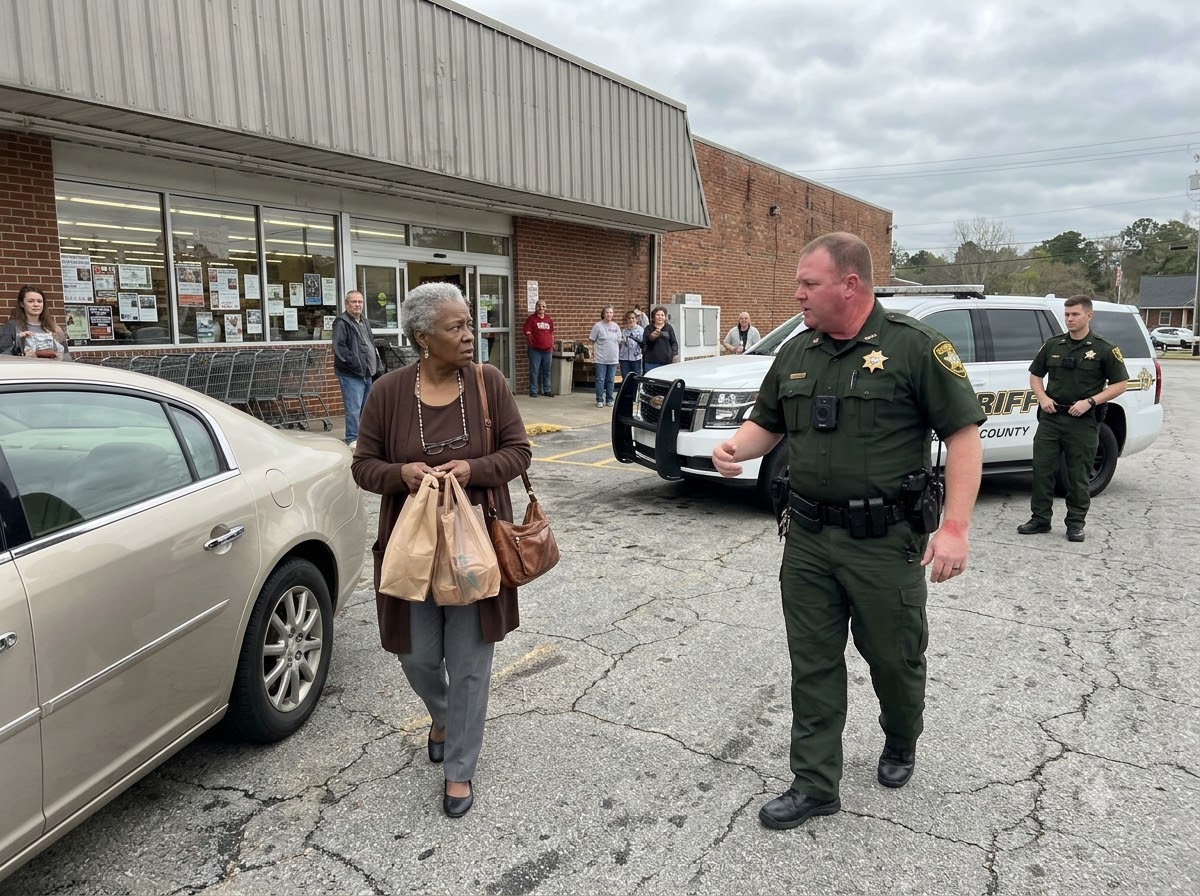
So she had stood at the teller window and watched a young man count out $6,800. And she had put it in her purse. And she had driven east with both hands on the wheel. She was doing 52 in a 55 when she saw the lights. A white Ford Explorer with a green stripe down the side and a light bar on top had been sitting in the median crossover just past the county line sign.
She’d noticed it the way you notice anything parked where it can watch you. Now it was behind her, close, and the lights were going, red and blue against the gray afternoon. Dolores put on her signal. She slowed. She pulled onto the shoulder, which was wide and graveled and littered with the shreds of old truck tires.
She put the car in park and turned off the engine and set both of her hands on top of the steering wheel where anyone walking up could see them. Her heart was going. She noticed that. She was a grown woman who had sat in courtrooms for 31 years and listened to men describe every terrible thing a person can do to another person, and her heart still went like that when a police car pulled up behind her on an empty road. Some things a body learns early and never unlearns.
Her fingers moved on the steering wheel, small movements, pressing, lifting, pressing again, in little clusters, the way a pianist’s fingers sometimes twitch when there’s music in the room. She didn’t notice she was doing it. She had done it for most of her adult life. In the side mirror, she watched the deputy get out. He was a big man, early 40s, with a sunburned neck and a short haircut, and a belly that pushed at the bottom of his uniform shirt.
He put on his hat before he walked up. He didn’t hurry. He came along the passenger side, which surprised her, and tapped on that window with one knuckle. She leaned over and pressed the button, and the window slid down. “Afternoon, ma’am,” he said.
His voice was friendly, not the voice she’d braced for. It was slow and warm and Georgia all the way through, the voice of a man who might ask after your mother. “Deputy Corbin, Colquitt County Sheriff’s Office. How you doing today?” “I’m all right,” Delores said. “May I ask why you stopped me?” “Yes, ma’am.
Noticed your tag light was out back there.” Delores looked at him. It was 3:50 in the afternoon. The sun, wherever it was behind those clouds, was still well up. “My tag light,” she said. “Yes, ma’am.



