Chapter 1 – The Missing Hours
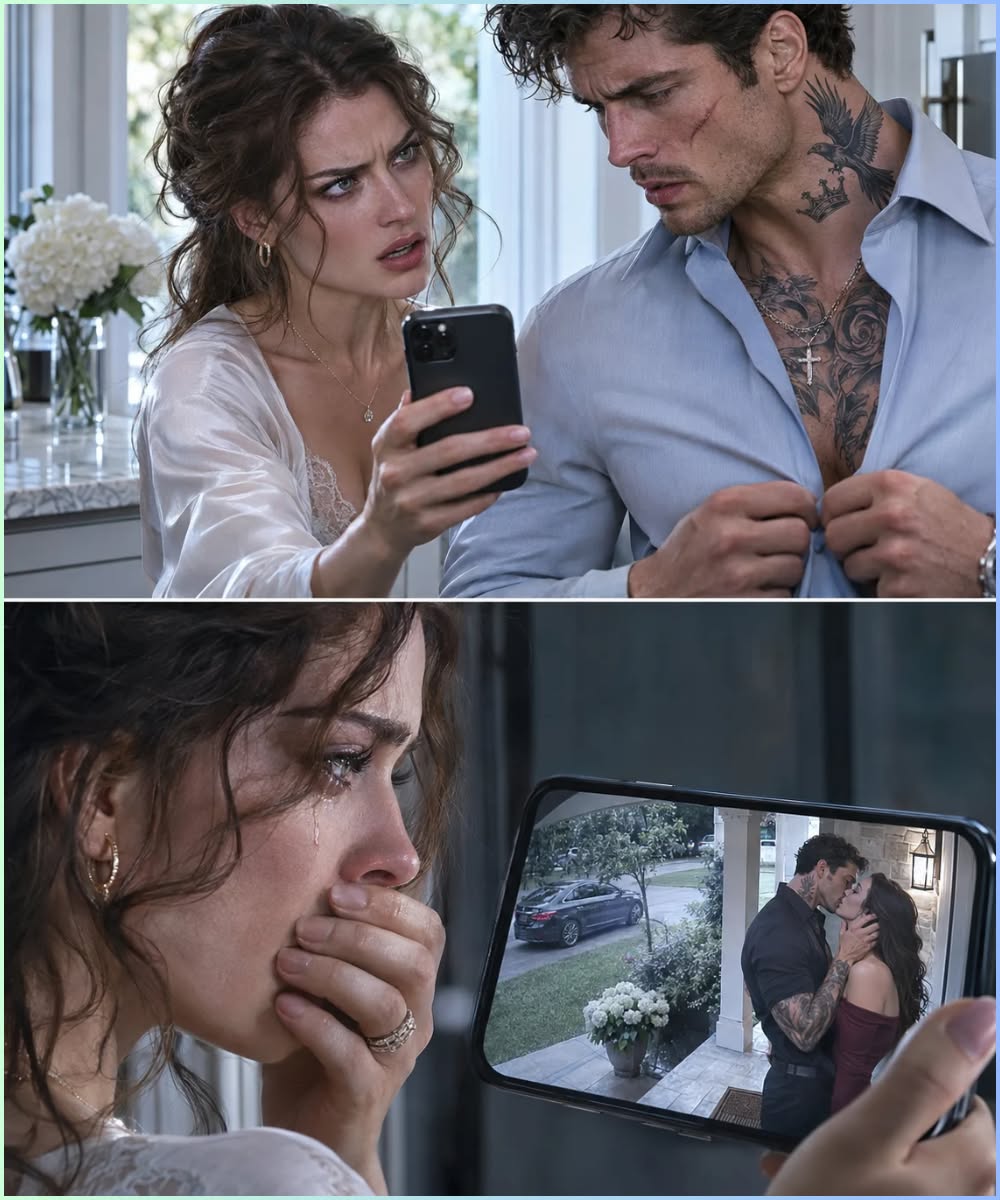
At 7:08 on a Sunday morning, while my husband stood six feet away from me buttoning the pale blue shirt I had bought him for our anniversary, I discovered that he had been deleting pieces of our life.
Not random pieces.
Sundays.
Every Sunday for almost two months.
Twenty-six doorbell recordings had vanished from the hours when I was volunteering across town.
I stared at the activity log on my phone until the words blurred.
RECORDING REMOVED BY LUKE HALSTEAD.
Seven Sundays.
Seven mornings when Luke had kissed my forehead before we left the house.
Seven mornings when he had smiled from the driver’s seat and told me he would see me after my shift.
Seven mornings erased.
“Why are you deleting our doorbell videos?”
Luke’s hand stopped halfway to his collar.
For a second, nothing moved except the ceiling fan above us.
Then he looked at me through the kitchen doorway.
“What videos?”
I had been married to Luke for nine years.
I knew the face he made when he didn’t understand something.
This wasn’t it.
This was the face he made when he needed three more seconds.
I turned the phone toward him.
“These.”
His eyes flicked toward the screen, then back to me.
“Oh.”
That one syllable frightened me more than denial would have.
“Oh?”
“I clean out the camera storage sometimes.”
“No, you don’t.”
His mouth tightened.
“Erin, it’s a doorbell app. I’m not keeping a diary.”
“Neither am I.”
I scrolled.
“Monday is here. Tuesday is here. Saturday is here. I have a three-minute clip of a squirrel attacking the welcome mat. But almost every Sunday between ten and one is gone.”
Luke reached for the coffee pot.
“We’ll be late.”
I almost laughed.
That was the moment something shifted inside me.
Not because I knew what he had done.
I didn’t.
But because I understood that my husband was standing in front of a specific question and trying to walk around it.
“Then we’ll be late.”
Luke poured coffee.
“You do this sometimes.”
“Do what?”
“You find a pattern and immediately decide it means something.”
I worked for the county records office. Most of my days were spent correcting dates, verifying property documents, and making sure old records were labeled accurately enough that someone could rely on them twenty years later.
Luke used to tease me about it.
He once told friends at dinner that I could detect a wrong date from across a football field.
I had thought it was affectionate.
That morning, he turned the same thing into a defect.
“I’m not deciding anything,” I said. “I’m asking why you deleted twenty-six clips.”
“I don’t remember deleting twenty-six clips.”
“The account remembers.”
He exhaled slowly.
“Can we not make our entire Sunday about this?”
I looked at him.
“You already did.”
He didn’t answer.
The only reason I had opened the camera archive at all was because our neighbor, Mrs. Leighton, had called the night before. A delivery truck had clipped the wooden post beside her mailbox, and she wondered whether our camera might have caught the vehicle.
We had installed the system two winters earlier after packages disappeared from our porch.
Luke had chosen the model.
Luke had created the account.
Luke had insisted I be added as an administrator.
“Shared house, shared access,” he’d said.
At the time, I had kissed him for saying it.
Now I stood in that same kitchen wondering how long shared access had existed only because he assumed I would never use it.
We drove separately that morning.
That wasn’t normal.
Usually Luke drove me to Ridgeview Community Chapel, where I attended the early service and then spent three hours helping with the weekend food program. Luke had told me that he stayed for the later service and helped with facilities afterward.
But when I reached for the passenger door, he said he had an errand first.
“What errand?”
He paused.
“Work thing.”
“On Sunday morning?”
“Refrigeration doesn’t observe the Sabbath.”
Normally I would have smiled. Luke owned a small commercial cooling company, and broken restaurant freezers had interrupted more than one holiday dinner.
That morning, the joke landed dead between us.
“I’ll see you later,” he said.
“When?”
“When you’re finished.”
“My shift ends at one.”
“I know.”
He leaned toward me as if he expected a kiss.
I stepped back.
His face changed.
Only slightly.
But I saw it.
For the first time in nine years, Luke looked at me as though he had just realized ordinary affection was no longer guaranteed.
I drove away.
During the service, I remembered almost nothing that was said.
My mind kept returning to the deletion log.
It wasn’t proof of an affair.
I knew that.
It wasn’t proof of anything except deletion.
But the problem with a missing record is that the absence becomes a fact of its own.
At the food pantry after the service, I discovered another one.
My name was on the volunteer board until two o’clock.
I stared at it.
My regular shift ended at one.
A coordinator named Dana Pierce had apparently changed it earlier in the week because of an expected grocery donation.
I vaguely remembered her mentioning that deliveries had been unpredictable lately.
Ordinarily, I would have stayed without thinking twice.
I liked the work.
My father had died when I was twenty-two, and during the strange empty year afterward, helping people had given my days edges again. Put six cans in a bag. Label an allergy. Carry a box to someone’s trunk. Small tasks could not cure grief, but they could keep it from swallowing an entire afternoon.
Luke knew that.
He had always said he admired it.
At 1:35, no delivery had appeared.
At 1:50, Dana sent a text saying the donor had rescheduled.
Sorry! Thanks for being flexible.
I read it twice.
Then Luke called.
“Still there?”
“Yes.”
“Thought you were done at two.”
I gripped the phone.
“How did you know that?”
A pause.