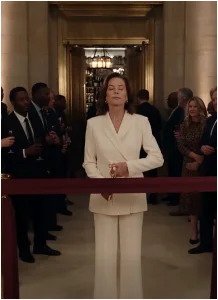
Across the cabin, Tessa clapped a hand over her mouth in horror.
“If you die of apparent natural cardiac failure while married to Graham,” Jonah breathed from Philadelphia, “the survivorship clause in your late father’s estate bypasses the divorce prenup entirely and hands Graham one hundred percent of Kensington Biomedical’s sixty-million-dollar voting stock!”
“And because you shocked them by leaving town six days early and filing for divorce this morning, they’re trying to use the toxin symptoms already in your bloodstream to have a judge lock you in a psychiatric ward before the drug metabolizes out of your system!”
“Tessa, have the pilot request priority medical clearance into San Francisco International right now,” I ordered, my voice turning to solid steel.
When our Gulfstream touched down on the tarmac at SFO forty minutes later, a black armored Escalade belonging to my West Coast security director—former federal marshal Liam Ross—was already waiting beside the hangar stairs.
Liam had worked for my late father for ten years before heading up my corporate protection division, and as he helped me down the steps into the crisp California wind, his sharp gray eyes took one look at my pale face and went lethal.
“The private toxicology lab at UCSF Medical Center is cleared and waiting for us on the fourth floor, Claire,” Liam said, holding the door open for Tessa and me.
Thirty minutes later, inside a secure private examination suite at UCSF, the chief of clinical toxicology, Dr. Elena Chen, walked back into the room holding a mass-spectrometry printout with a look of grave shock on her face.
“Miss Sterling, whoever has been preparing your food or linens wasn’t trying to calm your nerves,” Dr. Chen said grimly, pointing to a spiked peak on the graph.
“Your blood contains trace levels of oleandrin combined with a synthetic slow-release calcium-channel blocker that only exists inside research-grade cardiac pharmacology labs.”
“Another ten days of exposure at home would have triggered an irreversible ventricular fibrillation in your sleep that any routine autopsy would have signed off as sudden adult cardiac death.”
A cold shudder ran through my body—if I hadn’t seen Graham eat off Mara’s fork on Tuesday night and walked out when I did, I would have been in a coffin before Thanksgiving.
Suddenly, Liam Ross stepped into the exam room doorway, his hand resting near the tactical holster beneath his suit jacket as he looked at the security monitor in the hall.
Chapter 3 – The Trap in Ward Four
Through the narrow frosted glass panel of the examination room door, I heard the unmistakable sound of my husband’s polished, authoritative voice speaking to the floor nurses down the hall.
“Thank you, Nurse—my wife Claire has been refusing her cardiac medication during a severe manic episode, and Judge Reynolds in Philadelphia issued this emergency interstate guardianship writ so I can bring her safely home,” Graham said smoothly.
My stomach twisted into a violent knot.
Twelve hours ago, this man had spent his thirty-sixth birthday night in his ex-girlfriend’s bed while waiting for a slow-release poison on my pillowcase to stop my heart.
And now he had flown across the country to drag me back into that house in handcuffs under the guise of a loving, heartbroken physician!
“If the local deputies execute that interstate hold before a California judge hears our challenge, Graham gets physical control of your medical care for seventy-two hours,” Jonah Price warned through my earpiece from Philadelphia.
“Seventy-two hours in Graham’s custody is a death sentence,” Liam Ross said quietly, stepping between me and the door like a wall of iron.
“Dr. Chen, does this toxicology wing have a restricted bio-containment airlock?” I asked rapidly, my mind working with the precision that had built Kensington Biomedical into an industry titan.
Dr. Elena Chen nodded instantly, her eyes blazing with professional outrage at the man trying to abduct her patient.
“Better than that, Miss Sterling—you’re standing inside the University’s Federal Clinical Research Unit, which operates under a grant from Kensington Biomedical.”
Just as Graham, two uniformed sheriff’s deputies, and Graham’s arrogant younger brother Victor Vale—a sleek corporate lawyer who handled the family’s dirty work—pushed open the outer corridor doors of the unit, I didn’t run out the back elevator.
Instead, I stepped out into the center of the gleaming white hallway alongside Dr. Chen and Liam Ross, holding the stamped UCSF mass-spectrometry toxicology report in my hand.
Graham stopped dead in his tracks when he saw me standing tall, calm, and completely lucid in my tailored navy travel suit.
For a fraction of a second, the mask of the grieving, worried husband slipped, revealing the desperate fury of a man who had just realized his sixty-million-dollar meal ticket had cut his strings.
“Claire, sweetheart, thank God we found you,” Graham said, taking a step toward me with his hands outstretched as if to embrace me in front of the deputies.
“You forgot to take your arrhythmia stabilizer before getting on the plane, and your blood pressure is causing delusions—let the deputies help you to the ambulance so we can go home.”
“Take one more step toward me, Graham, and it will be the last thing you ever do outside a federal prison cell,” I said, my voice ringing clear and cold down the hospital corridor.
The senior sheriff’s deputy frowned, holding up the Pennsylvania faxed order.
“Ma’am, Dr. Vale has a signed medical incompetency petition from Philadelphia stating you are suffering from cognitive impairment and refusing cardiac care,” the deputy said.
Before I could speak, Dr. Elena Chen stepped squarely in front of the deputy and handed him a gold-sealed UCSF clinical certification alongside my blood toxicology results.
“Deputy, I am the Chief of Toxicology at UCSF and a court-certified forensic examiner for the State of California,” Dr. Chen announced sharply.
“Twenty minutes ago, three independent board-certified psychiatrists and neurologists on my staff examined Claire Sterling and certified that she possesses one hundred percent cognitive capacity.”