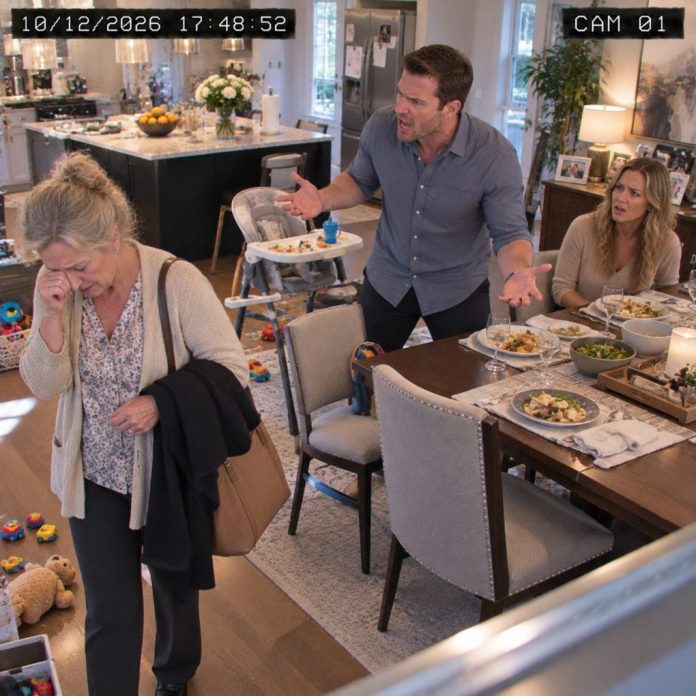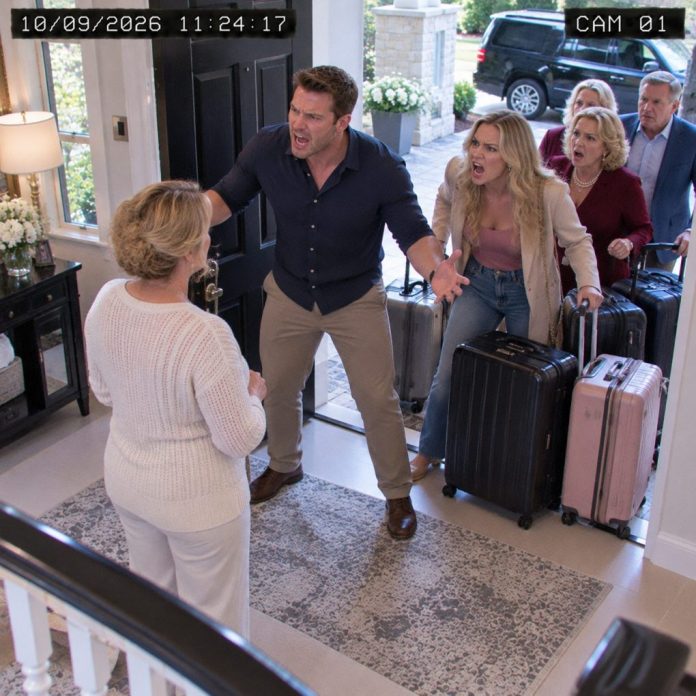
He arrived with his wife, Vanessa, and her mother, who was already asking whether the upstairs guest suite had a walk-in closet. Vanessa talked about opening the kitchen, replacing the staircase, and “making the house work for all of us.” My son, Caleb, stood behind them, smiling as if we’d simply missed a few holidays.
I hadn’t seen him since he walked away from our family restoration business after his father died. I’d called for years. At first, he didn’t answer. Later, he changed his number. Eventually, I stopped trying—not because I stopped loving him, but because he had made his choice clear.
Now he was back because a local business journal had published the sale price.
“I’m glad you’re doing well, Mom,” he said, while his wife’s mother measured the guest-room doorway with her eyes. “We should talk about what happens next.”
“What happens next for whom?” I asked.
Vanessa laughed lightly. “We’re family. We’re just trying to plan. Caleb said the company was always supposed to stay in the family.”
That was not what the papers said. Thirteen years earlier, Caleb had chosen to leave the company. He sold his fifteen-percent ownership share to me in a formal buyout, took the payment, and signed the agreement in front of his own attorney. I had kept the paperwork because I kept every important document.
“I’m not discussing the sale in my doorway,” I said. “Come with me. We’ll talk at my attorney’s office.”
Caleb’s expression tightened, but he followed. His wife and her mother came too, carrying a folder of renovation sketches. They seemed to think the meeting would be about how much of my money I planned to give them.
At the office, my attorney, Martin Shaw, greeted us and asked everyone to sit. He had handled the company’s records since before Caleb left. Vanessa placed her sketches on the table and began describing the changes she wanted to make to my house.
Martin didn’t look at them. He opened a file and slid one document across the table toward Caleb.
“This is the agreement you signed when you left the company,” he said.
Caleb glanced at the first page. Then he saw his signature beneath the words full and final sale of membership interest. His smile disappeared.
Vanessa leaned over his shoulder. Her mother stopped talking about the guest suite.
Caleb looked up at me. “You kept this?”
“I kept the truth,” I said.
Martin opened a second folder. “There’s something else you should understand before anyone makes plans around your mother’s money.”
Caleb stared at the agreement as if the ink might change if he kept looking. Martin turned to the signature page and pointed out the date, the purchase amount, and the clause stating that Caleb had no remaining ownership interest in the company.
“I thought this was temporary,” Caleb said.
“You had your own attorney,” Martin replied. “The agreement says you sold your share outright. The payment cleared the next day.”
Caleb rubbed his thumb along the edge of the paper. I remembered that day vividly. He’d been twenty-eight, angry that I wanted to keep the company running after his father’s death. He wanted to move west and start over. I bought his share because I wanted him to leave freely, not feel trapped by a business he no longer loved.
“I didn’t know you’d sell it for that much,” he said.
“You didn’t ask about the company for thirteen years,” I answered. “You didn’t call when I sent Christmas cards or when I had surgery. You didn’t ask whether we kept the doors open.”
Vanessa leaned forward. “But he’s your son. Surely that means something.”
“It means I love him,” I said. “It doesn’t mean he owns what I built after he left.”
Martin explained that the $4.2 million was the company’s sale price, not a check made out to Caleb. After taxes, legal costs, and the final employee payouts, the amount I received was smaller. It was still enough to change my life, but it was mine to manage.
Vanessa’s mother folded her hands. “We weren’t asking for all of it. We just thought the family should have a voice in the house.”
I looked at the renovation sketches. “You have a voice in your own home. This one is mine.”
Caleb finally met my eyes. “I came because I thought there might be a future for us. I didn’t know you’d already decided everything.”
“I decided nothing about us,” I said. “But you arrived discussing renovations before asking how I felt about seeing you again.”
That quieted him. For the first time since he’d walked through my front door, no one was talking about a guest suite or a financial plan.
Martin set the signed agreement aside and asked whether we wanted to continue the meeting. I said I had one question for Caleb. “Why now?”
He admitted that he’d seen the article and wondered whether he’d made a mistake leaving. Vanessa had encouraged him to reach out. They were behind on their mortgage, and her mother’s lease was ending. They believed my sale had created an opportunity for everyone.
“Did you miss me,” I asked, “or did you miss what you thought I could give you?”
Caleb’s face reddened. He started to answer, then stopped. Vanessa gathered the sketches. Her mother stood without a word.
Martin closed the file. “No one is being asked to decide anything today,” he said. “This office is here to clarify the documents, not distribute an inheritance.”
I watched my son stare at the paper bearing his own signature. The money had brought him back to my door. Whether he could stay in my life would depend on what he did after he left it.
Caleb left the office with the agreement folded in his coat pocket. Vanessa and her mother walked ahead of him. At the curb, he paused and looked back at me, but I didn’t chase after him. I’d done enough chasing for one lifetime.