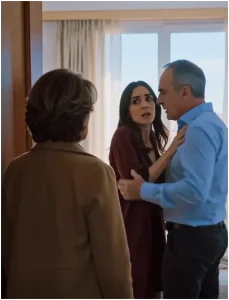
“Domestic dispute,” Vivian repeated.
Marcus finally looked at her.
“You know what I mean.”
“No. Say it.”
One of the investors looked down at the table.
Marcus exhaled.
“My relationship with Celeste is irrelevant to whether I’m capable of running this company.”
Celeste remained very still.
Vivian noticed the word relationship.
Not mistake.
Not affair.
Something established.
“Your relationship with Celeste is relevant if company resources were used to support it.”
Marcus smiled.
“There it is.”
“What?”
“The rich-wife revenge fantasy.”
Vivian sat back.
“You seem very interested in telling everyone what kind of woman I am.”
“I spent twelve years building this.”
“And?”
“And you don’t get to walk in because your feelings are hurt and pretend writing checks makes you a restaurateur.”
Vivian looked around the table.
Nobody interrupted.
Marcus mistook that for support.
He leaned forward.
“You funded it. Fine. I’ll say it publicly if that’s what you need. But I made it valuable.”
Vivian considered him.
There had been years when those words would have hurt her.
Now they mostly made her tired.
“I’ve never said you didn’t.”
Marcus faltered.
“You haven’t?”
“No.”
That answer seemed to bother him more than accusation would have.
Vivian continued.
“You built a great deal here. The question is whether you’ve begun treating the company’s money as if it belongs to you personally.”
Marcus’s hand tightened around his pen.
Rachel noticed.
So did Vivian.
After the meeting, Celeste caught Marcus near the elevators.
Vivian had stepped into the hall to speak with Rachel and heard them before they saw her.
“Tell me she can’t actually remove you,” Celeste said.
Marcus pressed the elevator button twice.
“She can’t.”
“She owns control.”
“On paper.”
Celeste lowered her voice.
“You said the restructuring would put you over fifty.”
“It will.”
“When?”
Marcus turned sharply.
“Can we not do this here?”
Vivian stopped walking.
The elevator opened.
Marcus and Celeste entered without noticing her.
Rachel came up beside Vivian.
“What restructuring?”
Vivian watched the doors close.
“I don’t know.”
That afternoon, she authorized a routine governance and expense review.
By six, Graham called.
“Vivian.”
His voice had changed.
“What is it?”
“We found the expansion facility Marcus signed last month.”
“How much?”
He told her.
Vivian stopped writing.
“He can’t approve that amount alone.”
“I know.”
“Who signed for Celeste’s consulting company?”
A pause.
“Marcus.”
Vivian looked toward the window of her office.
Below, traffic moved down Park Avenue exactly as it always did.
“Send me everything.”
Chapter 4 – What He Spent
The expenses were not dramatic enough to make good television.
That was what made them worse.
No offshore accounts.
No suitcases of cash.
No secret yacht.
There were hotel suites in Chicago and Miami coded as development travel.
There were dinners for two entered as investor cultivation when the named investors had not attended.
There was an apartment in SoHo leased through a subsidiary as a temporary residence for visiting creative talent.
Celeste had been living there for nine months.
Then came the consulting agreements.
Her outside design company had received payments beyond her Caven salary for brand work that should have been part of her job. Marcus had signed every approval.
Rachel placed copies across Vivian’s dining table on Sunday afternoon.
Vivian had asked to meet at home rather than at the office because she was tired of glass conference rooms.
Marcus’s shoes were still by the mudroom door.
He had not returned since the opening.
Vivian had not moved them.
“Can we prove fraud?” she asked.
Rachel took off her glasses.
“I wouldn’t use that word yet.”
“Good.”
“You don’t want fraud?”
“I don’t want a bigger accusation because it sounds better.”
Rachel nodded.
“What we have is sufficient. Undisclosed related-party transactions. Personal use of company resources. Potential breach of fiduciary duty. The expansion financing is another problem.”
Vivian picked up the loan package.
Marcus had committed the company to a hotel project in Los Angeles.
The numbers were ambitious even by his standards.
“He planned to do this without telling me.”
“He appears to have planned to present it after signing.”
“He thought momentum would force approval.”
“Probably.”
Vivian knew that habit.
Marcus had proposed marriage the same way.
He had invited twenty friends to a rooftop dinner for her birthday, then dropped to one knee before dessert. Later, when she asked why he had done it in front of people when he knew she hated public attention, he kissed her forehead and said, Because you think too much when I give you time.
At twenty-nine, she had found that charming.
At fifty, she heard the warning inside it.
Graham arrived with another box.
“I brought personnel records.”
Vivian looked at him.
“Why?”
“Because if you’re removing Marcus, you need to know what happens after.”
That was the first useful question anyone had asked all weekend.
Marcus had made himself central to everything.
Supplier relationships.
Chef recruitment.
Press.
Expansion.
Senior hiring.
Even the company holiday party.
If Vivian tore him out carelessly, employees who had done nothing wrong would pay for his mistakes.
She spent Sunday evening separating Marcus the husband from Marcus the executive.
The exercise proved harder than she expected.
At ten-thirty, Rachel ordered food.
At eleven, Graham fell asleep for twelve minutes in an armchair and denied it when he woke.
Vivian found a photograph while searching a desk drawer for an old operating agreement.
Marcus was thirty-eight in the picture.
She was standing beside him in the shell of their first restaurant, both wearing construction helmets. Marcus had drywall dust on his sweater.
Vivian remembered that day.
The plumbing contractor had quit.
Marcus had been furious. Vivian had sat on an overturned bucket eating takeout noodles while he called six replacements.
At some point he had looked at her and said, “This is insane.”
She had answered, “Probably.”
He laughed.
That laugh had been real.
She slipped the photograph back into the drawer.
Graham woke fully and came over.
“You okay?”
“Yes.”
He did not pretend to believe her.