Chapter 1: THE BOY WHO REFUSED TO BREAK
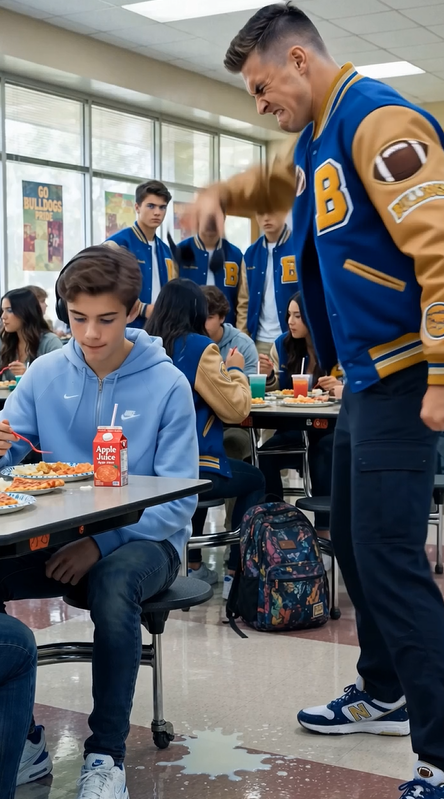
The first sound was my lunch tray striking the cafeteria floor. But what stayed with me long afterward wasn’t the crash. It was the laughter of thirty children—and the sight of a teacher deliberately turning his back while I stood there being humiliated.
Slices of apple scattered across the gray linoleum. A plastic carton of milk rolled beneath a nearby table, leaving a narrow white trail behind it. My worn canvas backpack slid several feet across the floor before one of its straps caught against the metal leg of a chair.
Standing directly in front of me was Damon Vance.
He was smiling.
Damon was larger than nearly everyone else in our grade. He had broad shoulders, expensive sneakers, and the effortless arrogance of someone who had learned that adults would excuse almost anything he did.
I was only ten years old. My gray hoodie had faded from countless washings, and the shoes on my feet had come from a secondhand store where my mother shopped when money was tight.
For months, I had tried to stay out of Damon’s way.
That afternoon, I had finally reached my limit.
“Pick it up,” Damon whispered, leaning close enough that only I could hear him.
“Get down on your hands and knees, scholarship. While you’re down there, you can clean my shoes.”
Behind him, his friends arranged themselves in a loose semicircle, blocking the narrow space between the cafeteria’s metal garbage containers and the entrance to the kitchen.
Trent and Kevin stood among them, grinning.
Two eighth-graders held their phones at chest height, recording everything.
They were expecting another entertaining afternoon at my expense.
For months, that was what I had given them.
Silence.
Apologies.
The spectacle of a smaller boy collecting his damaged belongings while everyone around him pretended not to notice.
But this time, I looked toward the cafeteria entrance.
Mr. Henderson was standing beside the open double doors.
He glanced at Damon.
Then he looked directly at me.
Our eyes met briefly, and I could tell he understood exactly what was happening.
He turned away and walked out.
Something inside me shifted.
I stepped onto a dry section of the floor, positioned my feet firmly beneath me, lowered my chin, and raised both hands.
Damon noticed immediately.
His smile grew wider.
“Oh, look at that,” he announced. “The little charity case thinks he can fight.”
Several students burst into laughter.
I didn’t say anything.
Damon moved another step closer. When I refused to lower my hands, irritation began replacing the amusement on his face.
“You really want to do this?”
I remained silent.
He drew back his right arm and launched a heavy, sweeping punch toward my face.
I didn’t flinch.
I didn’t turn away.
And in that fraction of a second before his fist reached me, I remembered something a seventy-one-year-old retired Marine had spent three years teaching me.
A fight isn’t determined by whoever strikes first.
It’s determined by whoever refuses to surrender control.
But to understand why I was standing in that cafeteria, surrounded by thirty laughing students, you need to understand what Damon had been doing long before that afternoon.
Because his cruelty hadn’t begun with a punch.
It had begun when he discovered how much Oak Ridge Middle School was willing to overlook.
I had arrived at Oak Ridge at the beginning of September after receiving an academic transfer voucher.
The school stood in the wealthy northern part of the county, surrounded by carefully maintained lawns, decorative brick buildings, and expensive homes concealed behind tall hedges.
Everything about the campus seemed intended to remind visitors that money mattered.
Polished brass plaques near the entrance displayed the names of generous donors. The athletic building had recently been renovated, and each morning, luxury SUVs filled the circular driveway as parents dropped off children carrying designer backpacks and wearing sneakers worth more than my mother’s weekly grocery allowance.
The neighborhood where I lived couldn’t have been more different.
Our apartment was beyond the old railroad yards, where abandoned industrial buildings stood behind chain-link fences and streets flooded whenever heavy rain overwhelmed the drainage system.
Our building was aging. The lights in the stairwell flickered, and the heating pipes knocked loudly throughout the winter.
My mother worked overnight shifts at a convalescent home.
Before taking that job, she had spent long days at a municipal laundry, standing beside enormous industrial washing machines until her hands became painfully red and cracked.
She never complained about how hard she worked.
The only thing she complained about was when she suspected I hadn’t eaten enough.
When the district approved my transfer to Oak Ridge, she sat at our kitchen table holding the acceptance letter and crying.
“You’re getting an opportunity I never had,” she told me, gripping the paper tightly. “Promise me you’ll make the most of it.”
“I promise.”
“And don’t worry about trying to fit in with the rich kids. Just be yourself.”
I nodded.
Neither of us realized how difficult keeping that promise would become.
On my first morning at Oak Ridge, I entered the administrative office wearing my old gray zip-up hoodie. Years of washing had left its cuffs badly frayed.
The backpack hanging from my shoulder had once belonged to an older cousin. A faded iron-on patch covered a tear near its side pocket.
The attendance clerk handed me a blue transfer voucher slip.
Standing beside the counter was Damon Vance.
He was waiting for a late pass, apparently because his father had already called the school to explain why he was arriving late.
Damon glanced at the blue slip in my hand.
His gaze slowly traveled downward toward my worn sneakers.
He didn’t speak.
He simply studied me through pale blue eyes, as though trying to calculate how easily I could be intimidated.
At first, I assumed he was curious about the new student.
Three days later, I understood the difference between curiosity and choosing a victim.