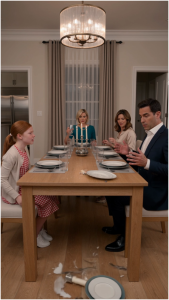
When I entered the courtroom, everyone noticed.
The prosecutor smiled.
He thought it made me look foolish.
Weak.
Emotional.
He didn’t understand.
The heart was the only honest thing in that room.
The prosecutor called his next witness.
A neighbor.
A woman named Linda.
She lived across the street from us.
She told the jury she had heard shouting the night of the incident.
The prosecutor walked toward her.
“Mrs. Hayes, did you hear the defendant yelling?””
“Yes.””
“What did he sound like?””
“Angry.””
The prosecutor turned toward the jury.
“And were you afraid?””
Linda hesitated.
“Yes.””
My lawyer stood.
“Mrs. Hayes, how long have you known my client?””
“About six years.””
“Did you ever see him hurt his wife?””
“No.””
“Did you ever see him threaten his daughter?””
“No.””
“Did you ever see him be violent toward anyone?””
She paused.
“No.””
The prosecutor objected.
“Relevance.””
The judge allowed the question.
My lawyer continued.
“Then why did you assume my client was dangerous?””
Linda looked uncomfortable.
“Because of what happened that night.””
“Or because of what you saw?””
She didn’t answer.
Everyone understood.
Assumptions were easier than truth.
After lunch, Sarah testified.
That was the moment I feared most.
She walked to the witness stand.
She placed her hand on the Bible.
And she promised to tell the truth.
I almost laughed.
Not because it was funny.
Because I wondered if she remembered what truth meant.
The prosecutor began gently.
“Mrs. Carter, tell the court about your relationship with the defendant.””
Sarah looked at me.
“We were married for seven years.””
“And how would you describe the marriage?””
She swallowed.
“Difficult.””
The prosecutor nodded sympathetically.
“Why?””
Sarah looked down.
“Michael had anger issues.””
The words hit me.
Even though I expected them.
Even though I prepared for them.
They still hurt.
The prosecutor asked about my tattoos.
About my past.
About every mistake I had ever made.
Then he asked the question he had been waiting for.
“Mrs. Carter, do you believe your husband is capable of hurting someone?””
Sarah looked directly at the jury.
“Yes.””
The courtroom was silent.
I felt something inside me collapse.
Not because strangers believed it.
Because Emily was sitting behind her mother.
Listening.
Watching.
Learning.
My lawyer stood for cross-examination.
“Mrs. Carter, you said my client has anger issues.””
“Yes.””
“Can you tell this court the last time he became violent with you?””
Sarah hesitated.
“I don’t remember.””
“You don’t remember?””
“No.””
“Isn’t it true that you never reported any violence during your marriage?””
She looked uncomfortable.
“I was afraid.””
“Afraid for seven years?””
“Yes.””
My lawyer walked slowly.
“Then why did you stay?””
Sarah looked at him.
Then at me.
“I wanted to protect my daughter.””
The courtroom reacted.
My lawyer let the silence sit.
Then he asked:
“Protect her from what?””
Sarah opened her mouth.
But no answer came.
For the first time, she looked uncertain.
Just for a second.
But I saw it.
The prosecutor noticed too.
He quickly objected.
The judge moved on.
But something had shifted.
A crack.
A tiny crack in the story Sarah had created.
And cracks become dangerous.
Because once people start questioning one piece of a lie, they start questioning everything.
That evening, as I was being taken back to my cell, an officer stopped me.
“Michael.””
I looked up.
“What?””
He handed me an envelope.
“Someone left this for you.””
I stared at it.
“Who?””
He didn’t answer.
I opened it carefully.
Inside was a single photograph.
My blood ran cold.
It was Emily.
Standing outside our house.
Holding a piece of paper.
On the back of the photo, someone had written six words.
Chapter 4: The Secret My Daughter Was Too Afraid to Tell
I stared at the photograph for what felt like an hour.
But it had only been a few seconds.
The officer stood there waiting.
“Everything okay?””
No.
Nothing was okay.
Because the picture in my hand wasn’t just a picture.
It was a warning.
Emily was standing outside our house, wearing her pink jacket, holding a piece of paper against her chest.
Her expression wasn’t the happy expression I knew so well.
She looked scared.
Terrified.
And someone wanted me to know that she knew something.
Something about that night.
“Who gave you this?”” I asked.
The officer shrugged.
“Came through the front desk. No name.””
“Was anyone else with it?””
“No.””
I looked down at the photograph again.
My hands trembled.
For six months, everyone had been telling me the same thing.
That I was the problem.
That I was dangerous.
That Sarah and Emily needed protection from me.
But now someone was saying the opposite.
Someone was saying my daughter knew the truth.
The officer noticed my expression.
“You want me to call your attorney?””
I quickly folded the picture.
“No.””
“Are you sure?””
I looked at him.
For the first time in months, I felt something I had almost forgotten.
Hope.
“No,” I said quietly.
“I’m not sure about anything anymore.””
That night in my cell, I couldn’t sleep.
Every time I closed my eyes, I saw Emily walking toward me in the courtroom.
The little red heart.
Her tiny hand holding the marker.
Her voice saying, “Now everybody can see you’re a good daddy.””
I kept thinking about the way she looked at Sarah afterward.
Not angry.
Not rebellious.
Afraid.
A five-year-old shouldn’t look afraid of telling the truth.
Children are supposed to be afraid of monsters under their beds.
Not afraid of the people they love.
The next morning, my attorney, Daniel, arrived earlier than usual.
The second he walked into the room, I knew something was different.
“What happened?”” I asked.
He placed a folder on the table.
“We need to talk.””
“That’s never a good sentence.””
He didn’t smile.
“Who sent you this?””
He placed the photograph in front of him.
My stomach tightened.
“You know about it?””
“Yes.””