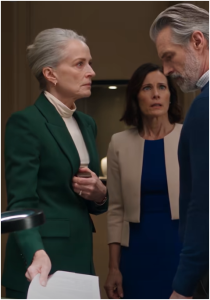
“I believe Denise Whitmore’s father was involved.””
Jada inhaled sharply.
“Her father?””
“Richard Whitmore was board chair at the time. He was also one of the people negotiating the refinancing agreement.””
I remembered Denise’s voice in my apartment, smooth and impatient.
The institution cannot be expected to carry every personal burden attached to its history.
At the time, I’d thought she was talking about the school’s finances.
Now I wondered whether she had been talking about me.
Coleman continued.
“Richard argued that the school needed freedom to redevelop the east wing and adjoining land. Your husband’s trust restricted certain uses. The original arrangement was designed to preserve the property for education, not to make it available for private development.””
Jada looked at me.
“Was the school going to sell part of the campus?””
“Not according to what they told me,” I said.
Coleman lowered his eyes.
“They were considering a development proposal.””
The parking lot seemed to tilt.
“What kind of development?””
“A private medical and residential complex. The plan would have replaced the old east wing and used part of the adjoining parcel for commercial purposes.””
“But the scholarship fund—”
“Was supposed to remain protected,” he said.
“That was one of the conditions your mother insisted upon.””
I stared at him.
“Then why was the fund never established?””
He swallowed.
“Because the final recorded documents did not include the clause requiring it.””
Jada’s mouth fell open.
“They removed it?””
“I cannot yet prove who physically altered the final submission. I can prove that the copy signed by your mother contained language that does not appear in the public record.””
“Then someone committed fraud,” Jada said.
“Potentially. But we need the original deed, the filing receipts, and the correspondence.””
I turned toward my truck.
The envelope.
For eleven years, it had sat inside my dresser, sealed with a strip of yellowed tape. I had moved it from one apartment to another, always telling myself that one day I’d open it when I had the strength to deal with whatever Daniel had left behind.
I had never imagined that it might be the one thing standing between the truth and another decade of lies.
“Come home with me,” I said to Coleman.
He nodded.
Jada climbed into the passenger seat.
During the drive, she stared through the window, watching the academy’s stone buildings disappear behind us.
“Did Dad know all of this?”” she asked.
“I don’t know how much he understood.””
“Did he know they might take the land?””
“I think he suspected something.””
“Then why didn’t he tell you?””
I gripped the steering wheel.
“He died before he could explain everything.””
She turned toward me.
“Mom, I’m sorry.””
“For what?””
“For being angry.””
I reached across the console and squeezed her hand.
“You have every right to be angry.””
“I’m angry at them.”” Her voice broke.
“I’m angry that you had to work so hard. I’m angry that you thought being poor meant you had to accept whatever people in expensive suits told you.””
I kept my eyes on the road.
“Sometimes, when you’re trying to survive, you learn to choose which battles you can afford.””
Jada looked down at the gold stole in her lap.
“Maybe today is the day we stop choosing the easy ones.””
When we reached our house, Coleman followed us inside.
The little two-bedroom home was quiet. The kitchen table still held a stack of unopened mail, and a pair of work gloves lay beside the sink. Jada’s childhood drawings remained pinned to the refrigerator, their colors faded by years of sunlight.
Coleman glanced around the room.
“I remember this house,” he said quietly.
“You came here once,” I replied.
“I came here twice.””
I turned toward him.
“What?””
His face drained of color.
“I visited before the signing, and I returned three weeks afterward.””
I remembered the first visit clearly. The second was only a blur: a knock at the door, a hurried conversation, and a man who had refused to meet my eyes.
“What did you want the second time?””
He looked down at the folder.
“I wanted to tell you the recording had been changed.””
My knees weakened.
“You knew?””
“I discovered the discrepancy after the filing was processed.””
“And you said nothing?””
“I was told the issue would be corrected internally. I believed that if I made a formal complaint, the school would collapse before the refinancing could be completed.””
I stared at him.
“So you let me believe everything was fine.””
“Yes.””
Jada stepped forward.
“You let my mother carry this for eleven years.””
Coleman’s eyes filled with tears.
“I know.””
“No, you don’t.”” Her voice sharpened.
“You got to go home. You got to sleep. You got to forget. She had to work two jobs while wondering why she never received the documents she was promised.””
He accepted every word without defending himself.
Then he placed the black folder on the kitchen table.
“I brought something else.””
He opened it and removed a sealed envelope with a faded signature across the front.
My breath caught.
It was the same envelope I’d seen Daniel carry into the bedroom shortly before his death.
The handwriting was unmistakable.
For Evelyn. Only to be opened if Westbridge denies the agreement.
I reached for it, but Coleman held it back for a moment.
“Before you open this,” he said, “there is something you should know. The original deed may not simply restore your rights. It may reveal that the property was transferred to the trust under conditions that were never disclosed to the school board.””
“What conditions?””
He looked at me with frightened eyes.
“That the school could remain on the land only as long as it served the children—not the financial interests of the people running it.””
Jada stared at the envelope.
“Then open it, Mom.””
My fingers trembled as I broke the seal.
Inside was a letter, a folded legal document, and a small photograph of Daniel standing beside a young woman in front of the old east wing.