Chapter 1
The first thing I heard was the laughter.
The second was my father trying not to cry.
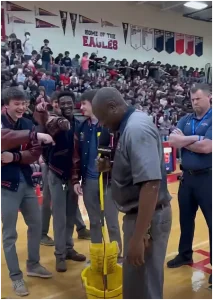
I was standing near the bleachers at Alder Creek High’s winter pep rally when Bradford Gentry, our school’s golden boy, lifted a yellow mop bucket over my dad’s head and dumped the entire thing.
Dirty water came crashing down over his gray uniform.
For a second, nobody moved.
Then the gym exploded.
Hundreds of students laughed. Someone screamed, “Do it again!” Phones shot into the air, recording every second. A few basketball players slapped the bleachers, laughing so hard they could barely stand.
And my father, Eugene Merritt, stood there with filthy water dripping from his hair, his collar, and his sleeves.
He was forty-six years old.
He had worked at Alder Creek High for eleven years, cleaning classrooms, fixing broken lockers, and staying late whenever the school needed him.
He knew which teachers liked their floors waxed twice a week. He knew which students left their lunches in the cafeteria. He even knew how to fix the gym’s ancient heating system.
But to Bradford Gentry, my father was just a janitor.
And apparently, that made him an acceptable target.
“OH, COME ON!” Bradford shouted, throwing his arms into the air. “It’s just a little water!”
The crowd roared.
Bradford stood in the middle of the gym wearing his expensive blue-and-white basketball jacket. His perfectly styled hair hadn’t moved. His white sneakers looked like they had never touched a dirty floor.
He was seventeen, the team’s starting point guard, and the kind of kid teachers called by his first name even when he was in trouble.
His father owned several car dealerships around town. His mother chaired the school’s athletic fundraising committee.
Bradford had never waited for anyone to give him permission to feel important.
He simply expected everyone to treat him that way.
I pushed through the students.
“Dad!”
He turned toward me.
Water ran down his face. His shirt was soaked through, and a dark puddle was spreading around his shoes.
But the first thing he did wasn’t wipe his face.
He looked at me and gave me a small, reassuring smile.
“I’m all right, Russ.”
He wasn’t.
His hands were shaking.
I reached for his shoulder, but he instinctively stepped back, probably worried his dirty uniform would get my clothes wet.
That nearly broke me.
“Bradford, what is wrong with you?” I shouted.
Bradford looked at me as if he’d just noticed a stray dog wandering onto the court.
“Well, look who showed up.”
His teammates laughed.
“Russell Merritt,” he announced, spreading his arms. “Everybody, make some noise for the janitor’s kid!”
A few students actually booed.
I glanced toward the bleachers, hoping one of the teachers would intervene.
Coach Stanley Pemberton stood beside the basketball team’s bench, wearing his blue whistle lanyard. He was forty-four, with a reputation for turning ordinary players into championship athletes.
He had watched the entire thing.
He hadn’t moved.
Instead, he gave Bradford a look that seemed almost amused.
“Bradford,” he called, “don’t make a mess of the court.”
That was it.
Not a word about my father.
Not a question about whether he was hurt.
Just a reminder not to make a mess.
Bradford grinned.
“See? Coach gets it.”
My father reached for my arm.
“Russell. Let’s go.”
His voice was quiet.
Too quiet.
“Dad, he just—”
“Please, son.”
I looked at him.
His eyes weren’t angry. They were frightened.
Not for himself.
For me.
He knew Bradford’s family had influence. He knew the coach could make his working life miserable. And he knew that if I lost my temper, the school would probably find a way to blame me.
So I swallowed the words burning in my throat.
Bradford noticed.
Of course he did.
He had been waiting for that.
“Hold on,” he said. “Where are you going?”
My father kept walking.
Bradford stepped in front of him.
“I think we should have a little fun before you leave.”
“Move,” I said.
He ignored me.
Instead, he pointed toward the far end of the gym.
“Russell, you ever play basketball?”
A few students chuckled.
I didn’t answer.
“Come on. Everybody knows your dad cleans the gym. You must have picked up a thing or two.”
His teammates began chanting.
“HALF COURT! HALF COURT! HALF COURT!”
I looked at the basketball resting near the scorer’s table.
Then I looked at my father.
“Leave him alone.”
Bradford tilted his head.
“What’s wrong? Scared?”
“I’m not playing your stupid game.”
“That’s disappointing.”
He turned toward the crowd.
“Apparently, the janitor’s son doesn’t believe in himself.”
More laughter.
Then he leaned closer to me.
“Unless you want everybody to remember how your dad just got embarrassed and you were too scared to do anything about it.”
My stomach tightened.
He knew exactly what he was doing.
He wasn’t challenging me because he wanted to see me shoot.
He wanted me to refuse.
He wanted the crowd to laugh at me, too.
And he knew I couldn’t simply walk away without feeling like I’d abandoned my father.
“Bradford,” Coach Pemberton called from the sideline.
For one hopeful second, I thought he was finally going to stop this.
But he only added, “Make it quick. We’ve got a program to finish.”
Bradford smiled.
“One shot, Russell. Half court. If you make it, I’ll leave your dad alone.”
My father stepped forward.
“That’s enough. He’s a student. I’m an employee. We don’t need to do this.”
Bradford looked down at him.
“Relax, Eugene. It’s entertainment.”
He said my father’s first name like he was speaking to someone who existed to serve him.
I felt my hands curl into fists.
Then I saw my father’s expression.
He was pleading with me without saying a word.
Don’t make it worse, son.
I hated that I understood.
I hated that he had to ask.
“Fine,” I said.
Bradford clapped.
“THAT’S WHAT I’M TALKING ABOUT!”
The crowd cheered.
I walked toward the scorer’s table, but before I reached it, my eyes caught something familiar.