My father’s old work jacket was hanging over the handle of his cleaning cart.
He always carried it, even when the gym was warm.
Inside it, wrapped carefully in a faded towel, was something round.
My mother’s basketball.
I stopped.
Dad followed my gaze.
His face changed.
“Russell,” he said softly.
I walked over and carefully pulled the towel aside.
The ball was old.
The leather had faded from orange to a dull brownish color. One seam was worn almost smooth, and a small patch near the lettering had started peeling away.
It wasn’t worth anything to anyone else.
But it was the last basketball my mother had ever owned.
I hadn’t touched it in months.
Maybe longer.
Bradford saw it and laughed.
“Seriously? You’re bringing that thing?”
I ignored him.
My mother, Sylvia, used to play basketball in our driveway.
She’d stand beneath the hoop with a ball tucked against her hip and call me over.
“Feet first, Russell. Don’t let your hands do all the thinking.”
She taught me how to position my shoulders, how to keep my elbow straight, and how to let the ball leave my fingertips instead of throwing it with my whole arm.
She had a little ritual before every important shot.
She would rub the faded seam with her thumb.
Then she’d smile.
“Trust your hands, sweetheart.”
She died when I was eleven.
After that, I couldn’t stand the sound of a basketball bouncing.
I stopped playing.
I stopped watching games.
I even stopped walking past the outdoor court where we’d spent so many afternoons together.
But sometimes, when nobody was home, I’d take her old ball outside.
I’d stand at the far end of our driveway and shoot.
One shot.
Then another.
I’d repeat the movements she’d taught me until the sky grew dark.
I never told Dad.
I wasn’t sure why.
Maybe I was afraid he’d look at me and see the person we’d lost instead of the person standing in front of him.
I picked up the ball.
My thumb found the faded seam.
For one brief moment, I could almost hear her voice.
Then Bradford shouted, “Come on, Cinderella! The clock is ticking!”
The gym laughed again.
I walked to the center-court line.
The basket looked impossibly far away.
Bradford positioned himself near the free-throw line, arms crossed, grinning like he’d already won.
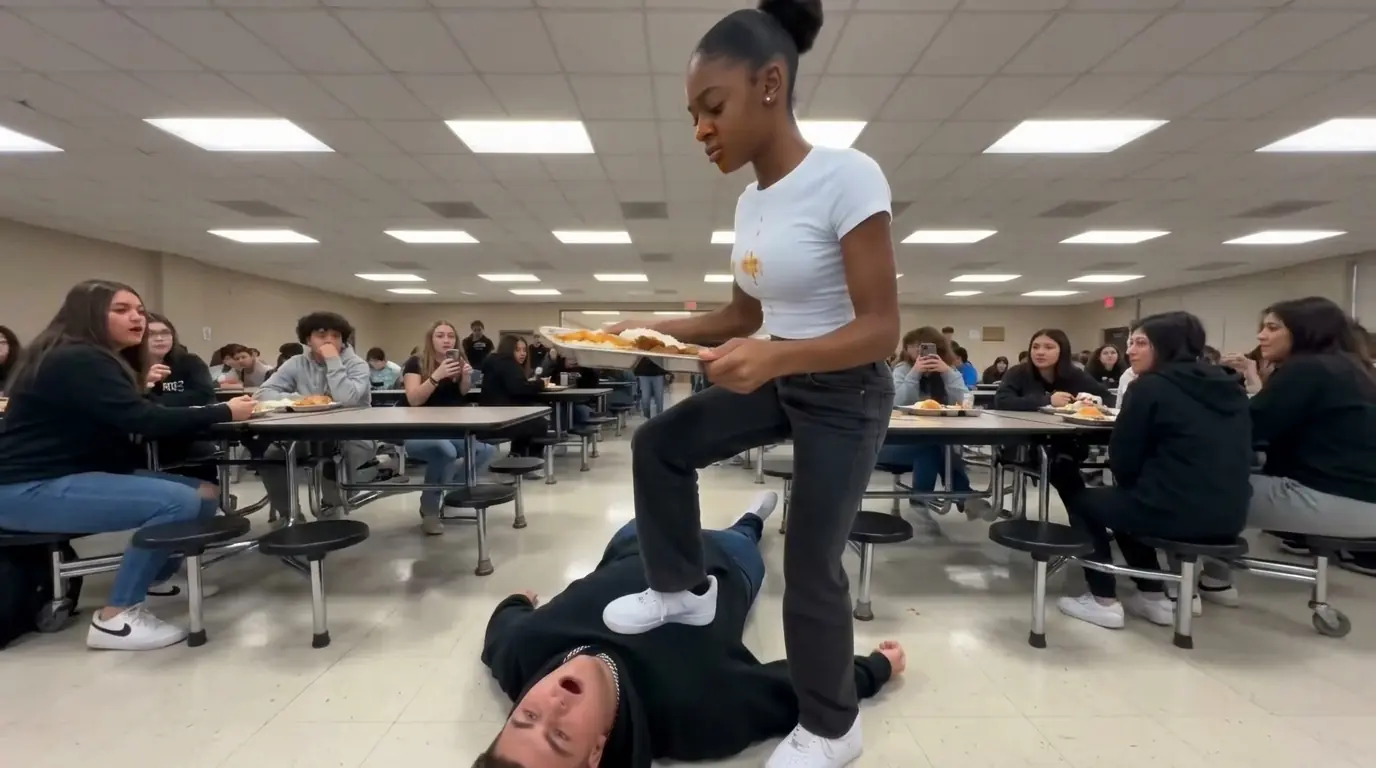
My father stood beside his cleaning cart, dripping wet.
I looked at him.
He gave me the smallest nod.
Not encouragement to impress anyone.
Just permission to do what I needed to do.
I turned toward the basket.
I placed my feet.
I rubbed the seam with my thumb.
Then I shot.
The ball rose high above the court.
For a moment, the entire gym seemed to hold its breath.
It came down toward the rim.
And dropped straight through.
Nothing but net.
The sound was so clean that I heard it echo across the gym.
Nobody laughed.
I lowered my arms.
Bradford’s smile disappeared.
“Okay,” he said, forcing a chuckle. “Lucky shot.”
I looked at him.
He tossed another ball toward me.
“Do it again.”
I didn’t want to.
I wanted to take my father home, get him into dry clothes, and forget this entire afternoon had happened.
But Bradford was already laughing again.
“Come on, Russell. Don’t tell me you used up all your talent.”
I picked up the old ball.
Rubbed the seam.
Shot.
Swish.
The second basket went in.
A girl near the front row stood up.
“Wait. What?”
Bradford stopped smiling.
“Again,” he said.
I caught the ball.
My hands were trembling now, but not from fear.
I thought of my mother standing in our driveway, laughing when I missed.
I thought of her telling me that a bad shot didn’t mean I was a bad shooter.
Then I shot a third time.
Swish.
The crowd began murmuring.
A fourth shot followed.
Swish.
By then, people were standing.
Phones that had been recording my father’s humiliation were now pointed at me.
Someone shouted, “NO WAY!”
Bradford looked toward Coach Pemberton.
Coach wasn’t smiling anymore.
He was watching me with his mouth slightly open.
I took the ball again.
My fifth shot sailed through the air.
For a split second, I thought it might hit the rim.
Then it dropped cleanly through the net.
The gym erupted.
I heard screams, whistles, and the sound of hundreds of hands clapping.
My father stood motionless beside his cart.
He wasn’t looking at Bradford.
He was looking at me.
His eyes were shining.
I had never seen him look so proud.
But there was something else in his expression.
Something I couldn’t quite understand.
It looked almost like grief.
Bradford snatched the ball after it bounced back toward the court.
“That’s enough,” he said.
I held out my hand.
“Give it back.”
He stared at me.
“What?”
“The ball. Give it back.”
He laughed, but it sounded different now.
There was no amusement in it.
“You’re getting pretty confident for somebody who just got lucky.”