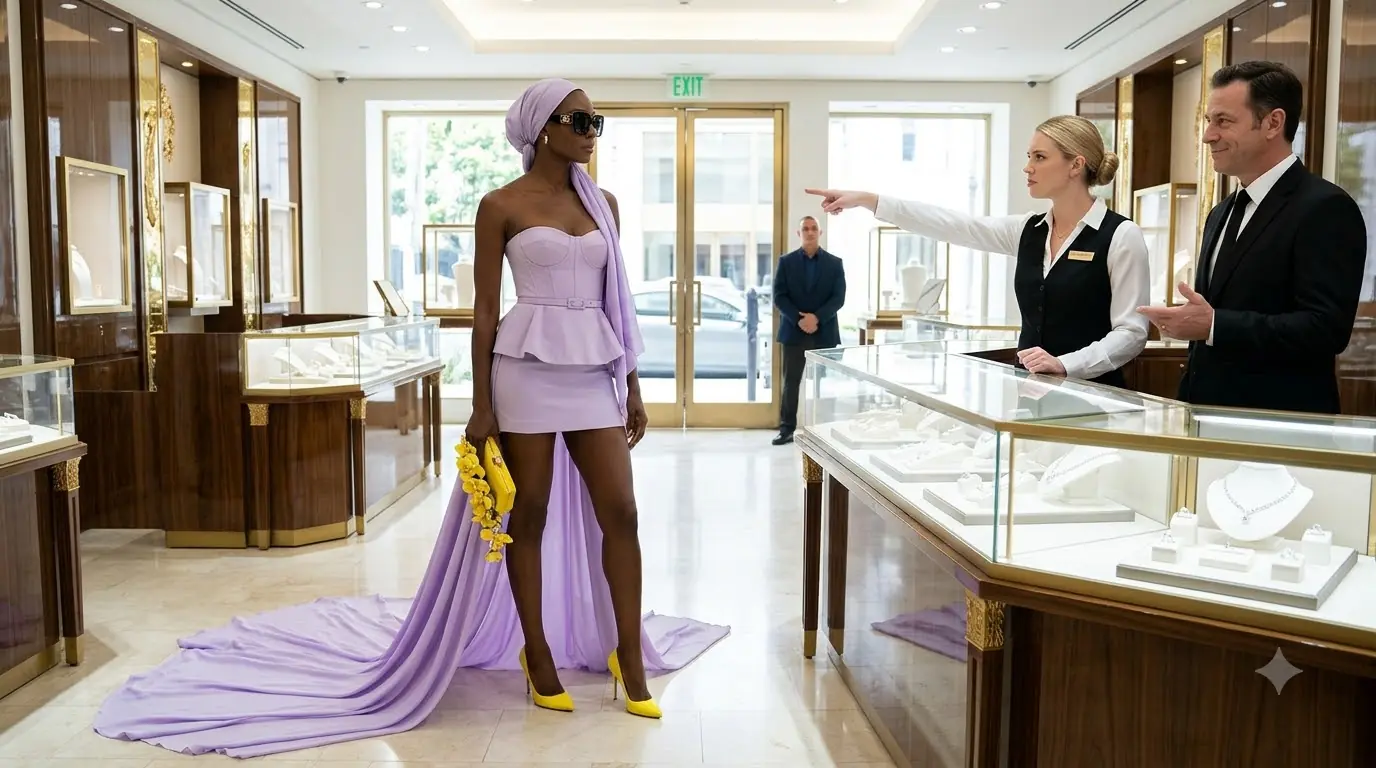
The manager swallowed.
“She’s here?”
The woman in lavender looked at her watch again.
10:17 a.m.
Exactly eleven minutes after she’d entered the boutique.
The manager stared at her.
Then at the gold-accented sunglasses.
Then at the yellow floral clutch resting on the counter.
His voice trembled.
“You mean… the woman standing in front of me?”
The telephone speaker was loud enough for the assistant manager to hear.
“That’s correct. The acquisition has closed. She is the new chief executive officer and controlling owner of the entire jewelry group.”
The manager stopped breathing.
The blonde saleswoman frowned.
“What is it?”
He didn’t answer.
The corporate representative continued.
“She specifically requested a visit to your location this morning. Please extend every professional courtesy.”
The manager slowly lowered the receiver.
His hand was shaking.
The blonde saleswoman stepped closer.
“Sir?”
He stared at the Black woman.
Then whispered, “Oh, my God.”
She calmly removed her oversized sunglasses.
Her eyes were steady.
Her expression was disappointed rather than triumphant.
The manager looked as though he might collapse.
“Ma’am…”
She held up one hand.
“Before you apologize, I’d like an answer to my question.”
He swallowed.
“Which question?”
She gestured toward the glass counter.
“Eleven minutes ago, you told me that you decide who deserves service in this store.”
She stepped closer.
“Now I’d like you to explain how you made that decision.”
No one spoke.
The blonde saleswoman stared at her manager.
The young security officer looked toward the floor.
The other customers stood motionless.
Then the Black CEO asked one final question.
“And while you’re explaining that, perhaps you can tell me why my mother’s original jewelry design is being displayed under another woman’s name.”
The manager’s face went completely white.
Because the ownership announcement was only the first surprise.
And the second was about to expose a secret that had been buried inside the company for twenty-four years.
Five hours earlier, the Black CEO had been standing in the dressing room of her Beverly Hills home, deciding whether to wear the lavender outfit.
The house overlooked a quiet garden filled with flowering trees and carefully maintained stone pathways. Beyond the terrace, the city stretched toward the distant hills beneath a clear California sky.
Her wardrobe contained more expensive clothing than she cared to count.
Designer suits.
Evening gowns.
Tailored coats.
Shoes made by craftsmen whose waiting lists stretched for months.
But the lavender ensemble held a significance most people would never understand.
Her mother had helped create it.
Not the garment itself, which had been produced by a respected fashion house, but the finishing details.
The narrow matching belt.
The headscarf arrangement.
The delicate construction of the flowing train.
And the cascading yellow flowers attached to the clutch.
Her mother had worked as a seamstress for much of her life.
She possessed the remarkable ability to look at a garment and immediately understand how it should move, where it needed support, and what small alteration would make it beautiful.
When her daughter first brought home the lavender outfit, her mother examined it for several minutes.
Then she said, “It’s beautiful, but it doesn’t look finished.”
The CEO laughed.
“Mother, it came from one of the most expensive fashion houses in Paris.”
Her mother shrugged.
“That doesn’t mean they got everything right.”
Three afternoons later, the outfit looked completely different.
The long train moved more gracefully.
The headscarf framed her daughter’s face.
The yellow floral clutch transformed the lavender fabric into something unforgettable.
And when the CEO looked in the mirror, she understood exactly what her mother had accomplished.
The outfit no longer looked like expensive clothing.
It looked personal.
That morning, the CEO had chosen it for the same reason she had chosen to visit the jewelry store.
She wanted to carry her mother’s influence into a moment her mother had helped make possible.
Her phone vibrated.
A message from her chief financial officer appeared on the screen.
Final acquisition documents confirmed. Transfer scheduled for 10:15. Public and employee announcements at 10:17.
She smiled.
Then checked another message.
Her attorney had confirmed that the final regulatory and contractual requirements for the acquisition were satisfied.
After nearly a year of negotiations, her investment company was about to take control of a prestigious American jewelry group operating twenty-eight boutiques across the country.
The company was known for expensive diamonds, exquisite craftsmanship, exclusive private-client events, and polished advertising campaigns featuring elegant models in luxurious settings.
Its flagship boutique stood on Rodeo Drive.
The same boutique she planned to visit that morning.
She was buying the group through a holding company she had founded years earlier.
The acquisition would make her the controlling owner and chief executive of the business.
It was an enormous achievement.
But she wasn’t excited simply because of the financial value.
She had a reason for wanting this particular company.
A reason she had discussed with very few people.
Twenty-four years earlier, her mother had been humiliated in the same Beverly Hills boutique.
And that humiliation had changed the course of both their lives.
The CEO remembered the day clearly.
She had been fifteen.
Her mother had taken her to Beverly Hills after finishing a difficult sewing job for a wealthy client.
They had ridden two buses to reach the neighborhood.
Her mother wore a simple cream blouse, a long skirt, and comfortable shoes.
In her handbag was a small velvet pouch containing a hand-drawn jewelry design.
The drawing featured delicate yellow flowers surrounding a central diamond.
Her mother had created the design as a personal tribute to her own grandmother, who loved yellow blossoms and had always believed that beauty should be something ordinary people could experience.
The woman had spent months refining the drawing.
A local jeweler had encouraged her to show it to a luxury jewelry house.
He believed the design could become commercially valuable.
And because the boutique had recently announced a program inviting independent artisans to submit original work, her mother decided to take the chance.
She didn’t expect fame.