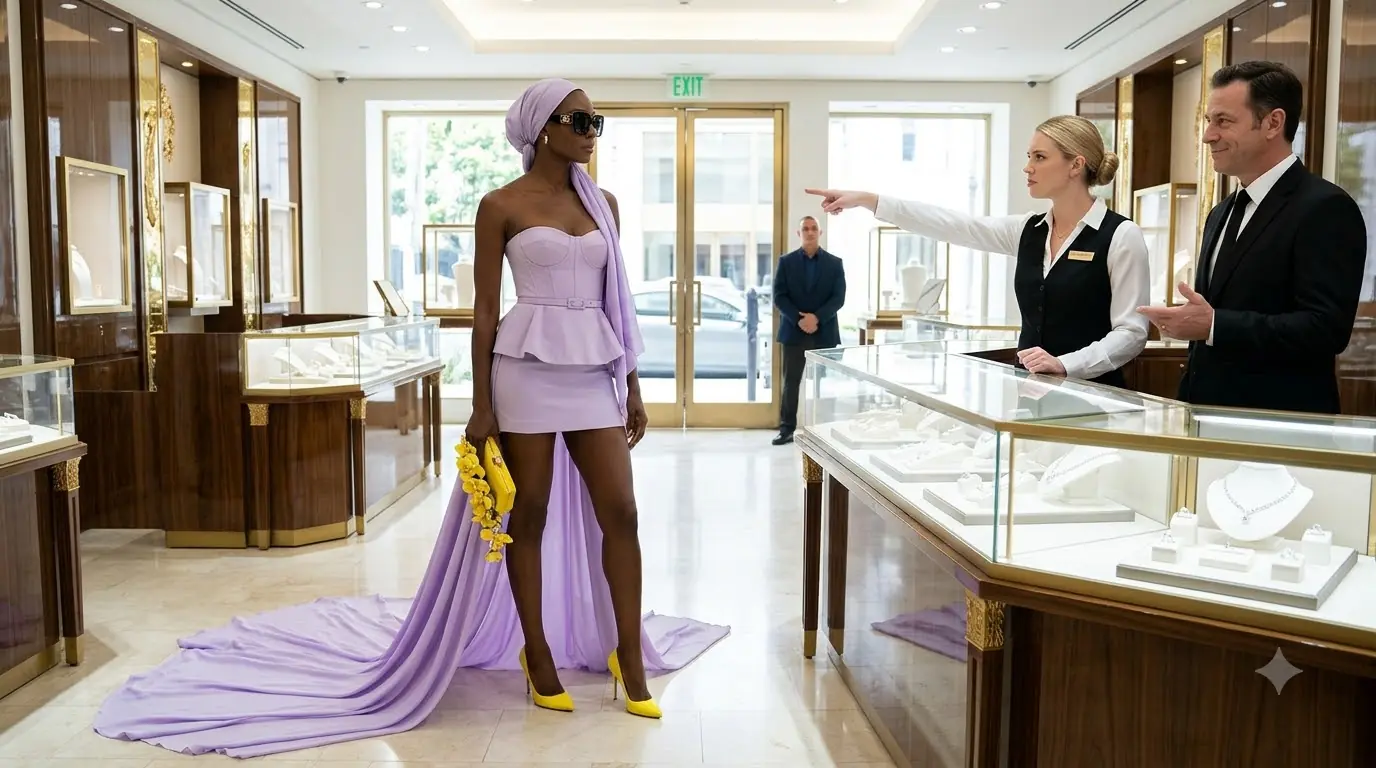
She didn’t expect millions.
She simply hoped someone would recognize her talent.
The CEO remembered standing beside her mother at the counter.
She remembered the expensive perfumes.
The beautiful glass displays.
The way her mother nervously smoothed her skirt.
Then the sales associate approached.
She looked at the woman’s clothes.
Then at the teenage girl beside her.
And said something the CEO never forgot.
“Ma’am, you need an appointment to bring unsolicited sketches into an establishment like this.”
Her mother smiled politely.
“I understand. I was told the design department might be interested in reviewing independent submissions.”
The associate barely glanced at the drawing.
“That’s handled elsewhere.”
“Could you tell me where?”
The woman sighed.
“This isn’t really the place for you.”
The teenage girl felt heat rise in her face.
She looked toward her mother.
Her mother held the drawing carefully.
Then said, “I only wanted someone to see the work.”
The associate shook her head.
“We have professional designers.”
Her mother nodded slowly.
Then placed the drawing back in its pouch.
“Thank you for your time.”
They left.
The CEO remembered walking beside her mother down Rodeo Drive.
For several minutes, neither spoke.
Then the girl began crying.
Her mother stopped.
“Sweetheart, what’s wrong?”
The girl looked up.
“They didn’t even look at it.”
Her mother smiled sadly.
“I know.”
“They treated you like you weren’t good enough.”
Her mother’s expression changed.
She crouched slightly to meet her daughter’s eyes.
“Listen to me.”
The girl wiped her face.
“People can refuse to see your value. That doesn’t mean your value disappears.”
The CEO remembered those words with extraordinary clarity.
They became one of the principles that guided her life.
She studied business.
Worked in finance.
Built investment firms.
Bought struggling companies and helped reorganize them.
And over the years, she became one of the most successful Black businesswomen in the country.
But she never forgot the woman standing on Rodeo Drive holding a rejected drawing.
Nor did she forget what happened to that drawing afterward.
A few months after the humiliating visit, her mother submitted the design through a small independent jewelry broker.
The broker promised to show it to manufacturers.
Several weeks later, he reported that nobody was interested.
Her mother accepted the disappointment.
She returned to sewing.
She raised her daughter.
She continued making beautiful things for people who rarely knew how much imagination went into them.
Then, years later, the CEO noticed something strange in a jewelry advertisement.
A yellow-flower diamond necklace.
Its central motif looked remarkably similar to her mother’s sketch.
The design was sold under the luxury jewelry house’s private collection.
And the person credited as its creator was the founder’s granddaughter.
At the time, the CEO was still young and had little money.
She asked her mother about it.
Her mother examined the advertisement.
For a long time, she said nothing.
Then she folded the page.
“Sometimes ideas travel farther than the people who created them.”
The daughter wanted to fight.
Her mother asked her not to.
There were no complete contracts.
The old broker had disappeared.
The original submission records were missing.
And she lacked the resources to challenge a wealthy company over a design that had been altered before reaching the market.
So the matter remained unresolved.
But the CEO never forgot.
And when the jewelry company became available for acquisition decades later, she recognized an opportunity.
Not simply to purchase a prestigious business.
But to examine its history honestly.
To improve how it treated customers.
And perhaps, at last, to discover what had happened to her mother’s design.
That morning, she fastened the lavender belt around her waist.
Adjusted her matching headscarf.
Placed the yellow floral clutch beside her.
Then looked at herself in the mirror.
Her mother had once been dismissed from that boutique because she did not look wealthy enough to belong.
Now her daughter was about to become its owner.
The CEO picked up her sunglasses.
Then smiled faintly.
“You should’ve seen this, Mother.”
Her mother was still alive.
Seventy-two years old.
Living comfortably in a beautiful house not far away.
But the daughter had kept the acquisition secret.
She wanted to surprise her.
More importantly, she wanted to discover whether the store that once humiliated her mother had truly changed.
She had no intention of announcing herself at the entrance.
She would simply walk in as a customer.
Ask to see a necklace.
And observe what happened.
At 10:06 a.m., she entered the boutique.
Eleven minutes later, the answer was painfully clear.
The silence following the ownership announcement was almost unbearable.
The blonde saleswoman stood behind the counter with one hand still extended toward the exit.
Her face had lost all color.
The store manager stared at the Black woman as though she had transformed into someone else in the space of a single telephone call.
But the woman hadn’t changed.
She wore the same lavender outfit.
The same square sunglasses with gold accents.
The same yellow heels.
And the same elegant headscarf.
The only difference was that the employees now knew how much power she possessed.
The manager cleared his throat.
“Ma’am, I am terribly sorry.”
She looked at him.
“For what?”
He blinked.
“The misunderstanding.”
She placed her sunglasses inside her clutch.
“Which part did you misunderstand?”
The manager glanced toward the blonde saleswoman.
Then back at the CEO.
“Your identity.”
The CEO waited.
The manager swallowed.
“We weren’t aware that you were the new owner.”
She nodded slowly.
“That’s true.”
He looked relieved.
Then she continued.
“But you were aware that I was a customer.”
His expression collapsed.
The blonde saleswoman stepped forward.
“Ma’am, I didn’t mean any disrespect.”
The CEO turned toward her.
“You told me my clothing was ridiculous.”
The saleswoman’s lips trembled.
“I was only trying to explain our standards.”
“You suggested I purchase costume jewelry somewhere else.”
The young woman looked down.
“And you refused to show me a necklace that was available for viewing.”
The manager interrupted.
“We have security procedures for valuable merchandise.”
The CEO turned toward him.
“Of course you do. Are those procedures written?”
“Yes.”
“Do they apply equally to customers?”
The manager hesitated.
“They should.”
The CEO nodded.
“Then I would like to review them.”
He glanced toward the back office.
“Certainly.”
She continued.
“And I’d like to understand why you ordered security to remove me when I hadn’t threatened anyone, damaged anything, or refused a legitimate instruction.”
The manager opened his mouth.
Nothing came out.
The young security officer still stood near the entrance.
He looked uncomfortable.
The CEO turned toward him.
“May I ask you something?”
The officer straightened.
“Yes, ma’am.”
“When the manager ordered you to remove me, why didn’t you?”
The young man swallowed.
He glanced toward his supervisor.
Then back at her.
“Because you weren’t doing anything wrong.”
The manager’s expression hardened.
The officer continued, more quietly.
“You were asking to see jewelry. I didn’t think there was a reason to remove you.”
The CEO nodded.
“Thank you.”
The officer looked surprised.
She turned toward the manager.
“Your security employee understood the difference between refusing service and responding to a genuine safety issue. I would expect the management team to understand it too.”