His mother, Carol, sat beside him with a champagne flute in one hand and a small, satisfied smile on her face. A moment earlier, she’d told the server to add another bottle to the check. Now the bill sat between us, folded beneath a silver dessert spoon.
We were at a crowded restaurant in downtown Chicago, celebrating Grant’s promotion. Carol had invited her sister and two cousins. I’d agreed to pay my share, but the total was nearly two thousand dollars. Grant had promised we’d split it. When I checked our banking app, there was no transfer from him, and he knew I’d been keeping my own account separate since we started saving for a home.
“I can cover my dinner,” I said. “I’m not paying for everyone.”
Carol gave a little laugh. “You’re married. What’s yours is his.”
Grant pushed the bill toward me. “Don’t embarrass me in front of my family.”
“I’m not embarrassing you. I’m asking you to pay what you promised.”
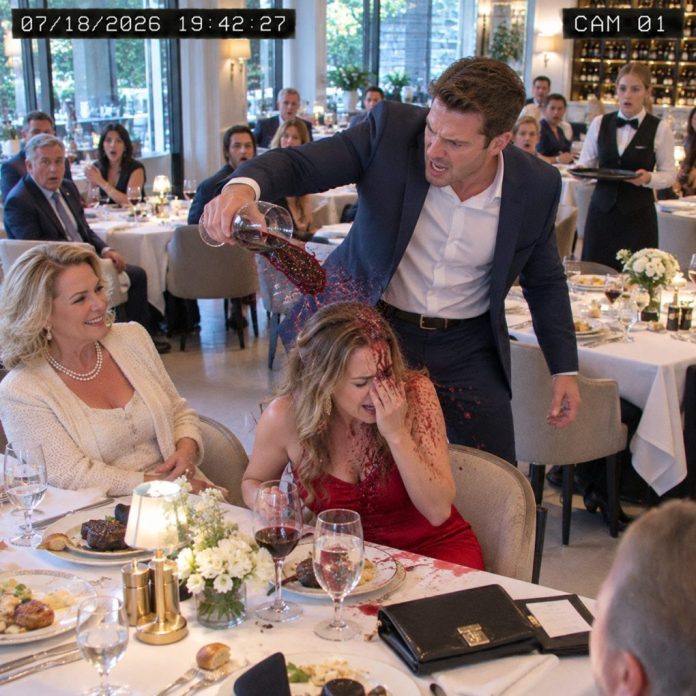
His jaw tightened. Then he lifted his glass and threw the wine straight into my face.
The cold splash hit my cheeks and soaked the front of my blouse. Someone gasped. A fork clattered onto a plate. Carol didn’t move. She just watched, still smiling, as though this was the moment she had been waiting for.
Grant leaned across the table. “Pay it,” he said. “Or we’re done.”
I wiped my eyes with a napkin. My hands were shaking, but my voice stayed even. I didn’t scream or throw the glass back. I reached into my purse, took out my phone, and called 911.
The dispatcher asked if I was safe and whether anyone was injured. I told her what had happened and gave the restaurant’s address. Then I asked the manager to keep the security footage and bring me a dry towel. He looked at the wine on my clothes and said, “Of course.”
Grant scoffed. “You’re calling the police over a drink?”
“I’m calling because you threw it at me,” I said.
The server cleared the plates but left the untouched dessert at the center of the table. Nobody spoke. A few minutes later, two officers walked in and asked which table had called.
Grant’s expression changed when they stopped beside us.
“Sir,” one officer said, “we need to hear what happened here.”
For the first time that evening, Carol’s smile disappeared.
The officers introduced themselves as Officer Reyes and Officer Miller. One spoke with me while the other asked Grant and Carol to stay at the table. The manager brought over a dry towel and quietly confirmed that the dining room camera had a clear view of us.
I told Officer Reyes that Grant had thrown wine in my face after I refused to pay the full bill. I said I wasn’t injured, but I wanted the incident documented. My voice sounded calmer than I felt. My blouse was wet, my eyes were burning, and the dinner had turned into a scene no one at the restaurant would forget.
Grant called it an accident. He said he’d been gesturing with his glass and I’d “overreacted.” Carol nodded along, adding that I’d been rude about the bill and had upset him. She never mentioned the threat.
The manager offered to show the officers the footage. They watched it on a tablet near the host stand. The video had no sound, but it showed Grant lift his glass, lean across the table, and fling the wine directly at me. It also showed me sitting still afterward, wiping my face and making the call.
When the officers returned, they asked Grant to step away from the table so they could speak with him separately. He looked at me as if I had betrayed him. I didn’t look away. This was not a private argument anymore, and I was done helping him pretend it was.
The officers took statements from the server and manager. They explained the next steps and gave me an incident number. They didn’t arrest Grant at the restaurant, but they told him not to follow or contact me that night. He complained that I was “destroying his career over dinner.” Officer Reyes reminded him that the report was about his behavior, not his promotion.
Carol paid the bill with her own card. As she signed the receipt, she muttered that I had made a family celebration humiliating. I looked at the untouched dessert and realized she was still more upset about the evening than about what her son had done.
I rode home with my friend Melissa, who had come to pick me up. Grant stayed behind with his mother. At my apartment, I changed clothes and took photographs of the wine stains before washing anything. Melissa helped me write down the order of events while every detail was still clear.
The next morning, I called a family-law attorney and asked what to do before Grant returned. She told me to keep copies of the report, the photographs, and any messages, and not to discuss the incident alone with him. I also requested that the restaurant preserve its video.
Grant texted that he was sorry “things got out of hand,” then asked me to apologize to his mother. I replied that I would communicate through my attorney until I felt safe. His next message said I was making a simple argument impossible to fix.
I didn’t answer. The officers had heard the witnesses, and the camera had recorded the truth. I wasn’t going to let his version replace it.
Grant called from his mother’s house that afternoon. He said the officers had treated him like a criminal and asked whether I planned to “take this all the way.” I told him the report was accurate and the next step was up to the authorities. Then I ended the call.