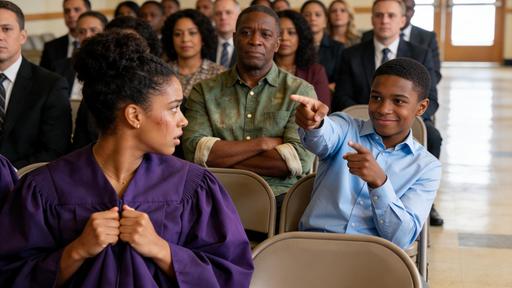
“It comes from showing up. Especially when showing up is difficult.””
The audience became quiet.
Jada looked directly at Raymond.
Then she stepped away from the microphone.
She walked down the stage steps.
The dean looked confused.
Denise straightened in her seat.
“Jada?”” she whispered.
Jada crossed the aisle.
When she reached her father, she gently placed her diploma folder on his knees.
Then she removed her gold valedictorian stole.
Raymond blinked.
“Sweetheart, what are you doing?””
Jada smiled through her tears.
“Dad, this achievement belongs to you too.””
She draped the gold stole around his neck.
The auditorium fell silent for a heartbeat.
Then someone began clapping.
Another person joined.
Within seconds, the entire room was standing.
Raymond’s hands trembled.
“Jada, you earned this,” he whispered.
She wrapped her arms around him.
“And you helped me get here.””
He held her tightly.
For the first time that morning, he didn’t care about his muddy boots.
He didn’t care about Denise.
He didn’t care who was watching.
He was exactly where he belonged.
But the applause had barely begun to fade when Principal Marcus Ellison approached the microphone.
“Ladies and gentlemen, before we conclude this ceremony, there is something important I need to address.””
The room settled.
Marcus adjusted his glasses.
He looked toward Raymond.
“Mr. Bennett, would you please remain where you are?””
Raymond slowly lifted his head.
“Yes?””
Marcus opened a thick folder.
“Your presence here today is especially significant because your name appears on the original property records of this university.””
The applause stopped.
Denise lowered her phone.
Her smile disappeared.
Marcus turned a page.
“And a new legal filing concerning that property was officially delivered to our administration this morning.””
He looked directly at Denise.
“Mrs. Whitmore, I believe you’ll want to hear what it contains.””
Chapter 2: The Secret Beneath the Foundation
Nobody moved.
The auditorium, which had been filled with applause moments earlier, now felt like a courtroom.
Raymond looked from Principal Marcus Ellison to Denise Whitmore.
“What property records are you talking about?”” he asked.
Marcus closed the folder halfway.
“The original deed to the land beneath Westbridge University.””
Denise stood abruptly.
“This is completely inappropriate.””
Marcus didn’t look at her.
“Please sit down, Mrs. Whitmore.””
“I will not sit down while you discuss confidential legal matters in front of hundreds of people.””
“Then perhaps you should have considered that before making public statements about Mr. Bennett’s involvement with this institution.””
A murmur spread through the audience.
Raymond slowly removed the gold stole from around his neck and placed it carefully on his knees.
“Marcus, I think there’s been some mistake.””
The principal shook his head.
“I wish there were.””
Jada moved beside her father.
“Dad, what’s happening?””
Raymond looked at her.
“I don’t know, sweetheart.””
But the truth was, he recognized the name Marcus had mentioned.
The original property records.
He hadn’t heard those words in nearly twenty years.
And he had spent most of that time trying not to remember what happened.
Twenty-one years earlier, Raymond had been a thirty-five-year-old construction worker with a pregnant wife, a small rental house, and barely enough money to keep the lights on.
He had worked for a company called Bennett Industrial Construction.
It wasn’t a large operation.
He owned a few trucks, employed eleven workers, and took whatever contracts he could find.
His father had taught him masonry.
His uncle had taught him carpentry.
Raymond had learned everything else by making mistakes and fixing them.
He wasn’t wealthy.
But he was proud of what he had built.
Then came the fire.
It started in a storage building on a Tuesday night.
By midnight, flames had spread through the workshop.
By morning, Raymond had lost most of his equipment, his inventory, and nearly every dollar he had invested in the business.
The insurance company disputed the claim.
His creditors demanded payment.
And the bank threatened foreclosure on the small parcel of land where his company operated.
That same week, a young attorney named Marcus Ellison had approached him.
Marcus had been working with a nonprofit foundation that wanted to establish a university in the area.
At the time, the surrounding neighborhood had been struggling.
Factories were closing.
Families were leaving.
Young people had few opportunities beyond low-paying jobs.
The foundation wanted to build a school that would change that.
But it needed land.
Raymond owned a large undeveloped parcel beside the old industrial road.
The property had been in his family for decades.
Marcus explained that the university needed the land, but the foundation didn’t have enough money to purchase it outright.
Raymond listened.
Then he asked one question.
“What happens to the children in this neighborhood if you can’t build the school?””
Marcus remembered his answer.
“They lose another opportunity.””
Raymond looked through the window at his little daughter, Jada, who was sitting on the floor drawing with crayons.
He made a decision.
He agreed to transfer the land into a trust.
Not as a gift.
Not as an ordinary sale.
It was a long-term charitable arrangement with strict conditions.
The university could use the property to educate students.
But it could never sell the land, transfer ownership to private individuals, or use it for purposes unrelated to education.
If the university violated those conditions, the property would revert to Raymond’s family trust.
Raymond also insisted on another provision.
A scholarship fund would be established for students from low-income families living in the surrounding community.
Marcus had called it an extraordinary gesture.
Raymond had simply shrugged.
“Someone helped me when I was starting out. I’m just making sure somebody else gets the same chance.””
The deal was signed.
Construction began.
And Raymond walked away with almost nothing.
He refused the foundation’s offer to put his name on the main building.
He didn’t want a statue.
He didn’t want a plaque.
He wanted a school.
Years later, he learned that the university had quietly removed his name from several historical documents.
Then his wife died.
Jada was only eight.