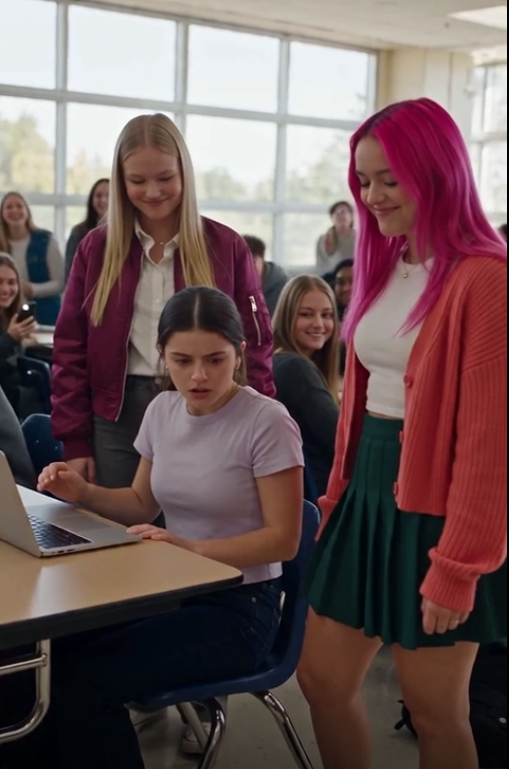
Sloane was tall, blonde, and strikingly pretty, with pale blue eyes and a smile that rarely reached them.
Harper had sleek dark hair and a talent for making ordinary comments sound insulting.
Addison was quieter, but she laughed whenever Sloane wanted her to.
I was trying to find my chemistry classroom when I accidentally brushed against Sloane’s shoulder.
“Sorry,” I said immediately.
She looked me up and down.
Her eyes stopped on my shoes.
“Are those seriously the ones you’re wearing?”
I glanced downward.
“They’re comfortable.”
Harper laughed.
“That wasn’t the question.”
Sloane tilted her head.
“You know there are stores that sell shoes made this decade, right?”
I felt my face grow warm, but I forced a polite smile.
“Thanks for the information.”
I stepped around them and continued down the hallway.
Behind me, I heard laughter.
It wasn’t especially loud.
It wasn’t even the cruelest thing anyone had ever said to me.
I told myself it didn’t matter.
But when I reached chemistry class, I noticed that I was looking down at my shoes again.
For the first time that morning, they seemed different.
Not uglier.
Just suddenly visible.
Over the following weeks, Sloane and her friends began noticing everything about me.
If I wore a sweater twice in one week, they commented.
If I carried an old canvas backpack, they asked whether it had come from a donation bin.
If I brought homemade food instead of buying lunch, they exchanged exaggerated looks of concern.
One afternoon, I was sitting alone at a table near the cafeteria windows when Sloane walked past and glanced into my lunch container.
My mother had packed rice, roasted vegetables, and chicken from the previous evening.
Sloane wrinkled her nose.
“Is that all you have?”
I looked up.
“It’s lunch.”
Harper leaned over Sloane’s shoulder.
“Maybe the cafeteria food is too expensive for her.”
Addison covered her mouth, laughing.
Sloane made a performance of reaching into her designer handbag.
“Should we start a collection?”
Several nearby students turned to look.
My cheeks burned.
“I’m fine, thanks.”
Sloane’s smile widened.
“Of course you are.”
She walked away with her friends, laughing softly.
I sat there staring at the food my mother had prepared before leaving for work that morning.
Nothing about the meal had changed, but suddenly I struggled to swallow a single bite.
That was how it began.
Not with one enormous incident, but with dozens of small humiliations that were easy for other people to dismiss.
A whisper as I walked past.
A laugh when I answered a question.
A photograph of my worn sneakers posted in a private student group chat.
A deliberately loud conversation about people who tried too hard to fit into places they didn’t belong.
Sometimes Sloane spoke directly to me.
Sometimes she made certain I could hear her without technically addressing me.
And sometimes, the worst part was the silence of everyone around us.
Students who had been friendly a moment earlier suddenly became fascinated by their phones.
Conversations stopped when I approached.
People avoided sitting beside me because they didn’t want Sloane noticing them.
It was as though she had established an invisible boundary around me.
And everyone understood the rules.
One person who didn’t always follow those rules was a boy named Owen Rivera.
Owen sat behind me in American history.
He was tall and thin, with curly hair that never seemed to stay in place.
He had a quiet sense of humor and a habit of drawing tiny cartoons in the margins of his notebooks.
He wasn’t particularly popular, but he didn’t seem interested in becoming popular, either.
One morning, after Sloane made another remark about my sweater, Owen caught up with me outside the classroom.
“You know she’s ridiculous, right?”
I tried to laugh.
“Who?”
He gave me a look.
“Maya.”
“She’s not worth talking about.”
“Maybe not.
But you shouldn’t have to hear that stuff every day.”
I shrugged.
“People say things.”
“Yeah.
And sometimes those things are meant to hurt.”
For a moment, I didn’t know how to answer.
Most students pretended not to notice what was happening.
Owen’s willingness to acknowledge it made me feel unexpectedly emotional.
“Thanks,” I said quietly.
He smiled.
“For the record, those shoes look perfectly normal.”
I laughed for real that time.
“That’s an extremely enthusiastic compliment.”
“I’m known for my poetry.”
After that, Owen occasionally sat with me during lunch.
We worked on assignments together and traded sarcastic comments about our history teacher’s obsession with dates.
His friendship didn’t solve anything.
But it reminded me that Sloane’s opinion wasn’t the only opinion in the building.
Unfortunately, Sloane noticed him, too.
One Friday afternoon, I found a folded piece of paper tucked into my locker.
Inside was a crude drawing of two stick figures wearing ragged clothes.
Above them, someone had written: WESTBRIDGE’S FAVORITE CHARITY PROJECT.
I stood there holding the paper while students hurried around me.
Owen appeared beside me.
“What is that?”
“Nothing.”
He reached for the paper, then stopped when he saw my expression.
“Maya.”
I crumpled it in my fist.
“It’s stupid.”
His face changed.
“Did Sloane do that?”
“I don’t know.”
“You do know.”
I stared at the floor.
He lowered his voice.
“You should tell someone.”
I had thought about it.
More than once.
But the idea of walking into the principal’s office and telling my father that other girls were making my life miserable felt unbearable.
People would immediately accuse me of using our relationship to punish students I disliked.
Worse, Sloane would discover that every insult she had thrown at me had landed.
I wanted to handle things myself.
“I can deal with it,” I told Owen.
He didn’t look convinced.
Neither was I.
The following Monday, I visited the student counseling office.
I deliberately chose a time when my father was attending a district meeting.