I didn’t want him accidentally seeing me and asking questions.
The office was tucked into a quieter hallway behind the library.
There were comfortable chairs, colorful posters about kindness, and a shelf lined with pamphlets offering help with everything from exam anxiety to college applications.
The counselor, Ms.
Evelyn Linden, greeted me warmly.
She was a woman in her early forties with short auburn hair, gentle brown eyes, and a soft voice that seemed designed to make students feel safe.
She wore a silver bracelet decorated with tiny stars and kept a bowl of peppermint candies on her desk.
She listened while I described Sloane’s comments.
I didn’t mention every incident.
Some of them sounded petty when spoken aloud.
Others were difficult to explain without feeling foolish.
Ms.
Linden nodded sympathetically.
“That sounds very uncomfortable.”
I looked down.
“It isn’t just one thing.
It’s happening all the time.”
“Have you tried calmly explaining how her behavior makes you feel?”
I almost laughed.
Sloane Whitcomb didn’t seem like someone who would respond positively to a conversation about my feelings.
“I don’t think that would help.”
Ms.
Linden folded her hands.
“Sometimes students don’t realize the impact of their words.”
“She knows.”
The firmness of my own answer surprised me.
Ms.
Linden considered that.
“Do you have any witnesses?”
“Owen Rivera has seen some of it.”
“And do you have evidence of a specific incident?”
I thought of the drawing in my locker, now crumpled in my bedroom trash can.
“Not with me.”
She nodded again.
“Then let’s be careful about escalating anything before we understand the situation completely.”
Her tone was gentle, but I felt something inside me sink.
“I just want it to stop,” I whispered.
Ms.
Linden leaned forward.
“Of course you do.
Everyone deserves to feel comfortable here.”
She passed me a tissue, although I hadn’t realized tears were gathering in my eyes.
“You’re stronger than you think, Maya.
Don’t let a few unkind comments define your school experience.”
I wanted to believe her.
She asked me to complete a short student concern form, and I carefully wrote down Sloane’s name, the names of her friends, and several incidents I could remember.
Ms.
Linden placed the form inside a folder, promising to review it.
As I stood to leave, she offered me a peppermint.
“Come back anytime you need to talk.”
I thanked her.
For a little while, I felt better.
Someone in authority knew what was happening now.
Surely that had to make a difference.
But nothing changed.
If anything, Sloane seemed to become more confident.
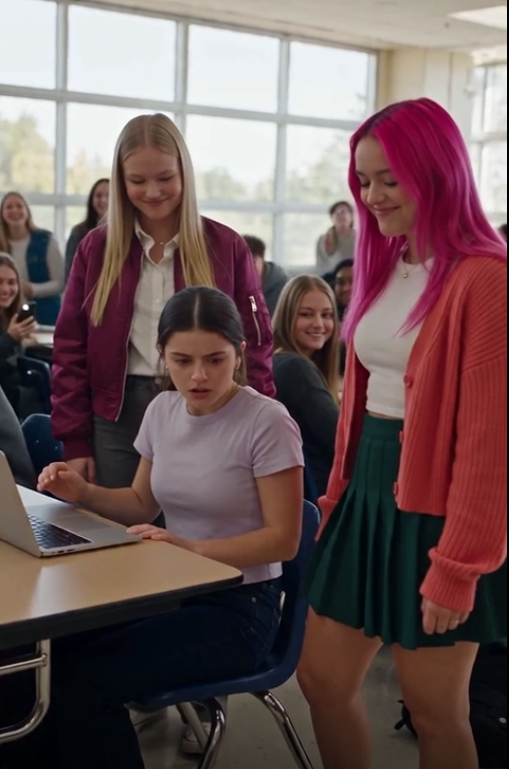
A week later, I entered the cafeteria and found that someone had moved my usual chair away from the table near the window.
Sloane was sitting there with Harper and Addison.
When I approached, she looked up innocently.
“Oh.
Was this your seat?”
I glanced at the chair, now pushed against the wall.
“Not officially.”
“Good.
I was worried.”
Harper smirked.
“She’s always sitting alone anyway.”
I walked away without responding.
Behind me, Addison laughed.
I spent lunch in the library that day.
Then I spent the next one there, too.
By the third day, I realized I was beginning to plan my entire schedule around avoiding three people.
I knew which hallway Sloane used after second period.
I knew when Harper visited the vending machines.
I knew which cafeteria entrance Addison preferred.
I even started arriving at school earlier because I was afraid of encountering them near the parking lot.
They weren’t simply making comments about my clothes anymore.
They were changing the way I moved through my own school.
My father began noticing that something was wrong.
One evening, he found me sitting at the kitchen table with an unfinished history assignment spread in front of me.
Normally, I completed my homework quickly.
That night, I had been staring at the same paragraph for nearly twenty minutes.
He set a mug of hot chocolate beside me.
“Rough day?”
I looked up.
“Just tired.”
He pulled out the chair opposite mine.
“Anything interesting happen at school?”
“Not really.”
He watched me.
My father had always been good at noticing what I didn’t say.
“You’ve been quiet lately.”
“I’m studying.”
“That’s not what I meant.”
I picked up my pencil.
“Everything’s fine, Dad.”
He didn’t push immediately.
Instead, he glanced at my notebook.
“American history?”
“Unfortunately.”
“Need help?”
“You’d probably turn it into a forty-minute lecture.”
He smiled.
“Only thirty-five.”
I managed a small laugh.
But when he reached for his mug, his expression turned serious.
“Maya, I want you to know something.”
I looked at him.
“Being principal doesn’t mean I stop being your father.”
The words struck closer than he knew.
“I know.”
“If something happens, you can tell me.”
For one brief moment, I considered telling him everything.
I imagined explaining Sloane’s comments, the lunch tables, the photograph of my shoes, the drawing in my locker, and the way my stomach tightened whenever I heard certain voices behind me.
But then I imagined him calling Sloane into his office.
I imagined the whispers spreading through the school.
Of course she got the principal involved.
Of course she thinks she’s special.
Of course her father is protecting her.
I couldn’t bear it.
“Nothing happened,” I said.
He studied me for another moment before nodding.
“All right.”
Then he reached across the table and squeezed my hand.
“Just remember that you don’t have to handle everything alone.”
I remembered those words many times afterward, usually when I was doing exactly that.
My mother noticed changes, too.
She asked why I no longer talked about school friends.
She wondered why I had stopped wearing a pale blue sweater I used to love.
She offered to take me shopping, assuming I had simply grown tired of my clothes.
I declined.
Buying expensive things wouldn’t solve the problem.