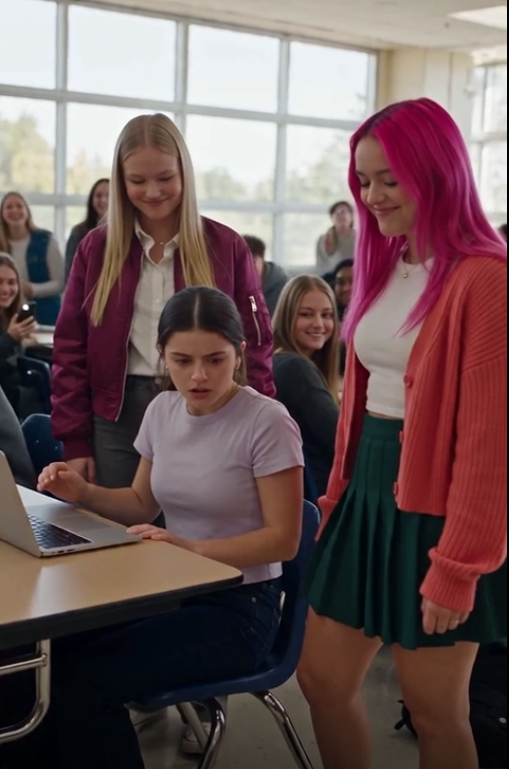
Sloane would only find something else to criticize.
And I hated the idea of changing myself to satisfy someone who enjoyed making others uncomfortable.
So I kept wearing my simple clothes.
I kept bringing my homemade lunches.
I kept telling my parents that school was fine.
But inside, I was becoming exhausted.
Every morning required a small act of courage.
Every lunch period felt like a test I hadn’t studied for.
Every time someone laughed behind me, I wondered whether I was the reason.
The worst part was how ordinary the rest of the world seemed.
Classes continued.
Teachers assigned homework.
The school orchestra rehearsed for its winter concert.
Students complained about exams and celebrated football victories.
My life was quietly falling apart inside a building that continued functioning as though nothing unusual was happening.
One afternoon, Owen found me sitting on the steps behind the gym.
It was cold enough that I could see my breath, but I hadn’t wanted to go inside.
He sat beside me without asking.
For a while, neither of us spoke.
Then he said, “You’re avoiding lunch again.”
“I’m enjoying the fresh air.”
“It’s forty degrees.”
“Very fresh air.”
He smiled briefly, then grew serious.
“Maya, this has gone too far.”
I looked away.
“I talked to the counselor.”
His eyebrows rose.
“You did?”
“Two weeks ago.”
“And?”
“She said she’d look into it.”
He glanced at me.
“Did she?”
I didn’t answer.
Owen leaned forward, resting his elbows on his knees.
“You’re not the only one Sloane treats this way.”
I turned toward him.
“What do you mean?”
He hesitated.
“There’s a girl in my algebra class.
Grace Kim.
She used to sit with Harper’s group.”
“I know Grace.”
“She stopped after they made a joke about her family.
Then someone started leaving comments on her social media.”
I felt a familiar tightness in my chest.
“Did she tell anyone?”
“She tried.”
“What happened?”
Owen shook his head.
“I don’t know.
She doesn’t really talk about it anymore.”
I stared across the empty athletic field.
Until then, I had been so absorbed in trying to survive my own days that I hadn’t considered how many other people might be experiencing the same thing.
“Why would they do that?”
I asked.
Owen picked up a small stone and rolled it between his fingers.
“Because people keep letting them.”
His answer stayed with me.
I began paying closer attention.
I noticed the way Sloane’s group laughed when a younger student dropped his books.
I noticed Harper snatching a notebook from another girl’s hands and making her chase it.
I noticed Addison recording a boy who was struggling through a presentation in class.
None of these moments lasted very long.
Each one could be brushed aside as a joke.
But taken together, they revealed something ugly.
Sloane and her friends didn’t simply dislike me.
They had discovered that embarrassing other people could make them feel powerful.
And they seemed remarkably confident that nobody would stop them.
One Friday, I overheard a conversation that bothered me more than I expected.
Sloane was standing outside the library with Harper.
A younger girl had just hurried away from them, wiping her eyes.
Harper looked slightly nervous.
“Do you think she’ll report us?”
Sloane gave a dismissive laugh.
“Let her.”
“What if someone actually checks?”
Sloane pulled a small mirror from her handbag.
“They won’t.”
Harper frowned.
“How do you know?”
Sloane snapped the mirror shut.
“Because they never do.”
I was standing just around the corner, close enough to hear every word.
For several seconds, I couldn’t move.
There was something about her certainty that unsettled me.
Not the casual confidence of someone hoping to escape consequences.
She sounded like someone who already knew there wouldn’t be any.
I considered returning to Ms.
Linden.
Then I remembered the concern form she had placed in her folder and the way she had encouraged me to remain calm.
Perhaps she was still looking into things.
Perhaps I needed to be patient.
Perhaps I was expecting too much.
I told myself all those things.
Looking back, I wish I had stopped trying to explain away the feeling that something was wrong.
The following Monday, our history class received a group assignment.
Our teacher paired Owen and me with two other students and gave us a week to prepare a presentation.
For the first time in several days, I felt excited about school.
We met in the library after classes, divided the work, and argued over whether Owen’s illustrations were useful historical diagrams or just elaborate excuses to draw cartoons.
I laughed so hard at one of his sketches that the librarian asked us to lower our voices.
It felt wonderful.
For almost an hour, I forgot about Sloane Whitcomb entirely.
Then, as we were leaving, I saw her standing near the main staircase.
She was watching us.
Her gaze moved from Owen to me.
A slight smile appeared on her face.
I recognized that smile.
It was the expression she wore whenever she found something new to use against someone.
On Tuesday, someone told Owen that Sloane had been spreading rumors about us.
On Wednesday, a photograph appeared in a student group chat showing us laughing together in the library.
Someone had added a caption suggesting that Owen was only spending time with me out of pity.
By Thursday, students I barely knew were asking whether we were dating.
Owen tried to make light of it.
“At least they think I have excellent taste.”
But I could tell he was uncomfortable.
I apologized.
He stopped walking and looked at me.
“What are you apologizing for?”
“For dragging you into this.”
“Maya, you didn’t drag me anywhere.”
His voice was firmer than I had ever heard it.
“They’re responsible for what they do.
Not you.”
I wanted to believe that, too.