She continued.
“I spent years letting Richard make decisions because I didn’t want arguments.”
I watched her carefully.
“And when I finally asked questions, he acted as though I’d betrayed him.”
Her eyes filled.
I reached toward her.
She took my hand.
“I thought being a good wife meant trusting him without asking.”
I shook my head gently.
“Trust doesn’t mean surrendering your judgment.”
She nodded.
“I know that now.”
We sat quietly.
Then she smiled.
“I’ve started making decisions for myself.”
I smiled back.
“Good.”
Spring arrived.
The garden woke slowly.
The roses began growing.
The sunlight lingered longer in the evenings.
And my house settled into a peace I had once believed I’d lost forever.
Liam visited regularly.
He called first.
Brought groceries.
Helped with repairs.
And when I told him I didn’t need anything, he believed me.
One afternoon, we worked in the garden together.
He knelt beside the rosebushes, carefully removing weeds.
I watched him for a moment.
Then smiled.
“Your father used to hate weeding.”
Liam laughed.
“Really?”
I nodded.
“He said weeds were proof that nature had a sense of humor.”
Liam laughed harder.
“I can hear him saying that.”
I smiled.
For a moment, the grief felt gentle.
Not sharp.
Not unbearable.
Just the quiet ache of remembering someone we’d loved.
Liam looked toward the house.
Then said, “Mom, I’m glad you stayed.”
I turned.
“What?”
He swallowed.
“I’m glad you didn’t let anyone talk you into leaving.”
My eyes filled.
I looked toward the windows.
The wooden shelves.
The porch.
The garden.
Then smiled.
“So am I.”
One evening, while sorting through old photographs, I found something tucked inside David’s gardening notebook.
It was a folded sheet of paper.
Yellowed at the edges.
I recognized his handwriting immediately.
My heart tightened.
I unfolded it carefully.
At the top, he’d written:
For Eleanor.
I sat down.
The room was quiet.
Sunlight moved across the floor.
I began reading.
My darling Eleanor,
If you’re reading this, I hope you’re sitting somewhere peaceful.
You have spent so much of your life taking care of everyone else.
You made our house a home.
You raised our son with more patience than I ever had.
You welcomed people.
Fed them.
Comforted them.
And somehow always found enough love to give.
But I hope you remember something.
This house was never meant to become another place where you had to work to earn your belonging.
It is yours.
Not because of the mortgage.
Not because of the deed.
Because we built a life here together.
And I want you to keep living that life.
Cook when you want to cook.
Rest when you want to rest.
Invite people when you want company.
And when you want quiet, let the house be quiet.
You have given enough, sweetheart.
Please remember that.
Love, David.
I lowered the letter.
For a long moment, I couldn’t breathe.
Then I began crying.
Not because the words were painful.
Because they were exactly what I’d needed to hear.
All those months, I’d been afraid that protecting my peace meant betraying the family David and I had built.
But he had understood.
He had always understood.
The house wasn’t supposed to become another responsibility I carried alone.
It was supposed to be a place where I could live.
That evening, Liam came over.
I showed him the letter.
He read it slowly.
Then sat down.
His eyes filled.
“Dad wrote this?”
I nodded.
He looked toward the mantel.
Then back at the page.
For a moment, he couldn’t speak.
Finally, he whispered, “He knew you.”
I smiled through tears.
“Yes.”
Liam swallowed.
Then read one sentence aloud.
“This house was never meant to become another place where you had to work to earn your belonging.”
His voice broke.
He lowered the paper.
“Mom, that’s exactly what I made you do.”
I looked at him.
He shook his head.
“I kept asking you to give more.”
His eyes filled.
“And I acted like you were selfish whenever you wanted something for yourself.”
I reached across the table.
Touched his hand.
He looked up.
“I’m sorry.”
I nodded.
“I know.”
He swallowed.
“I can’t change what happened.”
“No.”
“But I can make sure I never treat you that way again.”
I smiled sadly.
“That’s what matters now.”
The following New Year’s Eve, I didn’t host a large dinner.
I didn’t decorate for fourteen guests.
I didn’t spend hours preparing food.
Instead, I invited Liam and Brenda for a quiet meal.
Harper was spending the holiday elsewhere.
Our relationships had changed.
Some had healed.
Others had ended.
And some remained complicated.
But I no longer believed every relationship had to be preserved at the cost of my peace.
Liam brought dinner.
Brenda brought dessert.
I made a small salad.
We set the table together.
And when we finished eating, everyone helped clean up.
No arguments.
No demands.
No one assuming that my age meant my time belonged to them.
At eleven fifty-five, we moved into the living room.
David’s photograph stood on the mantel.
The warm white lights glowed around the windows.
Outside, the winter sky was dark.
Liam sat beside me.
Brenda settled into the armchair.
For a while, we watched the countdown on television.
Then Liam turned toward me.
“Mom?”
I smiled.
“Yes?”
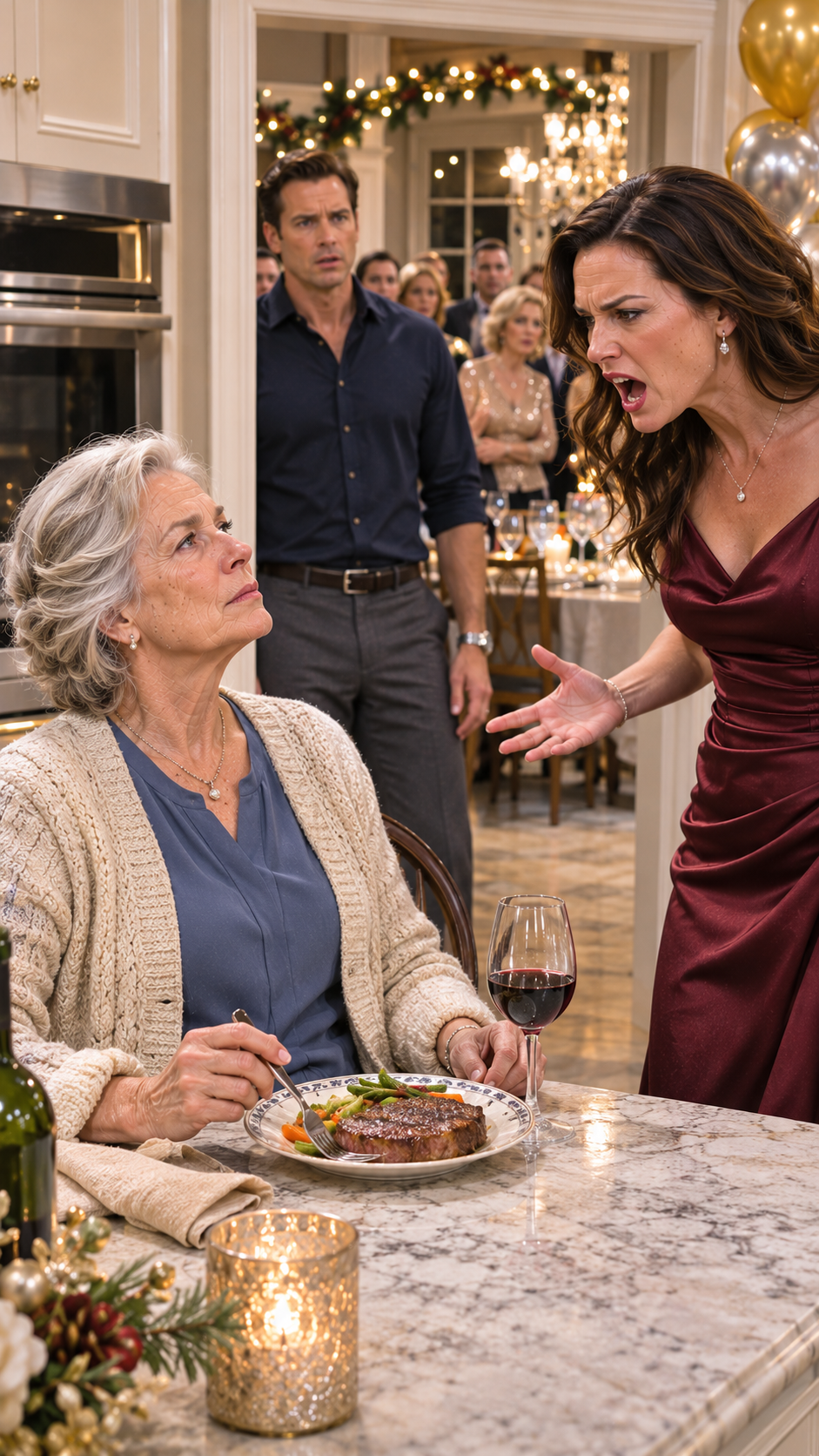
“Do you remember that New Year’s Eve with the steak?”
I laughed softly.
“How could I forget?”
He smiled.
Then his expression grew serious.
“I think about it sometimes.”
I looked at him.
He continued.
“Not because of the dinner.”
I waited.
“Because that was the night you finally stopped letting us take advantage of you.”
My throat tightened.
He looked down.
“And it was the night I started understanding how badly I’d let you down.”
I reached for his hand.
He took it.
I squeezed gently.
“Then something good came out of it.”
He nodded.
“Yes.”
At midnight, fireworks flashed beyond the windows.
Liam raised his glass.
“Happy New Year, Mom.”
I smiled.